Friday, November 12, 2021

Present, Tense

by Abir 

You’re writing a novel set in the current time. Do you include covid, politics, climate change among the background or foreground parts of the environment? If so, why? If not, why?


Good question.


I think part of the answer to this question comes down to the motivations behind why an author writes what they write. Some authors write mainly to entertain – to offer readers escapism from tough and difficult times. If so, it’s easy to understand why an author wouldn’t want to deal with the ‘bad news’ of the real world, especially if their readership has come to see their books as a  blessed relief from the pressures of their lives.


Other writers like to present the world to their readers, warts and all. For them, a gritty realism is key. Doing so without reference to covid or climate change would be increasingly difficult.


Then there’s another group, one that I fall squarely into, who use their writing to explore social issues. Speaking for myself, I do it because what motivates me to write are what I perceive to be social or political injustices. As such, and despite the fact that my books so far have all been set in 1920s India, all of them have been political books as well as crime novels. And the politics that they put under the microscope are as much the politics of today as they are those of the colonial era. So for me keeping politics out of my books would be a non-starter. Other issues though -pandemics and climate change - I’ve not had to deal with, not historically. 


But all that’s changing.


The book I’m currently writing is set in 2024 in the run up to the next US elections. At its heart it deals with political issues of radicalisation, populism and the collapse of the American Dream for so many people who once believed in it. But what of covid and the environment? Let’s take those in reverse – what’s happening to the environment is an intensely political subject and so it will feature in my book. It has to. Its impacts are social and economic and global and I need to talk about it.


Covid on the other hand feels slightly different. Yes, it has and will continue to have a political and socio-economic impact, but to me it is first and foremost a humanitarian catastrophe, and that’s something I feel less qualified to write about. Having said that, I can’t just ignore it. I’ll make reference to it, probably obliquely, but it’s not something I want to deal with head on. I’m more interested in writing about the ongoing societal ramifications of covid than the current human cost, because that, I feel, would be mentally and emotionally exhausting. Maybe it’s the fact that it’s all still so raw. We’re still in the middle of the maelstrom and I’m not sure I’ve got a handle on it. 


The conclusion I draw from reading the posts of my colleagues from earlier this week is that different writers will naturally be drawn to different aspects of writing. The world as it is will impact each of us differently and shape our writing in different ways, and that’s the beauty of crime fiction writing. It’s such a broad church that we can offer everything from pure escapism to damning social commentary while giving you a thrilling plot and more murder victims than you could shake a stick at. And that’s why I believe it’s the most popular genre of fiction today.


Have a good weekend, and stay safe.

Thursday, November 11, 2021

The World and All Its Warts from James W. Ziskin

 You’re writing a novel set in the current time. Do you include covid, politics, climate change among the background or foreground parts of the environment? If so, why? If not, why?

Yes, I would include Covid, politics, and all the rest in any book set in current times. If I were writing about the early 1940s, would I not feel obligated to mention the little contretemps known as World War II? Did Dickens not expound on the social and labor issues of his time? Street urchins, orphans, and workhouses? Ditto for Zola and Hugo?

As it happens, I don’t write much set in current day. Other than some short fiction I’ve written, my books are historicals, set in the near past. The Ellie Stone mysteries take place in the early 1960s, and my next novel, Bombay Monsoon, is set in 1975 India. Still, even while writing about the past, I try to represent the events and atmosphere of the day. In fact, it may be even more important to do so in historical fiction. Otherwise, what’s the point of historical fiction?

In Bombay Monsoon, for example, I write a little about the land reclamation that has been going for centuries in Bombay. It’s not the at the center of the story, but it’s an environmental and social issue that has long affected the local fishing communities, the geography, and the environment in Bombay.

More front and center, on the other hand, is the issue of quarantine in my latest Ellie Stone mystery, Turn to Stone. The story revolves around ten acquaintances trapped in a villa in Fiesole—above Florence—due to a suspected rubella outbreak. I owe a debt of gratitude to Boccaccio, of course, whose 14th century work, The Decameron, tells of ten friends who repair to a villa in Fiesole to escape the plague raging in Florence below. In Boccaccio, the refugees regale each other with stories to pass the time. In Turn to Stone, my characters do the same, with several winks and nods to Boccaccio along the way.

I hasten to point out, however, that Turn to Stone came out in January 2020, just before the Covid pandemic hit, which means I was not, in fact, writing about the current situation in the world.

But if I were to write a present-day mystery or thriller, I would certainly include details of our lives today. Consider this: once the pandemic finally ends, I intend to continue sanitizing my hands and surfaces I encounter wherever I go. And I will be wearing masks on airplanes, too. Why? For one thing I haven’t had a cold or the flu or been sick at all in more than two years. And I know why. 

The pandemic has hardly been fun, but it’s changed the world. Maybe someday science will find solutions to make the new normal go away. But until that happens, I’ll write about the world as I see it, warts and all. Politics, disease, climate change, and murder.

Wednesday, November 10, 2021

A guest post by Lisa de Nikolits

Lisa de Nikolits has been hailed as “the Queen of Canadian speculative fiction” and is the international award-winning author of ten novels. Her short fiction and poetry have been published in various international anthologies and journals. Originally from South Africa, Lisa lives and writes in Toronto, and I’m very pleased to have her here as my guest, answering this week’s question. 

You’re writing a novel set in the current time. Do you include covid, politics, climate change among the background or foreground parts of the environment? If so, why? If not, why?


by Lisa


So you’re writing a new novel and you’re tempted to use Covid-19, politics/politicians, climate change or current events in the plot. But before you dash off that first draft, I invite you to take a small pop-up quiz! 


1: I need this person/event or I can’t write my book. 


2: This person/event will be as relevant in three years as it is today.  


3: Everyone will know who and what I am talking about. 


4: The person/event will engage the majority of my readers. 


5: It’s not vital to my plot but it’s important to me to have my say when it comes to this person/event.  


6: If I don’t write about this person/event, I will regret it down the line.  


7: I have a unique spin on this person/event that no one else will have. 


8: I’ve run the idea past a few beta readers – do their eyes light up or glaze over? 


9: Is there a more interesting way I could tell this story without having to be specific about this person/event? 


10. Am I being lazy or savvy by using this person/event? 


In my experience, when it comes to writing, my imagination comes up with far better ideas than a fact that precipitated it. I like to use IRL as a seed for an idea and no more than that because while truth can be stranger than fiction, it can be more boring when transcribed as such. And, even if a thing is true, it may not ring true in a book. Truth may be stranger than fiction, but that doesn’t mean that strange truths make for good fiction.  


If I’m stuck for an idea, then I start off by using IRL event or person, but I invariably end up completely rewriting. With The Rage Room, I was concerned that by the time the book was published, that rage rooms would either have been written about by a bunch of other people or they’d become so commonplace that no one would be interested in them.   

But I answered my own questions like so:  


1: I need this or I can’t write my book. Yes. I need a room where people smash stuff.  


2: This will be as relevant in three years as it is today. Yes. Even if rage rooms become commonplace, my spin on them will be like no one else’s.  


3: Everyone will know who and what I am talking about. It doesn’t matter if they don’t because I’ll contextualize it via plot and backstory.  


4: The person/event will engage the majority of my readers. The concept will excite some readers and turn others off, but I have to write this book anyway.


5: It’s not vital to my plot, but it’s important to me to have my say when it comes to this person/event. It’s pivotal to the whole book.  


6: If I don’t write about it, I’ll regret it down the line. Yes! I would have kicked myself several times over if I didn’t write it. 


7: I have a unique spin on this person/event that no one else will have. Absolutely. Time travel like it’s never been done before (and it’s not just me saying that, reviewers and readers have said the same thing.) 


8: I’ve run the idea past a few beta readers – do their eyes light up or glaze over? Light up! 


9: Is there a more interesting way I could tell this story without having to be specific about this person/event? No. I have to do it this way.  


10. Am I being lazy or savvy by using this person/event? The Rage Room was the most difficult book I’ve ever written. It challenged me like no other book, and I’m really proud of my tenacity at seeing it through. In the end, it said everything I wanted it to say.  

Thank you for having me as a guest today, and I hope you’ve enjoyed the post. 


You can find out more about Lisa and her writing at her website here.

Tuesday, November 9, 2021

Do You or Don't You?

Terry Shames here, answering our weekly question: Do you include covid, politics, climate change among the background or foreground parts of the environment? If so, why? If not, why? 

I’ve read two recent books that include Covid, but only glancingly. One was Michael Connelly’s The Fifth Witness, and the other was Beautiful World, Where Are You, by Sally Rooney. In the first, the virus is mentioned toward the end in a casual way. The reader knows what’s coming, but Haller doesn’t. In Rooney’s, there are several long emails exchanges between friends and in the last couple of chapters there is reference to the fact that they haven’t seen each other in a while because of lockdown. They both fit in seamlessly, which I admire. 

 After 9/11 it took a few years before anyone mentioned the event in novels. And I remember the first time I read a book that used the even in its plot. In fact, I remember vividly each book I’ve read that refers to it or uses it directly. Which is to say that like 9/11, Covid had such a profound effect on the United States and the world that it will take time to let the ramifications of it settle in. In fact, because of the strange reluctance of some people to obtain vaccinations against the virus, part of a national rejection of science and expert opinions, I think it might take even longer. Notice I said “strange” reluctance. I hesitated to voice an opinion about it because the subject is a powder keg—another reason to hesitate before tackling such a major world event. 


 I write books set in small town Texas, an area noted for its conservative thinking. That means my characters have to include people with ideas and opinions directly opposed to my own. I’ve tried to make them seem fully human, not caricatures. For example, one of the characters is an advocate of gun rights. He is vocal about his opinion that people would be better off if they carried a gun. This is directly oppositional to my thinking. I’ve never made him a major character, but he’s sometimes a thorn in the side of Samuel Craddock because of his stance. But in one book, A Reckoning in the Back Country, I decided to focus more on him. When I did, he revealed a human side, a background that made him more sympathetic overall. It turned out he had a developmentally disabled son whom he treated with great respect and love. 

 All of my books are concerned with social issues—the way veterans are treated, gun carelessness, religious bigotry, racial intolerance, drugs, etc. In one book I addressed dog fighting, which was a subject that horrified me, and yet I felt like I wasn’t doing my job as a novelist if I pretended dog fighting doesn’t exist in rural areas of Texas. I don’t judge people who decide not to include social issues and national events in their books. It’s a hard decision. 

Authors have written great books that completely ignored current events--a war raging, political turmoil, economic upheaval. Jane Austen's book are about insular society, and there are glancing mentions of events, but nothing meaty. her aims are different. So it isn’t absolutely necessary to address these things. But I wouldn’t feel I was being true to myself as a writer if I didn’t give my characters the dimension of acting and reacting in the real world. 

 I recently read a good example of someone incorporating a social phenomenon in his book. In Last Looks by Howard Michael Gould, the protagonist has retired to become a hermit and has set himself the task of only owning 100 things. Gould manages to make the situation very funny, like when the protagonist has to decide whether a pair of sox is one thing or two. But it’s also thought-provoking, about careless consumption and how hard it is to stick to a strict regimen adopted out of the best intentions. 


Infusing humor is particularly difficult, and Gould does it brilliantly. By using humor he avoids being didactic. It’s a danger any writer faces who tries to incorporate current events and social issues; especially ones they have strong opinions about. It’s a decision we all have to make—how much to include, and how to tackle it. And sometimes why to tackle it at all. If it isn’t germane to the plot and characters, why do it? It can't be a casual decision because it affects people deeply and as authors, our job is to speak to our readers without preaching or being careless. p> 

Sunday, November 7, 2021

Current Affairs in Crime Fiction

You’re writing a novel set in the current time. Do you include covid, politics, climate change among the background or foreground parts of the environment? If so, why? If not, why?

Brenda Chapman starting off the week.

Most of my novels are written in a vaguely current time frame. While I haven't shied away from topical issues, I haven't specifically tackled the climate change issue except in passing. As for politics, I don't get into this much either. The pandemic is something I blog about on my personal Saturday morning blog but haven't so far included in my books. 

Just what am I writing about you ask?

My focus in writing crime fiction are the puzzle and the characters. Occasionally, an issue, such as forced marriage or sexual exploitation of teenage girls, has been a major part of the plot, but in the context of the crime. 

Climate change is mentioned in relation to the changing weather but isn't a major plot point -- or hasn't been up to this point. 

As for politics, I live in a government town, the capital of Canada, and worked in the federal government for 18 years, give or take. I know a lot about the inner workings of the system and include references to those working in one department or another. I'm not interested in espousing my own political views through my work, although in the upcoming book, Blind Date, I take a bit of a crack at the far right mindset, although in the context of the crime.

I believe that my main objective as a crime fiction author is to entertain, to take readers out of their everyday lives to live in a fictional world with a puzzle at its centre. I want to create characters whom readers grow to care about, root for, despise, have empathy for ... My characters are flawed -- some are really flawed -- but always interesting, and hopefully sympathetic. If these characters got into the politics of the day and tried to convince readers to lean one way or the other politically, I don't believe this would make for great entertainment.

The debate about setting stories during the pandemic began with the pandemic's onset. The inability to gather during the lockdowns would have made interesting challenges for fictional investigations. I've read a couple of books that allude to the beginning of the pandemic but none that place the story in the middle of the outbreak. I'm not averse to doing so, but my stories to date have not been grounded in a specific year. If the pandemic was integral to the story, however, then I would certainly set the book squarely in the middle.

Crime fiction can be used to raise an issue or to shed light on a current situation, but an author must be careful not to overdo. Less can be more in getting a point across. I hate being preached to and believe most readers would agree with this sentiment. I liken espousing a point of view in fiction to putting too much research into the book so that readers are taken out of the story. The message needs to be subtly delivered with a deft hand. This is the challenge, but when well done, can be effective and make for great reading that leaves a lasting impression and perhaps has readers looking at an issue, a prejudice, a strongly held belief in a new light. 

Website: www.brendachapman.ca

Twitter: brendaAchapman

Facebook & Instagram BrendaChapmanAuthor

Friday, November 5, 2021

Thomas Pluck plots the perfect dinner party.

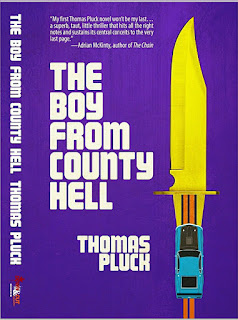
Josh Stallings here, I’m proud to have Thomas Pluck filling in today. Not only is he a hell of a guy, he’s also a stunningly talented and versatile writer. Prolific too, with over fifty published short stories, two short story collections, and three novels, Blade of Dishonor, Bad Boy Boogie and it’s just released Sequel, The Boy from County Hell. The Boy from County Hell is lyrical and brutal, hard and heart breaking. It reminds me of James Lee Burke, in it’s beauty, but it beats with a heart that is pure Pluck. 

Joe R. Lansdale said, “The real star here is his (Pluck’s) control of style, both hardboiled and poetic at the same time. Impressed.” Me too.

__________________________


Q: Mr. Pluck, You’re having a dinner party. Which four authors living or dead do you invite?


A: One thing crime writers are known for, that often goes overlooked, is how often we rhapsodize about food.

"Your book made me so hungry!" is high on the list of things readers say, at least to me. And I know other crime writers have made me wish I was in L.A. in line for a food truck, or wherever their characters are having a good nosh. Food is a restorative, and less cliche than the cold shower that heals all wounds. 

And when writers get together for a meal, memorable times are had. In fact, I had quite a memorable one with Josh here, our wives, and Scott Montgomery, at a place in New Orleans said to be Elmore Leonard's favorite restaurant. I remember the eggplant stuffed with crab, waiting in line, and the streetcar ride, but I can't remember the name of the place. I think it starts with a V. Maybe Josh will jog my memory. So, in reality Josh would be at my dinner party of 4 writers living or dead, but because it would be cheating to include him, just assume he has a free invite and would be there.


To keep cheating, I'll begin with James Lee Burke. The king of the Louisiana crime writers. Not to throw shade at Elmore Leonard, who was born in New Orleans, but he moved on and isn't as regional as JLB. The first novel of Burke's that I read was Black Cherry Blues, and that inspired me to make a road trip to New Orleans with a friend from college, and go to Mulate's, where Dave Robicheaux liked to go. I also had a copy of Road Food, the bible of hole in the wall eateries before Guy Fieri was a twinkle in his hair stylist's eye. I've never had the pleasure of meeting Mr Burke, but his books have had a great influence on me. And they always make me hungry. He'd always have a seat at the table.


One writer who I've had a fine meal with, and would do so again, is Lawrence Block. We grabbed a bite at a Laotian place not far from the Mysterious Bookshop, a month or so before the pandemic, and we tormented each other after the lockdown by mentioning that meal. Or at least I tormented him. The food was good, the conversation better. LB writes some of the best dialogue in the business, and sharing a table with him gives you an inkling where he gets it from. So he'd be there.


I got to speak with Harlan Ellison on the phone a few times. For business, when I edited an anthology he graciously let me include one of his stories in. That book is Protectors, and Josh has a fine story in it as well. I met Harlan once, many years ago, at a Science Fiction convention. He was a great talker, and I wish I'd had a chance to chat with him outside of the signing line. While he would likely take over whatever conversation we were having at the table, he is invited. He is one of the first writers who made me want to be a writer, because he talked endlessly—I could stop there, but I'll continue—about the art and business of writing, and didn't glamorize it. He's the kid who ran away to join the circus and became a writer. The stories he could tell. 


And who could keep up with him? Joyce Carol Oates could. I've had the pleasure of sipping iced tea in Joyce's back yard while she talked about television shows with Sarah, my wife, and I hope I get the opportunity again someday. I like telling her that the first book of hers that I read was Zombie, the one inspired by Jeffrey Dahmer, so I got the gruesomest out of the way first. Another fearless writer like Harlan who doesn't shy away from talking honestly about writing, the magical side of it, that we are often embarrassed to talk about, at least publicly. Writers make a habit of venting on social media about how they "hate" writing. I get it, but if we hated it, we wouldn't do it. Is it difficult? Sometimes, yes. I won't pretend it isn't. But we love writing, or we wouldn't make it through those suffering times. And sometimes we just gotta vent about it, like screaming into a paper bag, to get it over with. So we can get back to writing.


Thank you, Josh, for inviting me to write this. May we be at a dinner party—among the living—again soon.


Thursday, November 4, 2021

Will and Jane and Dot and James, by Catriona

READING: Borrowing from the NYT Q&A with authors: You’re having a dinner party. Which four authors living or dead do you invite?

It is so tempting to cheat on this question by pretending I misread it, and go for fourteen and a table extension. (I've got one in the garage that my dad made.) Or even forty, although that would have to be a buffet.

But if I'm really going to hold it down to four, it's pretty easy.

1. Shakespeare. Who else? How could you get the chance to meet any dead writer and choose another one? There are so many questions: what happened in Love's Labours Won, Will? Who was the dark lady? Why in the name of the fairy king did you not get one good copy of each of your plays, sign them, and put them somewhere safe for later? 

Also, I'd like to show him his Wikipedia page, and his Google hits and say howzabout that then? You, sir, are all that and yonder bag of chips. And I'd like to say sorry about your wee boy, and we haven't forgotten him; he's still talked about four hundred years later.

2. Jane Austen. I'd want to say thank you for doing what you did because without you I wouldn't be doing what I do. I'd want to tell her she is still unsettling insecure men two hundred years later and they don't even know she's doing it. (They think the problem is with her. Snort.) Oh and I want to know how Sanditon was going to play out, and what was in some of the letters she made her sister destroy. I'd show her the Colin Firth P&P and the Keira Knightley one and get a ruling. And I'd feed her up and try to instill the rudiments of nutrition and germ theory and maybe she wouldn't die and we'd have twelve instead of six and fragments. Oy.


3. Dorothy Whipple. I love Dorothy Whipple and she deserves to be better known than she is. Her modest oeuvre of domestic fiction from between the wars is quietly magnificent. I want to show her the beautiful dove-grey Persephone editions of her work. Also, I think she and Jane would get on well, while the rest of the guests were being . . . how can I . . .?


4. probably the best way to explain is that my final guest would be James Baldwin. A few years ago I'd have asked him along to show him that things were getting better. Now, I'd ask him along to see if he had any wise words that could help us stop things getting any worse. And I'd love to see him sparring with Shakespeare (as he would) and I want to know if Jane would wither him or if he would slash her to ribbons. I'm not sure who my money would be on out of the pair of them. Or maybe they'd bond.


And on the bench - in case any of my four flounced off in high dudgeon; I'm the first to admit they're a motley crew:

1st alternate. Robert Burns. He's my favourite bard (sorry, Mr S), but there's no mystery about his life. He put it all out there and made it rhyme. So, while for fun he'd be unsurpassable, I wouldn't be left with questions if he stood me up.

2nd alternate. PG Wodehouse. For laughs. For wit. For another chance to show another dead writer a Wikipedia page and say look at your legacy. 

And the food would be prepared by Nadiya Hussain, who is an author but would be attending as a cook, so that means I didn't cheat.

What a night thiswould be. It would warm my bones when I was old, remembering. 

Cx

Wednesday, November 3, 2021

My liver will never cope... by Cathy Ace

READING: Borrowing from the NYT Q&A with authors: You’re having a dinner party. Which four authors living or dead do you invite?

I have to say, off the bat, that all my picks will be dead ones…because there are too many living authors I love and miss to include them all, and I can’t bear the idea of having to pick just four! So let’s assume there’s a GIANT knees-up planned for all my author-chums still this side of the grass, to be held at the venue pictured below (one of my favourite places to be - the bar on the top deck at the stern of a cruise ship)…then let’s get onto the rest of the question.

Welcome one and all...


Me, at16...
going on 17
First pick: without question, William Shakespeare. I’ve had a thing about Shakespeare since Mrs. Hammond and Mr. Lee led the English Literature classes at Llwyn-y-Bryn Senior Comprehensive School, in Swansea, as we read the Great Bard’s plays aloud. The way his words feel as you speak them? Magical. And – of course – whenever there’s the chance to hear them spoken by talented actors, they sound even better. My favourite role was Iago – which I read with gusto at the age of seventeen with Mr. Lee reading Othello. I still love those long, poisonous speeches. I performed Lady Macbeth’s “unsex me” speech as part of my audition for the Welsh College of Music and Drama (yes, I got in, but my parents’ view that acting was something one did for fun, as opposed to it being a potential career, won the day, which meant I elected to go to university instead).

On November 5th the eleventh Cait Morgan Mystery is published (interesting, if puzzling segue, you’re thinking…right?) and I have finally brought my love of all things Shakespearean into the light…you see, the book concerns the family of a recently deceased Shakespeare aficionado, so there are allusions, references, the shape of one of his sweeping tragedies, and even quotes as chapter titles (with a list of sources at the end of the book). So, if you like the idea of a classic, closed-circle Whodunnit, at a country house outside London, just before Christmas, with more than a smattering of Shakespeare…this could be the book for you! (BSP over, now!)


Second pick: Dylan Thomas. Another writer who knew how to get words onto the page so they sing when you speak them. I’d love Shakespeare and Thomas to meet…I suspect massive amounts of drinking would ensue, and I suspect they’d get on like a house on fire. I’d also enjoy listening in to their conversations about their wives because – let’s be honest – their lives were…shall we say “complicated”, and leave it at that?

Almost loved to death!

Third pick: JRR Tolkien, because I’d want to ask him so much about Middle Earth, and how he managed to keep the worlds he invented straight in his memory. He’s another wordsmith who crafted tales which stir the blood, though his academic background would be something I’d also like to talk to him about, as well as his use of runes (I used to take all my notes in geography class in Elven Runes…let’s just say I was heavily into Tolkien at the same time I was heavily into Shakespeare, okay!).

Fourth pick: difficult, because there are still dozens of authors on my list, and it’s a toss-up between Graham Greene and Emile Zola…but I’ll go with Emile Zola (and let’s assume he can speak English, because my French wouldn’t be up to it). His novels are epic. His ability to create a scene in the mind is second to none. His characters – who I met when I was in my teens – are so realistically drawn, they still exist in my mind’s eye as through they were real people. If ever there was a writer who could conjure flawed characters, yet allow the reader to understand why they had become the way they were, this is your man. Just the character of Nana (in Nana) alone has enough depth to her for me to be in awe of his abilities. And his plots? Complex? Just a bit. Love them…and hate them, too, because they highlight humanity’s inhumanity all too well.

These have all been with me since my teen years...

So there you have it – all men! Which makes me sound as though I don’t read works by women, which is untrue…but I can’t decide which of the men to get rid of on the list, so may I get around this little difficulty by inviting each of these men to bring a plus one? And those will be: Agatha Christie, Ngaio Marsh. PD James, and Ruth Rendell…which balances not just the genders, but also the dearth of crime fiction (though I’d argue that Shakespeare and Zola wrote a great deal about crime, and criminals).

Oh – and I’ll bring my husband, because I wouldn’t want him to miss this for the world!

BLATANT SELF PROMOTION PART TWO! 


The 11th Cait Morgan Mystery will be published on Friday 5th November!

MORE INFORMATION AND LINKS HERE


Tuesday, November 2, 2021

Meet John A. Hoda!

Our panelist group gets three posts this month, so I'm surrendering one of them to John Hoda, who I think my fellow panelists and the blog readers will find interesting...

Frank
----------------------------------------------------------

My name is John A. Hoda. I am a former cop; long-time fraud investigator and I still carry a PI license in the state of Connecticut. I’ve been a storyteller all my adult life. At parties or get-togethers, I always had a story or two or three for those gathered. My writing career started with writing in industry magazines and periodicals. I am thankful to the editors who helped me polish my lumps of coal into shiny diamonds. Several awards came my way for the articles I wrote, so I was confident in my writing skills and enjoyed writing occasionally, and I am still a regular columnist with PI Magazine. 

 My story could end nicely there, but I always had this one story kicking around in my head. I had the beginning and the end, but the middle eluded me until one day my son and I were at the baseball stadium, and he brought a program. The middle was revealed to me, and I started babbling to him the bones of my story. He reminded me I never wrote fiction. He was right, but that didn’t stop me, and I set off on my writer’s journey. First, I bought a Dummies book I treated like a writer’s bible. I still refer to my faded highlights before I start my next book. Second, I had to decide on whether to go the traditional route or become an indie-author. I inhaled J. A. Konrath’s manifesto on publishing and realized that I could be my own boss as I have done with several investigation businesses over the years. I knew that writing the best damn book I could was only half the battle. 

In March 2013, Ernie Hemmingway and I had something in common. Our last names began with “H”, and we were both published authors. I had a real-life launch party complete with a cake and book reading (see above photo).

Then life got in the way.

I had a business reversal that had me scrambling. There’s something about paying the mortgage and keeping the lights on that is important. It wasn’t until 2017 that I recovered and put my retirement plans back into play. I discerned then that for the next three years I would slowly turn the business operations of Hoda Investigations, LLC, over to my son and focus on building my author’s platform. This was a six-month discernment. Following the advice of Derek Sivers from a Tim Ferriss podcast of making ‘Hell Yeah or No” decisions and with a little help from AARP’s Life Reimagined, I decided that writing brought me the most joy. I loved being an investigator, but there came a time when I knew I should hang up my spurs, and I am glad I did. Although I still have one last wrongful conviction exoneration case that I won’t let go of until we walk an innocent man out of prison for a murder in 1997 that he had nothing to do with. 

Then, I got up to speed on Joanna Penn’s podcast, The Creative Penn, and purchased her “How to Market a Book”. There are a few left of the hundred post-it notes I wrote my tasks on. I put them in step-by-step order for publishing, marketing, social media, and writing. I also planned a side hustle to help support the cost of self-pubbing. 

I also created a podcast as my main social media out-reach where I interviewed investigators, investigators who wrote both true-crime and fiction, and finally, award-winning and best-selling authors. I titled the podcast MyFavorite Detective Stories. More on that later.

I then created four non-fiction books thanks to Rekka Jay, who did the covers, formatting, illustrations, editing and proofreading. I sell these books wide in both digital and print and act as ‘books as a business card’ for my coaching business, where I coach private investigators how to survive and thrive in business at www.ThePICoach.com. The coaching sessions help offset my costs for publishing and marketing my fiction. 


There were a couple of characters in my first novel, Phantasy Baseball, It’s About a Second Chance, that I expanded in a police procedural set in Philadelphia involving the Russian gang. I had had some insurance fraud cases with them back in the mid ‘80s and never forget seeing some CCTV footage of what happened to a business owner who didn’t come up with the protection money. Odessa on the Delaware introducing FBI Agent Marsha O’Shea was released in 2019 and I then wrote three books in the Marsha O’Shea series and released them in January 2021 and followed that with a prequel novella, Liberty City Nights, which is FREE on my website, www.JohnHoda.com, and I followed it with the last book in the series, Elm City Towers, which came out in October. 

I have nearly completed the first of four books in the Gwendolyn Strong Small Town Cozy Mystery Series. Everything she learned about solving mysteries, she learned in kindergarten. 

I belong to a writers’ group in town, an online critique group, and a Mastermind Group with Frank Zafiro and Dana King. My days are now equally split with the mornings on meditation, exercise, marketing and admin, and my afternoons between writing, coaching, or podcasting. It’s a pleasant rhythm and I bounce out of bed most morning with a zeal to tackle my projects.

I had to pivot with the podcast which has over 141 episodes. I had another 32 episodes of How to Rocket Your Private Investigations Business and it was that one that I had to nuke. The cost of running the shows needed to be offset. At first, I thought about sun-setting the remaining podcast where I was almost only interviewing Crime Fiction writers, but with help from Frank and Dana, I doubled down on my brand and the incalculable capital of having created friendships in this tribe. I hope to monetize the podcasts with sponsors and am looking to relaunch in 2022. I will still ask the best-selling and award-winning writers to come on every other week and I will focus on debut Crime Fiction writers on the alternating weeks. It’s a Hell Yeah decision and I am excited about it. 

The best time of my day is when I sit down with a hot coffee and write. Several hours can go by in a blink of an eye. I try to complete a brief chapter every time I sit to write. I shoot for 1,870 words. Sometimes, I really get on a roll and the words flow like honey on a hot summer’s day. Other times, it’s just a matter of filling out my outline and get the words on the paper. I can always revise later. I know I can exercise more and market better, but I rarely miss my writing windows and I look forward to my coaching sessions and my podcast sessions. I feel I am in alignment with what I truly want to do and am thankful for the opportunity to express myself this way in my second career.

- John A. Hoda

Monday, November 1, 2021

My Dream Dinner Party

 Q: You’re having a dinner party. Which four authors living or dead do you invite?

-from Susan 


Every Sunday in the New York Times Book Review section, some famous writer is asked a version of this question and I read them avidly. I weight their lists and imagine conversations. Now that I have the chance, I’m almost paralyzed.


I realize that inviting Will Shakespeare could be awkward if someone asked him if the Earl of Oxford really did the writing? I could see a sword fight breaking out. Of course, if we accept that he did write his own work, his genius would leave us breathless. In any event, it would surely be his show. We’d be thrilled but it would be a play, not a dinner party. So, regretfully, I will leave the Bard out, but will promise to re-read a play soon.


Jane Austen, yes. I expect she’d be a mordant wit, making sharp and funny observations, but always cloaked in a veneer of good manners and quiet grace. Her mind fascinates me. My only worry is that I’d wind up in one of her books in an unflattering portrait. 


David Sedaris, because one good wit deserves another. Unlike Jane’s, his barbs are aimed mostly at himself. I wonder if she’d enjoy him? I think so, because, like hers, his humor is sly, he’s an observer, and his family inspires much of his work.


Brian Doyle because, like a hell of a lot of people, I miss knowing he’s in the world. He won four Pushcart Prizes, published a lot of novels, lots of magazine pieces, and, posthumously, a collection of short essays that are full of his gentle but occasionally laugh out loud humor. I think he’d fit right in and he'd love being among them.


Barbara Neely, because she, like my other guests, enjoyed poking a sharp stick at people’s pretensions and delusions about the importance of social and economic class. She cherished some of her characters enough so that we did too, and made sure Blanche White found joy and self-respect in spite of the difficulties she faced. 


If I had a big enough table, I’d invite a dozen more, but my brain would be on overload just trying to absorb the collective brilliance of these four so I won’t be greedy. 


The menu:


Bouillabaisse

Baked scrod with brown butter sauce

Pork medallions with barbeque sauce

Pommes de terre eau gratin

Fried greens

Tarte Tatin


Something for everyone?


Photo: Mark Jordan

Table setting: Mark Jordan

Friday, October 29, 2021

Don't Talk To Me Like That

 by Abir

“Dialogue is often hard to do right,” he said. Give us your tips for writing killer dialogue.


‘Hi Alan.’ I said.

‘Oh, hello Abir. How are you?’ He replied.

‘I’m fine, Alan. Musn’t grumble. Erm, how’s the family?’ I asked.

‘They’re good,’ he said. ‘Surviving. 2021 eh? What a year.’ 

‘Tell me about it,’ I said. ‘Also, why are you staring out of that window?’ 

‘I am waiting for the bookshop delivery guy,’ he said. ‘He’s bringing me a dozen copies of your new book, called The Shadows of Men, that’s out on the 11th of November.’

‘A dozen copies?’ I questioned. 

‘Yes,’ he said. ‘My heating’s broken and I need something to burn.’

‘Oh Alan,’ I said. ‘Always joshing.’

‘Wait,’ said Alan.

‘Err, what is it?’ I said.

‘This conversation,’ he said. 

‘What about it?’ I asked.

‘Well, umm, it’s pretty terrible,’ he opined.

‘Terrible?’ I asked. ‘But how? You know, umm, this is how we speak isn’t it? It’s authentic.’

‘Err, yes, but authentic isn’t always best,’ he said. ‘Filter coffee is authentic, but Nespresso is better,’ he joked. ‘See, umm, the problem is this. Spoken dialogue is long winded… and full of pauses.’ He paused. 'And it can't live in a vacuum. Look at us. We're two guys standing in a room of nothing, not moving, just facing each other and talking. Who does that? And then there’s the, erm, the distractions. By the way, did you watch the football last night? It was a most thrilling game. Anyway, err, where were we? Ah yes, dialogue. Look. How about we start this again?’

‘Ok,’ I said. ‘I’ll leave the room and come back in.’


This time I didn’t knock. Just turned the handle and walked in. Alan was looking out of the window like he was expecting something, the end of the world, maybe. 

‘Hey,’ I said.

His reply was little more than a grunt. 

‘Hey, Mukherjee.’

‘Something up?’ 

He turned his gaze back to the rain outside. ‘You could say that.’

I walked over to him. The room felt like an icebox with the door left open.

‘Wanna tell me about it?’

I wasn’t sure why I was speaking in an American accent. It just felt right. Felt kinda noir-y.

‘That new book of yours, the one with the pretentious title.’

‘The Shadows of Men?’ I wondered where he was going with this. ‘What about it?’

‘I ordered a dozen copies.’

That came as a shock. He’d never expressed any love of my work before. A single copy would have been a surprise. Twelve sounded like he was ill, possibly gravely.

He scratched distractedly at his ear. ‘Guy from the bookshop was meant to bring ‘em over today. I been looking out for his little bicycle all mornin, but there’s been no sign of him.’

I followed his gaze out of the window. The rain was coming down heavy. Like it was in a hurry or something.

‘Maybe he’s waiting for the rain to stop?’

Alan snorted. ‘Or maybe he’s building an ark.’

I changed the subject. ‘Still, it was good of you to buy twelve. You getting your Christmas shopping done early?’

‘Not exactly,’ he said. ‘The heating’s broken and I need somethin’ to burn.’

‘It was funny the first time,’ I said. ‘It lost something when you repeated it.’

‘Yeah,’ he smiled. ‘But the dialogue was better second time round.’


Thursday, October 28, 2021

Speaking of Dialogue… by James W. Ziskin

“Dialogue is often hard to do right,” he said. Give us your tips for writing killer dialogue.

1.) Don’t make dialogue “realistic.” Rather, make it “seem realistic.” People do not speak in complete sentences. They often express themselves in an incoherent manner. They correct themselves, start over, get frustrated, and give up. Or they run on and on, talking as if they’re being paid by the word. Find a happy medium between Shakespeare’s dialogue (one speaker at a time, reeling off wonderfully constructed, logical sentences), and the drunken guy at the end of the bar trying explain his bowling technique.

2.) Keep the speakers clear in the reader’s mind. There are several ways to do this.

a.) You can use attribution tags such as “he said,” “she asked,” and “I ejaculated.” (Better not use the last one unless you’re writing a Sherlock Holmes pastiche, as I did in “The Twenty-Five-Year Engagement.”) 

b.) Adjacent description. Tell the reader that Hildebrand snorted in derision, then quote him without attribution. 

c.) Design your dialogue with a logical back and forth—like a tennis rally—from one speaker to the next. You can always tell which player has hit the ball; do the same in your dialogue.

3.) Give your characters personality. Maybe one speaks in a precious way, while another is a person of few words. Your characters shouldn’t all sound alike. I remember a sitcom that aired a few years ago, New Girl, with Zooey Deschanel. The show was funny, but I I felt every character had the same sense of humor and timing of their delivery. They all sounded the same.

And now for some controversial advice:

4.) Use exclamation points when your characters shout. 

Compare 

“Look out. He’s got a gun.” vs. “Look out! He’s got a gun!”

“Help.” vs. “Help!” Even the Beatles used an exclamation point.

5.) If you use foreign dialogue, use it sparingly. Try to make it understandable without a translation. Sometimes a translation is necessary, of course. And don’t have a foreign character say “oui” or “sì” when they’re speaking English. “Yes” is the first word everyone learns! (Yes, exclamation point.)

6.) Be careful with patois and/or ethnic speech. Be very careful. That goes for Southern, Irish, African-American, Caribbean, Hispanic, Indian, French, Native American, LGBTQ+, and everything in between. Better to have your characters speak neutrally than to be a cliché.

7.) Avoid obvious information dumps disguised as dialogue. The characters know what they’re talking about and shouldn’t over-explain to each other in what is an obvious attempt to inform the reader.

“Well, my dear wife Marge, as you know my youngest and favorite sister, Betty—who is very fragile emotionally and suffers from acute social anxiety caused by low self-esteem and a fear of abandonment—is the same age as you. Do you remember that she told you several times that she didn’t want me to marry you and that she resented you because you beat her out for first violin in the seventh grade orchestra on the same day she got braces and her boyfriend broke up with her? And don’t forget that in the third grade you told Billy Pendergast—the boy both of you had a secret crush on—that she had cooties? And you felt sorry afterwards but were never able to express your regrets to Betty about the incident, despite your repeated attempts, because she wouldn’t listen.”

In the interests of not over-explaining, I’ll stop here.

Wednesday, October 27, 2021

Putting words in their mouths

“Dialogue is often hard to do right,” he said. Give us your tips for writing killer dialogue.


by Dietrich


I love writing dialogue, something that really brings the characters to life, revealing personality, and making them believable. Good dialogue can make a reader laugh or cry. Bad dialogue can too, but for different reasons.


I like to read aloud the exchanges between characters. Their words can be quippy, evasive, insinuating, funny, or even blatant lies. The only thing dialogue can’t be is boring. 


To put words in their mouths, I need to know each of the characters first, so I need to build their back stories in detail — a lot more than I’ll ever include in the story. I think it’s knowing them to the core that lets me to get their speech sounding distinct, natural and believable. 


When I go places, I listen to the way people speak to each other — yeah, that’s right, eavesdropping. And I steal lines whenever I hear something I can’t resist for one of my characters. 


I don’t want the dialogue to sound exactly the way people speak to each other. Have you really listened to the way most people speak? There’s too much rambling and repetition, meandering, umming and awing, and a lot of unnecessary blabber. Good dialogue needs to have some of this to seem real, but it also needs to be economical — to cut to the chase and lead somewhere. 


I avoid including a lot of backstory or details in their speech. I’m not stuffing a holiday bird. If I do, the characters’ words lose their authenticity, and their speech becomes narrative.


It’s best to keep it short and sweet. The great thing is there can be so much more behind their actual words. So much is revealed behind what their not saying.

Writing dialogue is my chance to chuck everything I ever learned about proper grammar out the window. This isn’t the place for fancy words, much less a place for proper grammar. And political correctness — forget about it. A character would never say, “I will need a pistol to properly rob the bank, and Jimmy, who’s been my accomplice for two years now, would like a Thompson gun with the drum magazine, please.”


When I’m dealing with characters of limited scruples, I have to avoid getting on my soapbox, interjecting my own sensibilities on the poor sap. To tell the truth, I find some of them quite offensive, but the thing of it, they need to speak their own words, not mirror my own feelings. 


When I’m just following along and typing out their words, feeling like I’m listening to a conversation, then I know I’ve got it right.


There are many authors who are masters at writing dialogue, and I’ve learned a lot from reading Elmore Leonard, George V. Higgins, James Lee Burke, Walter Mosley, Nick Hornby, Toni Morrison, and Cormac McCarthy, to name just a few.