Thursday, May 18, 2023

Reading, Writing, and a Good Cause from James W. Ziskin

Do you set aside time for reading, or is it a haphazard affair? Do you think reading helps your writing?

Of course reading helps my writing. I believe all authors came to writing from a love of reading. Why else would we sit alone—or maybe tussling with a cat hellbent on appropriating our keyboard—for months on end fretting over the perfect words, the cleverest plot twists, and the best fleshed-out characters? Because we learned to love storytelling.

Now, to this week’s question: Do I set aside time for reading? Not exactly. 

Here’s the thing. I’m not a fast reader. I read at a pace better suited for a miler than a sprinter. But when I’ve agreed to read someone’s book with the intention of providing a blurb or critical feedback, I make sure to finish on time. At least I try to make sure. I read in bed and whenever I can find a few minutes. Or, if I can get my hands (should I say ears?) on a audiobook, I listen in the car, when I’m cooking, or watching a game on TV. I spend more than an hour every day driving, so that’s time well spent. Writers who’ve asked me to read their yet-to-be published work know that I always request a Word document if possible. Word’s Read Aloud function works pretty well, and it’s getting better all the time. Sometimes formatting slows the Read Aloud process. Asterisks, for example, stop the reading dead in its tracks. You have to hit a forward button to get it going again. I like to ratchet up the speed to go faster, but eventually you reach a point of diminishing return. You simply can’t follow if the narration is too fast. Other apps will convert text to speech, as well. Give them a try. There’s no substitute for a human narrator, but if there’s no audiobook available text-to-speech might work for you.

SISTERS IN CRIME INNOCENCE PROJECT

On a totally unrelated topic, I’d like to invite you to take a look at the Sisters in Crime Innocence Project Auction. (Click here or on image for link.) The auction starts today, Thursday, May 18, and runs through Sunday, May 21.


Imagine someone you love has been convicted of a crime they didn’t commit. Or even someone you don’t know. Or you. Wouldn’t you want someone to help exonerate you? Them? The Innocence Project helps those wrongly convicted—the innocent—get the justice they’ve been denied. The Innocence Project not only uses DNA and other sophisticated methods to overturn wrongful convictions, but they also work to rebuild the shattered lives of these people once they’ve been released from prison. 

The Sisters in Crime auction features dozens of offerings from many of your favorite authors, including our own Catriona McPherson and yours truly. Not that I’m claiming to be one of your favorite authors, but you get my point. I’m donating my time for an activity at which I humbly claim to excel, viz. drinking. Well, that sounds horrible. Let’s say cocktails. I’m hosting a virtual cocktail party for the low, low price of $30 per person. All proceeds go to the Innocence Project. For your thirty bucks, you be able to prepare and enjoy a non-alcoholic beverage that features prominently in my latest novel, Bombay Monsoon. It’s a fresh-lime soda, a delicious and refreshing drink that is sure to transport you to the Subcontinent along with me. And for those of you who partake, you can pour yourselves your favorite libation. Me? I shall be drinking my usual Dewar’s Scotch on the rocks.

By the way, Catriona is offering a 50-page manuscript critique. That’s priceless. But you can bid on it and do some good for the starting price of $50. 

Besides signed books, book club visits, and manuscript critiques, there are also conference registration packages for Bouchercon and Thrillerfest.

I can’t list all the authors and agents participating, but maybe you’ve heard of some of these (in no particular order): Lee Child, Sara Paretsky, Naomi Hirahara, Charlaine Harris, David Heska Wanbli Weiden, William Kent Krueger, Hank Phillippi Ryan, E.A. Aymar, Michael Connelly, Rachel Howzell Hall, Lori Rader-Day, Chris Bohjalian, Alex Segura, Catriona McPherson, Jess Lourey, Laurie R. King, Kellye Garrett, T. Jefferson Parker, Deanna Raybourn, Leslie Karst, Debra H. Goldstein, Donna Andrews, Tracy Clark, Mia P. Manansala, Wanda M. Morris, Allen Eskens, Rhys Bowen, Meg Gardiner, Hallie Ephron, Art Taylor, Edith Maxwell, Sarah Weinman, Ellen Byron, Elle Cosimano, Edwin Hill, Glen Erik Hamilton, and Rob Hart.

Please consider bidding on some items. Hope to see you there.


Wednesday, May 17, 2023

Time well spent

Do you set aside time for reading, or is it a haphazard affair? Do you think reading helps your writing?

by Dietrich


I don’t have a set routine for reading, but I always manage to find time during the day to read. Reading is so inspiring, and it’s what got me into writing in the first place. Back when I was a kid, it was just the best kind of entertainment. Thank you, Dr. Seuss. Thank you, Roald Dahl. Thank you, Beverly Cleary.


It’s still the best kind of entertainment, and since e-books and audiobooks have come along in all their wonderful formats, it’s broadened the time I get to spend with a good story. Now, it’s not just for curling up in a favorite chair or a just before-bedtime thing. I can listen to a story while I’m cooking, or walking, or driving, or whatever. And e-readers have saved my back from heavy lugging since I don’t need to stuff a ton of books in my suitcase anytime I go on a trip. 


Does reading help? You bet it does. I read the kind of books that I would like to write, and in turn, I write the kind of books that I would like to read — again, it’s inspiring. And reading is like a mental gym too, allowing my mind to create images as the chapters spring to life; it’s like watching a movie, only better.


“‘Read a lot, write a lot’ is the great commandment.” — Stephen King


Here are a few I’ve read lately that I highly recommend: Slow Horses (Slough House #1) by Mick Herron; Stella Maris (The Passenger #2) by Cormac McCarthy; Snow Falling on Cedars by David Guterson; Drive and Moth, both by James Sallis; American Housewife by Helen Ellis; The Trackers by Charles Frazier, The Ice Harvest by Scott Phillips, and Old Babes in the Wood by Margaret Atwood.


Speaking of reading, my new one, The Get, drops in twenty days.


What’s it about?


Lenny Ovitz has plenty of secrets. He works for a volatile crime boss, is drowning in debt to the wrong people, and he’s certain his soon-to-be ex is aiming to screw him over. Somebody is going to have to get whacked. 


I hope fans of crime fiction will find plenty of entertainment in its pages. You can find out more about it here — thank you. And if you're in Toronto on June 3rd, it would be great to see you at the launch.


Tuesday, May 16, 2023

What Goes Around

Terry here, with our question of the week: Do you have old unpublished manuscripts that you might revive? Why did you abandon them? What would it take for you to go back to them? A few years ago, I bought a new desk.
I decided it was a symbolic gesture that deserved something grand. For me, that was weeding out old manuscripts. I promised myself I could keep anything that looked promising. 

 Mind you, these were books that landed good agents, but the agents were never able to sell them. One major publisher kept one for a year before “reluctantly” saying no. Others wrote things like, “love the plot, not the characters,” or “loved the characters not the plot.” Or, as one agent who rejected one of the books put it, “The contrivances are too ample.” (Loved that line!) I was always puzzled why the three books that found good agents couldn’t find a publisher.

 Back to the weeding out process: When I started reading the old manuscripts I discovered why they hadn’t found a home. Most of them were godawful.
I didn’t hesitate to pitch them in the trash. The mystery to me is why they even found agents. I suppose the writing itself was okay, but the books were derivative, or boring, or stupid (a critique word I would never use on anyone else’s work). It was clear to me why it took six novels before I “hit” with the Samuel Craddock series. 

 But I did keep a couple of manuscripts. They need a lot of work, but they have a kernel of “something.” I periodically daydream about overhauling one or another of them. Why don’t I? I’ll give you an example. The first book one is a book I wrote many years ago that went through about twenty revisions—and I mean complete revisions. It went from being a female amateur detective to ending up as a male cop in a small California town on the coast. Along the way, the amateur sleuth became an artist, who would become the love interest of the cop. The last version was pretty good, except for one glaring problem: The solution to the crime was ridiculous. Preposterous. Impossible. And the problem is that I’ve never been able to think of a way to end it that makes sense. So it sits there, an “almost.” 

 Another had a pretty good story, but the detective was either too quirky, or not quirky enough. I never could figure out which. And like the other one, at the end it kind of ran into the weeds. 

 That’s not to say that I haven’t read books with outlandish endings that made no sense, or that I haven’t read books with detectives who didn’t quite have that “certain something” to make them interesting. I have. Which is why I sometimes fantasize that with a few tweaks they could be good books. 

 So why haven’t I tackled them? Because I’m too busy with current projects.
I’ve just completed the editorial changes for my next Craddock book. I’ve just turned in a standalone to my agent, who has asked for a few changes. I need to write the next book in the Craddock series. And I’m working on another standalone. Oh, yeah, and I have a new series coming out next spring. Who has time to go back and rewrite history?

Saturday, May 13, 2023

My Reading Style

Do you set aside time for reading, or is it a haphazard affair? Do you think reading helps your writing?

Brenda 

Like all writers, I am a voracious reader and have been since my first visit to the public library. We were also read to as kids, and happily passed along this same joy of reading to our own two daughters. I'd have to say that a lifetime of reading good books has been essential to me becoming and progressing as a writer.

My sister Donna on left, Dad and me - story time!

I began writing while also holding down a full-time job and raising two young kids. I learned to snatch bits of time while getting done what needed attention. I could write with the television on, with numerous interruptions, and in fits and starts. My reading back then followed much the same pattern.

As for my current reading habits, I continue to follow the haphazard timetable, much like how I still write. I normally start off reading a new book slowly and once I'm into the story, I'll spend greater swathes of time turning pages. If I'm completely engrossed, I'll set aside an entire day to read, but this happens rarely nowadays because I'm so busy. 

When I settle into daily writing, I like to write for a while and then take a break to read a chapter from somebody else's novel that I've got on the go. I don't find that their style or story impacts my writing, rather it inspires me to keep going. Sort of, if they can get through the sticky middle ... so can I!

I also like to read a chapter to two before turning off my bedside lamp. And of course there's seasonal reading: winter, in my office with the gas fireplace on and a cup of tea at hand; summer on the back deck, sitting in the shade in the heat of the day with a glass of something cold to sip on.

When I first began my writing journey, my goal was to have one book published. Since then, I've seen 24 books to print plus some short stories, and all this with my pantser, haphazard lifestyle. I'm thinking whatever I'm doing is working for me, in both my imaginary- and real-life worlds :-)

Website: www.brendachapman.ca

Twitter: brendaAchapman

Facebook & Instagram: BrendaChapmanAuthor


Friday, May 12, 2023

How to Survive When Not Writing, by Josh Stallings

Q: Writers say they write because they have to. Is that true of you? What happens if you don’t write? Do you get cranky? Bereft? Restless?


My office is dark tonight


A: If you have any other choice, don’t love too deeply, don’t get married, don’t have children, and whatever you do don’t become a writer. Every one of these actions will sooner or later break your heart. 


If you are the sort of person who sees that the upside of these choices outweighs the risks. If you are willing to gamble it all on a person or persons. Then you’ll understand why I fall deeply in love with people and ideas.


I write for multiple reasons. It gives me exhilarating joy when a string of words come together and chime like a table full of crystal flutes.   


I write because I see a certain book in my head that I want to see in the world. 


I write because it gives me a reason to hang with other writers and I love their mad generous brains. 


Most of all I write because fiction is how I organize my feelings about my life past present and future. This isn’t to say I view writing as therapy but it can be therapeutic. 


Looking back at writing TRICKY I knew I was dealing with a dangerous interaction our family had with the LAPD. What I didn’t see was that it was a way for me to spend time with Dylan as he was before schizoaffective disorder. Cisco is a version of Dylan that I was desperately missing. Writing it made me confront grief and loss. 


Life being a funny bugger, by the time TRICKY was published the Dylan that we knew was back to his wonderful wise and wise-ass nature. 


Now as for what happens if I stop writing, I have had some recent experience with that. For both personal and business reasons I needed to walk away from writing. Stopping a third of the way into a novel felt like this, for the first three weeks I kept having ideas I hadn’t time to write, so I made lots of notes. After that I felt the story drifting away from my subconscious. I was very busy on a personal level so this didn’t cause much distress, until it did. 


I have nostalgia for my finished books once they are published. I miss how I felt when I was writing YOUNG AMERICANS. I miss hanging out in 1976 San Fransisco for the year I took to write it. Nostalgia erases the hard nights when I wanted to burn the first draft and walk away, leaving rosy images of youthful escapades and violent shenanigans. 


Walking away from an unfinished work in progress leaves me with what the Welsh call Hiraeth, a longing for a home or a feeling that no longer exists or never existed. This is more than a poetic metaphor, it is also logical. What is a work of fiction if not a home that never existed? Unfinished, it becomes an unkept promise.  


A purely psychological negative effect of not writing is that my emotions become more volatile. Writing allows me a productive place to let go of bottled up feelings. Real life can be hard, no shit, right? Some people given a rough day take it out on family or pets. Some crush it down with whiskey or drugs. Some become emotional zombies. I say this as a way to justify my solution, killing people.


I remember the first time I killed a whiny client. His name was Blake something or other and I blew him up with a car bomb. It felt good and just. Before you panic and call the cops, this murder was fictional. No cheese eating studio suits were harmed in the telling of this tale. 


Without fiction or whiskey I have turned to meditating to help even my moods out. It works when it works.


Here’s where I am today. Nine months after halting my latest book it is starting to bubble up again. I used to be arrogant, ok more arrogant. I would say, “no writing can be solved when you are away from your keyboard or pen and paper or chisel and rock tablet.” 


Now I cry bullshit on myself. 


In 1991 I was working at Mosfilm Movie Studio in Russia. Our Art Director Victor, told me a wonderful story about the invention of modern film editing. In the 1920’s the French lab that supplied Mosfilm with photographic chemicals for reasons lost to history, cut them off. For six months a group of film makers met every day and didn’t make films. Instead they smoked, drank Turkish coffee, and argued about film theory. Out of this time Sergei Eisenstein came up with the idea of montage. He describes this as, “Spatial forms and time could be broken within a montage, freeing the artist from artificial constructs and continuity editing to construct poetic film language.”


After chemicals started flowing back into Russia, Eisenstein made Battleship Potemkin and taught the world about the power of montage editing. Whether this is fact or fable doesn’t matter to me. What stuck with me was that sometimes my best work is done when I’m not “working.”   


Q: What happens if you don’t write? Do you get cranky? Bereft? Restless?


A: Yes. And as long as I don’t take those feelings out on those around me they can be useful. Even when I’m not writing, I’m writing.


*********


I can’t sign off without congratulating two of my fellow Criminal Minds on their Anthony Awards nominations. 


Catriona McPherson’s Scot in a Trap was nominated for BEST HUMOROUS NOVEL, and her Place of Fear was nominated for BEST HISTORICAL NOVEL.


Gabriel Valjan’s Hush Hush was nominated for BEST PAPERBACK/EBOOK/AUDIOBOOK, and his “C.O.D.” was nominated for BEST SHORT STORY.


Two nominations each, wow. Clearly neither of these brilliant writers ever stop writing. I’m proud to be on the same blog as them and all the other amazing Criminal Minds.

Thursday, May 11, 2023

Imaginary Friends, by Catriona

But first a note from my ego:

I was gobsmacked and flabbergasted to get the news on Monday that In Place of Fear and Scot in a Trap have both been nominated for Anthony awards at this year's Bouchercon. Already looking forward to going back to San Diego, after Left Coast Crime 2020 was so rudely interrupted, I'm now fizzing with the prospect of getting to be on panels with Wanda Morris, Raquel Reyes, Ellen Byron, Greg Herren, Jen Chow, Erica Ruth Neubauer, Karen Odden, Mariah Fredericks and Lev Rosen.


Now we will return to our advertised schedule.

"Writers say they write because they have to. Is that true of you? What happens if you don’t write? Do you feel cranky? Bereft? Restless?"

Yes! But, my God, it took me a long time to work it out. I've been writing fiction since January 2000, full-time since June 2005, and it was only about four years ago that I connected a familiar feeling of crabbit aimlessness with periods when there was nothing creative on the go.

Don't get me wrong - I can take holidays. I have at least two weeks off every Christmas where I don't write a word and barely leave the fireside. Also, while I've never checked how long I can lie on a beach, reading till I'm hot, swimming till I'm cold, reading till I'm hot again, and then having a shower and eating seafood, A. I know it's longer than three weeks and B. I'm willing to do the experiment if anyone's got funding to cover it.  

But if there's ever more than a week in mid-April, say, or late October, where I'm not writing or editing something, I start to move furniture around and throw out my belongings. (I sound like a hamster with new bedding.)

I wonder what it's about. I'm going to go to the Post Office now and see if I can come up with a theory.

I'm back and here's what I've got (ad hoc theories for all occasions). I think I get lonely when I'm not writing. A first draft is like getting to know new friends and all the subsequent drafts are like meeting up again and hanging out with them. Maybe when I'm thrown back on reality I miss the companionship. It would certainly explain why page proofs don't cut it: there's no back and forth between me and the characters at that stage; there's only grammar and continuity admin.

It's similar to the way I still, after decades, miss my sisters when I'm getting dressed for an event. After being the youngest of four girls growing up, I regard it as a massive swizz when there's only my wardrobe to rake through for an outfit.

Now this theory might not survive the day but, whatever the reason for my grumpy restlessness when I'm not writing, I've developed a way of avoiding it. Guess what that is.

I write. 

Once you've picked yourselves up off the floor, let me explain. Because it's not quite as inane as it sounds. At the moment, for instance, I've just edited Dandy Gilver No.16 out the door (i.e. I've done everything I could do on my own and turned it over to the publisher, via my agent who checked for embarrassing disasters). Before that, I edited Last Ditch No.6 out the door. So I haven't been thinking about anything else since about last August.

A chasm was all set to open before my feet, once I had written a promised short story, some contract synopsis stuff, and an article for later in the year. Next Monday, if I hadn't had my wits about me, I was going to be all alone, no imaginary friends to play with. 

Hence, the item on my to-do list that made Neil laugh long and hard, and look at me as if I was some kind of weirdo.


But you know what? It worked. I can now cross off the third-to-last task on my six month to-do list, spend the rest of this week finishing up the short story and get ready to meet some new friends on Monday. No weirdos here.

Cx


Wednesday, May 10, 2023

Mind Games... by Cathy Ace

Writers say they write because they have to. Is that true of you? What happens if you don’t write? Do you feel cranky? Bereft? Restless?

I’m one of those writers who doesn’t write every day. Let me clarify – I do write every day, but I don’t write my fictional works every day. To be honest, I can’t think of a single day when I don’t write something, even if that’s an email to a colleague with whom I’m working on some sort of project or other, or something personal, or – say – a blog post! I know that’s not really what this question is about, but I have to say right now that, for me, the process of writing something…anything…is fulfilling: I am, at heart, a communicator, and any form of writing allows me to communicate, so is satisfying.

Now for what this question is really about – given the forum within which it appears – do I write my fictional works all the time? No, I don’t. And, no, that doesn’t leave me feeling cranky or restless or bereft, because – for me – the process of creation is about a great deal more than “just writing”. I am constantly (and I mean that literally) thinking about my work…and thinking about my work is me being as involved with it as I am when I’m at my keyboard typing. I might be plotting a specific book, thinking about character development, working out a knotty problem, or whatever – all of which plays into the process of planning my next book (or even the one after that, to be honest, because heaven knows I find it difficult to focus on just one future book at time!).

First draft DONE!
For me, the physical act of writing is something I do in fence-ringed chunks of time rather than something I dribble out on a daily basis. The latter approach just wouldn’t work for me; I have never been that sort of person. My process is to build the movie of the book in my head, with all the plot points and characters worked out until there’s a complete story told, then I break it into parts, then into chapters, then I outline those chapters, then finalize my research and write up all the detailed character backgrounds…then I write the first draft. After that draft there’s the inevitable editing process to struggle through (can you tell that I hate it!?) until the final draft is through its copy-checking phase and the book is ready to be formatted for publication – which I also do myself.

And it grows and grows...until it's really DONE!
Along the way there’s the cover design to be done, the setting up for pre-orders, the pre-publication promotional effort, followed by the post-publication effort…and so forth. All of this is an integral part of bringing a book to my readers, and each aspect gets the attention it needs and deserves.

So, in summary, for me writing is a part of the whole…the part I enjoy the most, but – as long as I’m able to be thinking about my book plans – I’m a happy person, living a life that’s taking place in my head, as well as in the world where reality exists.

If you'd like to find out more about what's started in my head and ended up on the page in the past, you can find out more about my work at my website: https://www.cathyace.com/

And...if you'd like to find out more about the MOST RECENT thoughts I've been having, then check out the cover reveal on MAY 21ST of my forthcoming WISE ENQUIRIES AGENCY MYSTERY BOOK 8 (to be published on July 24th) at https://drusbookmusing.com/


Tuesday, May 9, 2023

The Writer Donkey by Gabriel Valjan


Writers say they write because they have to. Is that true of you? What happens if you don’t write? Do you cranky? Bereft? Restless?


Guess.


This is a playful question because literature is filled with characters who are Gloom and Doom types, Grumps, Moody Misanthropes, and Negative Nancies, yet nobody talks about the author behind the page. Nobody would argue that Scrooge enjoys the lemon more than the lemonade. Mr. Darcy is rude and surly. Sherlock Holmes and Coraline can thumb wrestle for the championship title of Most Moody. Holden Caulfield is both snarky and negative. I want to say my favorite creation is the blue bear Mr. Grumpy from the Care Bear series, but that’s too on the nose. I’d also like to say that my dark side is as complex as Severus Snape, cold and enigmatic on the exterior, but conflicted and hot with emotions, underneath.


The truth is comical.


When I don’t write, I am a cross between Eeyore and Ove. Me not writing is an international incident, British as Milne’s donkey and Swedish as author Fredrik Backman’s curmudgeon. If the name Ove is a mouthful of marbles for you, you’ll be happy to know there’s a Netflix adaptation called A Man Called Otto. For the record, the name Otto was a mouthful for Mexican actress Mariana Treviño who played Marisol in the adaptation. How and why? The vowel O in Otto is pronounced differently in Spanish than it is in English. It made me howl. Yes, I am a weirdo.


And yes, I can be a difficult person when I’m not writing. Unlike Jack Torrance, work does not make me a dull boy.


I’m American as Jay Gatsby, in the sense that I’m always trying to improve myself. Remember Jay’s Self-Improvement Program, inspired by his reading Benjamin Franklin? I feel compelled to be ON all the time, or occupied with projects. There’s no down-time for me because idle time is the personal highway to vices. Once upon a time, I was a very bad boy.


Writing provides me with a natural high, a kick of endorphins, and it distracts me from the chronic and unrelenting pain I have from nerve damage as a result of surgery and radiation.


There’s another aspect of my personality at play here. I am a reserved and guarded person by nature. The reasons are numerous, but suffice it to say the recipe is part Catholic upbringing (self-control equals discipline) and part environmental (emotions equal weakness equals a point someone can exploit and have exploited, at my expense).    


Question: What does all of this have to do with writing?


Everything. When I’m not writing, I feel as if I should be revising something to make it better. If original sin started with the snake in the Garden, then the Catholic Curse is the snake eating its own tail because Perfection is impossible.


Anybody who knows me knows I have a sense of humor about my workaholism. I don’t know if sardonic is the proper adjective, but I’m willing to call myself an ass. Hence, Eeyore. If I were to be accused of being a pessimist, my response would be that I am a covert optimist. If I am down and long in the face, it is because I have a lot of energy and I need to direct it somewhere. Writing is an obsession but not a vice for me. The donkey ears become visible when I start to doubt my talent. Set aside the Catholic theology about Pride, I worry like the lovable donkey that I will wake up a hack, realize the well of ideas has dried up, and my mojo with language has evaporated.


Before you take out the dart gun and aim it at me or send the posse with the butterfly nets after meby the way, I have a low center of gravity and I can run fastI will say that I’ve gotten better at channeling the potentially destructive forces into something constructive. I’ve learned to let go. When I have taken my novels or short stories to the limit of my talent, in the here and now, I release them into the wild. This is not defeat or abject obedience to my Muse, but an acceptance that I will be better tomorrow than I am today.


I have to write.


Hee-Haw.


Monday, May 8, 2023

I Am a Writer

Q: Writers say they write because they have to. Is that true of you? What happens if you don’t write? Do you cranky? Bereft? Restless?


-from Susan


Truth is, I’ve been writing since I was about seven years old and I can’t imagine a life without writing. I remember playing teacher at age seven with my younger, captive siblings, me writing assignments with my fingernails on green leaves in the yard. Yes, a writer! 


At ten I wrote, edited, laid out, and published The Wolff Weekly, an illustrated broadsheet with heds, decks, and captions for my illustrations. Fortunately, given the kind of family news we generated, its circulation was extremely limited, but there were multiple copies - remember carbon paper? That I understood the shape and function of newspapers at that age suggests I was reading The Washington Post already. 


High school was all about writing. School newspaper, yearbook, essays, A+ on every subject where writing was involved. I was awarded my first typewriter at a school assembly, and I am guessing few if any classmates were surprised. 


And so it goes. My previous careers all revolved around writing: freelance and staff reporter, newspaper editor, publicity director, public relations, non-profit marketing and fundraising, strategic communications consulting. Watching and admiring people who can wait tables, decorate houses, climb scaffolding, and do their taxes, I realize that it’s a damn good thing I can write because I’d suck at anything else!


When I can’t work on a book in progress for a few days, I get distracted and edgy. When I am writing without a contract and deadline, I get itchy and unhappy. When the computer lid is closed, something is wrong. When I’m casting about for an idea…but, wait, I’m never short of ideas for what to write, often a happy escape from what I am writing. 


Hello, my name is Susan and I’m a writer.


Friday, May 5, 2023

Harold - The Middle-Aged Master Criminal


Do you have old unpublished manuscripts that you might revive? Why did you abandon it (or them?) What would it take for you to go back to them?


By Abir


I was born lucky. At least that’s what my mum says. And when it comes to writing, that’s probably true. I didn’t start writing my first novel till the age of forty. I know – I don’t look a day over twenty-five – but trust me, I’m old and I’m lucky.


The first full novel I wrote was published, and in the years since I’ve been fortunate to always be in contract, agreeing my ideas in advance with my publishers, sending them a synopsis of what I intended to write, and then going ahead and writing. So I don’t have unpublished manuscripts squirreled away in a drawer somewhere. What I do have, though, are semi-formed ideas and the opening chapters of several things I started writing when I was in my thirties and then stopped because: 

a)     I read what I’d written and got scared; 

b)    I got bored; or 

c)     Life/work/kids got in the way.


Amongst them there is one particular idea that I would love to resurrect. It’s the story of a middle-aged man who dreams of committing the perfect crime. In the few chapters I’d written, he’s called Harold and is having a bit of a mid-life crisis. His wife has fallen out of love with him, his kids think him irrelevant, and he has grown to hate his job (he’s a banker for the world’s ultra-rich). Naturally he blames a lot of this on his name. It’s been hard for people called Harold ever since 1066. Our Harold though, has a plan to change everything. He’s going to commit the perfect crime and he’s going to get away with it. Of course, life never pans out that smoothly, especially for people called Harold, and his plans, through no fault of his own, go wrong. Harold alas finds himself running for his life. Can he save the situation before he ends up in an early grave?


I think there’s something alluring about committing the perfect crime. I still believe in the idea and I will write it one day. So why did I stop writing it? I think the answer lies in the fact that back in 2010 when I started it, I really had no idea of how to write a book. I got mired in boring bits and never concentrated on what mattered. As a result, what I wrote was pretty crap and the process scared me.


Now, thirteen years later, I’m a lot more experienced. My skills as a writer have improved, and whilst I don’t always get it right first time, I have the confidence to keep working at it until I have something decent.


So one day I will write about Harold, because his story still interests me, and because I think it’d be fun. After all, there’s a bit of Harold in all of us.

Thursday, May 4, 2023

Prisoner of Love from James W. Ziskin

Do you have old unpublished manuscripts that you might revive? Why did you abandon it (or them?) What would it take for you to go back to them?

Yes. Plenty of unpublished manuscripts, but none I want to revive. Those were stories and words that served their purpose. Training.


Now that that’s done, on to a different topic. 

Since I had a new short story drop this week, I want to write about that.


“Prisoner of Love” is part of GET UP OFFA THAT THING, an anthology of crime fiction inspired by the songs of James Brown. Yes, that James Brown. The Godfather of Soul. Gary Phillips edited this collection, which is published by Down and Out Books. These stories are not meant to be pastiches or retellings of the songs that James Brown recorded. Rather, the titles and lyrics serve as a jumping-off point for new creations. In my case, I built my story on the same emotions and themes as JB did in his song “Prisoner of Love.” Namely fragility, vulnerability, powerlessness, devotion, and resignation. The idea that one person may hold the upper hand in a relationship. Some prisoners of love suffer and maybe lash out, while others accept the imbalance gladly. Love is more important than power to them.

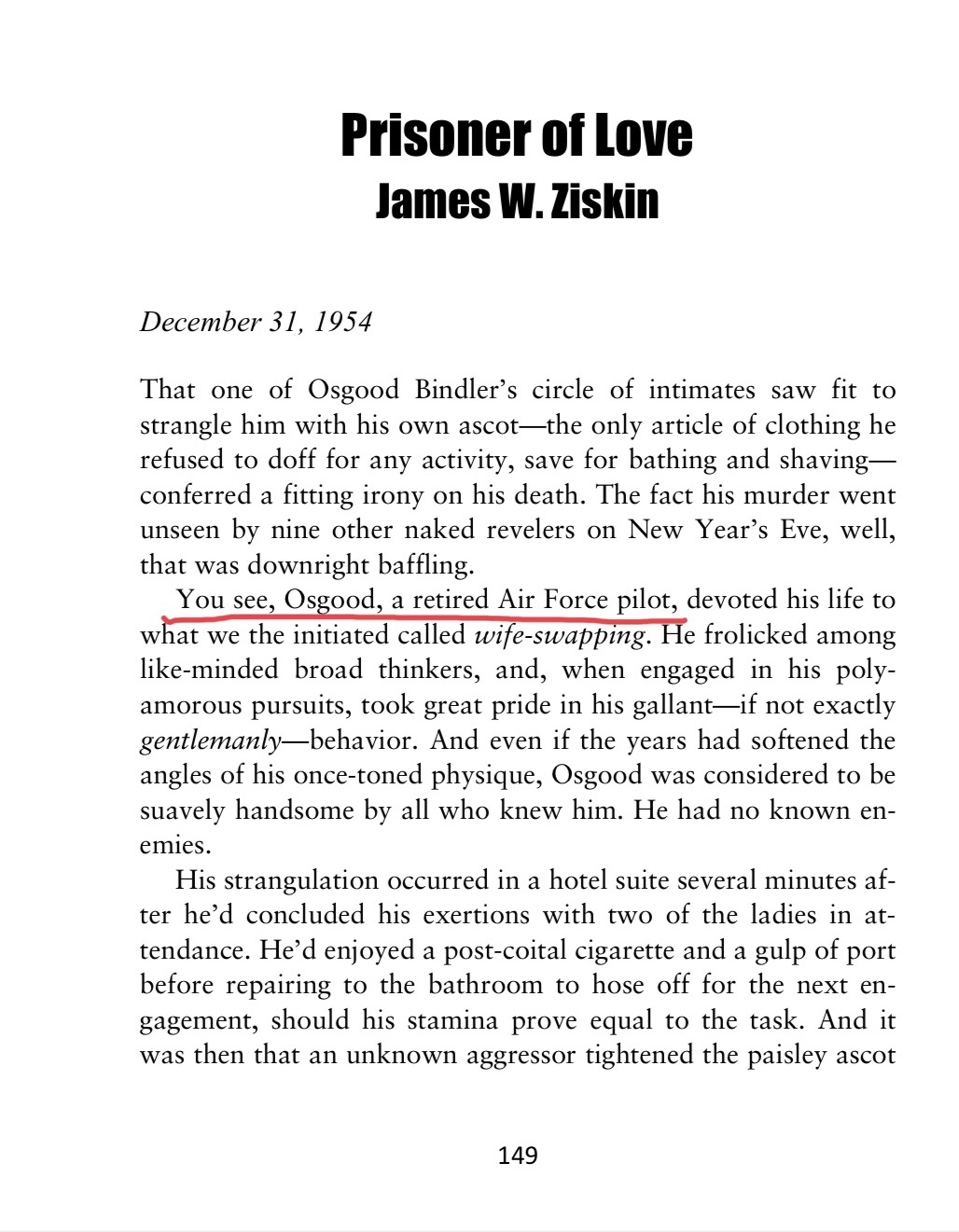
“Prisoner of Love” is set on New Year’s Eve 1954 at an—ahem—wife-swapping party. The term “swingers” wasn’t coined until later, so I must refer to the revelers as wife-swappers. Interesting fact: wife-swapping gained popularity—it seems—among Air Force couples in the 1950s. I asked my dad about this shortly before he passed away last year. He’d served in the Air Force as a captain and flight surgeon, and he said those stories were well known at the time. And, so, I chose as my murder victim one Osgood Bindler, a retired Air Force pilot.


For my wife-swapping story, I chose to keep the sex off the page, even if it was simmering just under the surface. And I wanted to try something unusual, if not daring: there’s absolutely no dialogue in this story. Not one word. My goal was to write it so the reader wouldn’t even notice. Not sure if I’ve succeeded, but time will tell. I counter-balanced the absence of dialogue with Nelson’s precious and refined narration. If his descriptions were compelling enough, I thought, maybe the reader would forget about dialogue and enjoy the ride. Here’s Nelson’s description of himself and his meager charms:


Nelson, a lecherous, pansexual doctor with loads of money and wicked intentions, is the “detective” and narrator of this story. Some readers may recall him from two of my Ellie Stone mysteries. In Heart of Stone, he and his voraciously sexy wife, Lucia, are suspects in the deaths of two men who’ve died in what at first appears to be a diving accident on an Adirondack lake. The husband and wife team also show up in Cast the First Stone, set in Hollywood in 1962, and spend all their time trying to get Ellie into bed. But in 1954, Nelson and Lucia have not yet met…

That is until the fateful New Year’s Eve wife-swapping party described in “Prisoner of Love.”


As for the rest of the shenanigans in “Prisoner of Love,” I’ll leave that for you all to read, as I don’t want to give away any spoilers here.

Now back to this week’s question. Do I have any manuscripts I might like to revive?

While I don’t have a manuscript I’d like to revive, I am planning to write a series of short stories featuring Nelson and Lucia Blanchard. “Prisoner of Love” serves nicely as the first installment, an amuse-bouche, if you will, to their enduring lust story.