Wednesday, July 3, 2013

Trouble at the Front


How timely this question is!  I've just hit SEND on the edited draft of THE DAY SHE DIED, my second contemporary stand-alone for Midnight Ink.  It's notable for being the first book that's coming out under my title after a run of five that were changed. 

And you know what?  The editor was right and I was wrong every one of those five times.

The last modern one AS SHE LEFT IT started life as OPEN THE DOOR.  Well, actually it started life as FISHBO'S PUFFER.  Neither of my attempts were terrible but ASLI is best.

I thought I was going to have two keepers in a row, mind you, because DANDY GILVER AND A REGRETTABLE KETTLE OF HERRING (just submitted) struck me as pure genius, but Editrix Lestrange at my London publisher pointed out that nothing about that title says "crime".  Duh.

A BOTHERSOME NUMBER OF CORPSES began as TROUBLE WITH YOUNG LADIES

AN UNSUITABLE DAY FOR A MURDER was once TROUBLE IN STORE

And DANDY GILVER AND THE PROER TREATMENT OF BLOODSTAINS - a gem of a title - gave me endless gyp along the way.  I called it IN THE DARK.  It's about  a. a coalminer's strike b. buried secrets and c. servant life in the basement of a house.  In the dark x three!  But then Mark Billingham brought out his new book and it was called In The Dark (for no good reason that I could see or at least not for three of them).

So then we called it DEEPEST RED, as in blood and as in the people's flag of the left wingers who wanted the strike to succeed.  I liked it; others thought a quote from a Marxist anthem might not hit the right note.


So for a while, just among ourselves, we called it TROUBLE DOWN BELOW.  It started as a joke, but after a while it seemed quite, quite fine.  This is how people manage to be called things like Dr Sprinkle (he works at my local surgery) and Hampton Sublet (A colleague of my husband's) without giggling all day.

So, all in all, I'm very grateful to my editors for thinking up better titles than I do. 

My favourite title of recent years?  Hands-down, saw it in the bookshop and bought the book without even looking reading the back jacket copy . . . WITCHES ON THE ROAD TONIGHT.  That it was about depression-era Appalachia, a time and place that fascinate me, was a bonus.  It's still on the TBR pile but every time I see it (while dusting) it makes me happy.

Thursday, June 20, 2013

Butlers and wise guys need not apply.

There's three categories of books I can't read while I'm writing.  (Writing meaning first-drafting; chipping the virgin story out of the ground.)

1. Books similar to mine that I want to be able to say I didn't read and haven't stolen from even if we've both got retired burlesque dancers who fly the first air ambulances in Worcestershire and killed their twin brothers with a grapefruit spoon.

So that's Jacqueline Winspear and Rhys Bowen - the other two blonde Brits who live in northen California and write amateur detective stories set in the UK in the 1920s.  And Carola Dunn (as above except it's Oregon) and Kerry Greenwood too.  Which is a lot of great books to not read.  Moof.

2. Books in the wider genre so breathtakingly, heartbreakingly fantabulous that I'd get a case of the why-bothers only Ben, Jerry and Sheldon Cooper could cure.  This sees off Dennis Lehane, Ruth Rendell and Ann Cleeves.  There are more but I need to stop now because even listing them is dispiriting. 

3.  Books by writers whose style is insidiously contagious (and who are too famous to hyperlink).

Raymond Chandler is just about the worst of these.  I was reading him once while writing and decided that Dandy Gilver's tea frock could fit her like a mermaid's scales.  Why not?  (I caught it in the edit.)

Ernest Heningway isn't worth the risk either.  Nick and the fish and the big two-hearted river?  Hugh Gilver sometimes poddles off with his rods hoping to catch a salmon but it's not the same.

But pipping them both at the post (or poking them both smartly in the second waistcoat button, as he would say) is PG Wodehouse.  Some of Wodehouse's lines make me laugh out loud no matter how many times I've heard them.  When Bertie Wooster had a hangover and "a cat stamped into the room".  Or when Mr Beach is displeased but says nothing and PW describes it thus -  "ice formed on the butler's upper slopes".  Genius.  Or when  . . . I think it's Bingo Little . . .  sends a telegram that begins - "I say Bertie old boy stop yes Bertie stop I wonder old chap if I might have a word stop"  The narrative goes on - "The telegram is not Bingo's natural form."

So part of the joy of getting that first draft done is to be able to read absolutely anything again.  Mystic River or Right Ho, Jeeves.  The world's my TBR pile.


Thursday, June 6, 2013

Catriona McPherson: Private Eye

I'm the wrong person to ask about day jobs because I've so rarely had a day job I either a. liked or b. was any good at.  For sure, I've never had a day job that c. was going to make my fortune.

I tried banking.  Hah.  Fifty-pound-notes got bundled into hundreds.  Which was four notes, right?  After they searched my bag and and my pockets and recounted my stash and looked down the back of the couch, a very honest wages clerk came back to the bank and returned the extra.

I tried being a university lecturer.  Hah.  I was one of four lonely linguists in an English literature department, teaching phonetics and syntax to kids who wanted to learn Jack Kerouac.  When one of my colleagues asked me what I read for pleasure I said I only read the TV Guide to see what time Star Trek was on.  I forgot to wink; he believed me; I was the talk of the senior common room.

I worked in a pub serving food but my portion control was non-existent and just before the place went bankrupt I was demoted to cleaning.

I worked in the Fine Art and Local History departments of Edinburgh City Library.  That, I loved.  That, I could do.  That, was between university courses.

So giving up a full-time day job in 2000 to try this writing lark wasn't as difficult a decision as it might have been.  I did part-time tutoring to make some money and also had a number in my head: if I ever got an advance of *this* amount, I said to myself, I'd give up even the tutoring and write really full-time.  That took five years and it was scary when it came.

This is year thirteen of writing stories and I feel as if I'm just about to get a day-job again in a funny kind of way, because I'm about to start renting an office in town and going back to having a commute instead of working in my house.  It'll be a big change - no more jammies, no more leftovers for lunch, no more chats with Joe the UPS guy . . .

My one regret is that my office doesn't have a half-window of bumpy glass on which I can put my name in gold paint like Philip Marlowe.  That would have been something.  But learning to smoke those unfiltered cigarettes might have been tough and a raincoat and fedora in this climate would have killed me.

Oh and also:  AS SHE LEFT IT comes out on Saturday.  Yeay!


Thursday, May 9, 2013

A tale of three mothers

That's Dandy Gilver's, Opal Jones's and mine.

Dandy Gilver's mother started her off with a good smack in the chops by naming her Dandelion.  Mr and Mr Leston were great devotees of the Arts and Crafts movement, so popular in the late Victorian age, and it seemed like a good idea, I suppose, to call their daughter after one of England's most neglected wildflowers.  I think, in contrast, that if you want someone in your family to have a funny name you should change your own.

After the christening, Dandy's mother receded and Nanny Palmer came to the fore, as was usual in the upper classes at the turn of the 19th century.  It's Nanny Palmer whose voice is still in Dandy's head and whose spirit hovers.


Dandy got a better deal than Opal Jones, the heroine of my new stand-alone AS SHE LEFT IT (8th June).  When the book opens Opal is coming back to her childhood home after her mother's death.  Here's what she finds:
The curtains were shut, like always, and the bed, like always, was heaped up
with pillows and cushions, piled high with quilts and blankets, a nest. 
Magazines and a toilet roll, some clothes, some bottles of course, an ashtray
and a big soup tin without its label for emptying the ashtray into and, where
the blankets were pushed back and the pillows and cushions were flattened,
a round hole, tiny.  Big enough to hold her mother?  Must have been.
She hadn’t died there; she’d gone to the hospital; admissions, acute medical
– or that bit of acute medical that’s basically the drying-out ward – then HD
then ICU and there she had died.  But it had started here.  One night, or one
morning more likely, she had climbed in and never climbed out again.
My two heroines have very different lives and grew up into very different women.  Dandy is brisk and capable and it would take a lot to sink her. Opal is tough on the outside but wary of going to places that will open her wounds. One the other hand, Opal can feel things; Dandy believes that feelings are not quite respectable and avoids them.  Hm, maybe they're more similar than I realised, after all.

I got a whole lot lucker than either Dandy or Opal when it came to mums. My mother, Jean McPherson, brought up four girls, knitted all their jerseys, cooked two hot meals a day from scratch and taught them a love of books.  What more could you ask for?  Okay, themed launch-party cakes:


cut with the McPherson family musical cake-slice. UK Mother's Day has been and gone but every day is a good day to say "Thanks, Mum."


Thursday, April 25, 2013

"Hours of verbage (sic) and boredom" (says a review I could have lived without seeing)

Reece on Monday said it was unimaginable that anyone didn't.  Hilary on Tuesday said it was a big fat lie that anyone didn't. Chris on Wednesday was worst of all - he made it seem like a good idea to give it a go.

Readers, until this week, I was that unimaginable big fat liar who'd never given it a go.

Hand on heart, I did not read my reviews.

Wait a minute, wait a minute, hang on.  Let me add a few caveats.  If my publicist emails me and the subject line is "nice/good/great/fab/amazing review from _____" I open the link.  I read, I download, I email to my dad to print and give to my mum for her scrapbook.  Thanks, Mum.  (She spent her working life in libraries and is a better archivist than I could ever be.)


Also, on the Saturday after the UK publication date of a new Dandy Gilver I will buy the Scottish broadsheets (if I'm there) and look through the book reviews.  It's a small country with a lot of newspapers so the strike rate is high and I'm not a big enough name for anyone to want to take me down.

And that - that last point - is why I don't look at reader reviews on Amazon etc.  All you have to do is write a book to make someone on Amazon want to take you down and leave you bleeding.  And while I enjoy a good one-star review of Pride & Prejudice as much as anyone (click here for a favourite) I don't see how any writer could want to read sneers, swipes and cynicism about their own stuff?  How could it not make you want to curl up in a ball and only uncurl to put a DVD of Pillow Talk in the machine and open the Pringles?

That was my position until earlier this week, as I say.  Since then I've had the highest of the high and the lowest of the low: a Goodreads review (click here) of the ARC of AS SHE LEFT IT that made me go and stare at myself in the mirror just to see what that big a genius looked like.  (Not really.)

And this (click by all means).  One of the two-star reviews of my first published novel, AFTER THE ARMISTICE BALL, is a doozy.  It's an anonymous review by someone who's never reviewed anything else (not even the banana slicer) and it's got everything: mistaken beliefs hotly defended, unfounded accusations, personal attacks - I'm crass and discourteous, don't you know? - and then there's the bit that really got me.

My "bad writing" is illustrated by writing that's nothing like mine. God, that's annoying! The reviewer gives "over-vivid, lengthy, painful and agonizingly contrived descriptive phrases" as a taster of my kind of prose as well as an evaluation of it. Tricksy. But if you can find a noun in AFTER THE ARMISTICE BALL pre-modified by four adjectives, one of which is pre-modified by an adverb, I will give you a thousand dollars.

So, all in all, I'd rather not read reviews.  Except Chris made a good point about saying thank you for kind ones, Hilary was a shining example of psychological health and Reece was convincing about using them as tools for improvement.  I'm going to wait and see what Sue Ann says tomorrow.

Thursday, April 11, 2013

To bump off or not to bump off.

Q: Having come up with a perfect murder, isn't it annoying not to use it get rid of some numpty?' (I translated, being unequipped to say what makes someone a jerk, and therefore un-entitled to murder them.)
A: No.

I don't think I've ever come up with a brilliant murder method.  In eight and a first draft mysteries my murders have been:
  1. baroque to the point of insanity (first novels: never knowingly underwritten)
  2. only available to murder one specific person in a small town (my home town) on one Friday every August (which isn't that handy really)
  3. [the concept album]
  4. preposterous (hey, why set a book in a circus and then just shoot someone?)
  5. even more preposterous (with less of an excuse, mind you)
  6. preposterous's mad uncle who lives in the attic (why did I start this?)
  7. possible. Woo-hoo! (But not these days with mobile phones and CCTV)
  8. preposterous (and disgusting - my darker period begins)
  9. ask me later
But even if I did come up with something . . . viable, if you'll forgive that unfortunate word in this context, I just don't see killing someone.  Anyone.  I mean, up to and including Osama Bin Laden.  (Don't freak - see below.)

In Kate Atkinson''s new one Life After Life (click), the only possible exception comes up.  If I could time-travel back to 1930s Germany I might well pre-emptively kill Hitler, to save 15,000,000 others.  I'd pre-emptively kill Osama Bin Laden too actually.  If I could time travel.  On the other hand, the one time I did write a time-travel caper it wasn't called Kill Hitler.  I called it Save Elvis.  Which tells you a lot about me.

But back to evil mass-murdering psycopaths and why I wouldn't punish them with death after the fact.  It's because in my personal philosophy, this life is all there is and being dead doesn't hurt enough.  If you don't have any supernatural beliefs then being dead is no worse than not being born yet.  I was absolutely fine for millenia before 1965, a state of pain-free non-existence I think is too good for evil people.  Of course, they'll get there in the end but I wouldn't help them.

If you believe in hell, I can see why killing Hitler and Bin Laden would be an excellent idea. But if you believe in redemption for all then executing a monster just fast-tracks him to the good bit - like taking away a toddler's meat and potatoes and letting her go straight to cake.  I've always wondered about that.  I've always wondered too, for the same reason, why devout believers think murdering a good person is bad.  If you're ushering them into a life of eternal paradise, then . . .

I think the most fit punishment is to make someone accept what they've done and accept the suffering they've caused.  Then they live with themselves.  That's my idea of vengeance.  If I try to get my moral ducks in a row, the next step is atonement and forgiveness.  All three together pretty much underpin the "crime" part of the African system of Ubuntu (click) which is what allowed the awesome era of truth and reconciliation in South Africa after the end of apartheid.  I remember being blown away by the Black South Africans' ability to forgive and move on, and the White South Africans' ability to face their own acts, lay them down and walk on, without debilitating guilt.  They really are useless at festering.

In a culture of vengeance-based or payment-based justice like ours the TRC could never have happened.  I remember a radio programme on the BBC years ago when a Northern Irish combatant (I can't remember what side he was from) was faced with a post-apartheid South African describing Ubuntu and was totally unable to comprehend it.  He got pretty close to saying that the Irish Troubles were too severe and South Africa had had it easy.  He stopped himself just in time, I'm glad to say, and I always wondered if they chatted off-air and what came of it. 

So, in conclusion, killing people is not for me.  And I wish Ubuntu was what South Africa exported, instead of diamonds.  It outshines them any day.


Thursday, March 28, 2013

It's my story and you'll cry if I want to

Dandy Gilver is a unenthusiastic wife, a half-hearted mother, upper-class, a city-lover, relies on sevants to do everything from cooking her meals to choosing her clothes.  I'm married to my best friend, don't have kids, working-class, country-bumpkin, grow some of my own food but cook all of it from scratch and am usually wearing something from at least a thrift store if not a dumpster.

And here's the kicker.  She loves dogs and I love cats.


Oh and she hasn't had the action-packed hair-colour past that I've been through either. 

Safe to say Dandy's not me.  But does my stand-alone character, Opal Jones, share my interests?


The whole of As She Left It takes place in a few pretty fraught weeks in Opal's life, with not much time for macrame and yoga.  And it's just occurred to me that I don't think she switches on a radio or telly or plays a single track of music in the entire book.  She does give up on Ikea as a source of furniture and goes to a charity shop instead, so with a bit of a stretch I suppose you could say we're both bargain-hunters.  Or mean anyway.

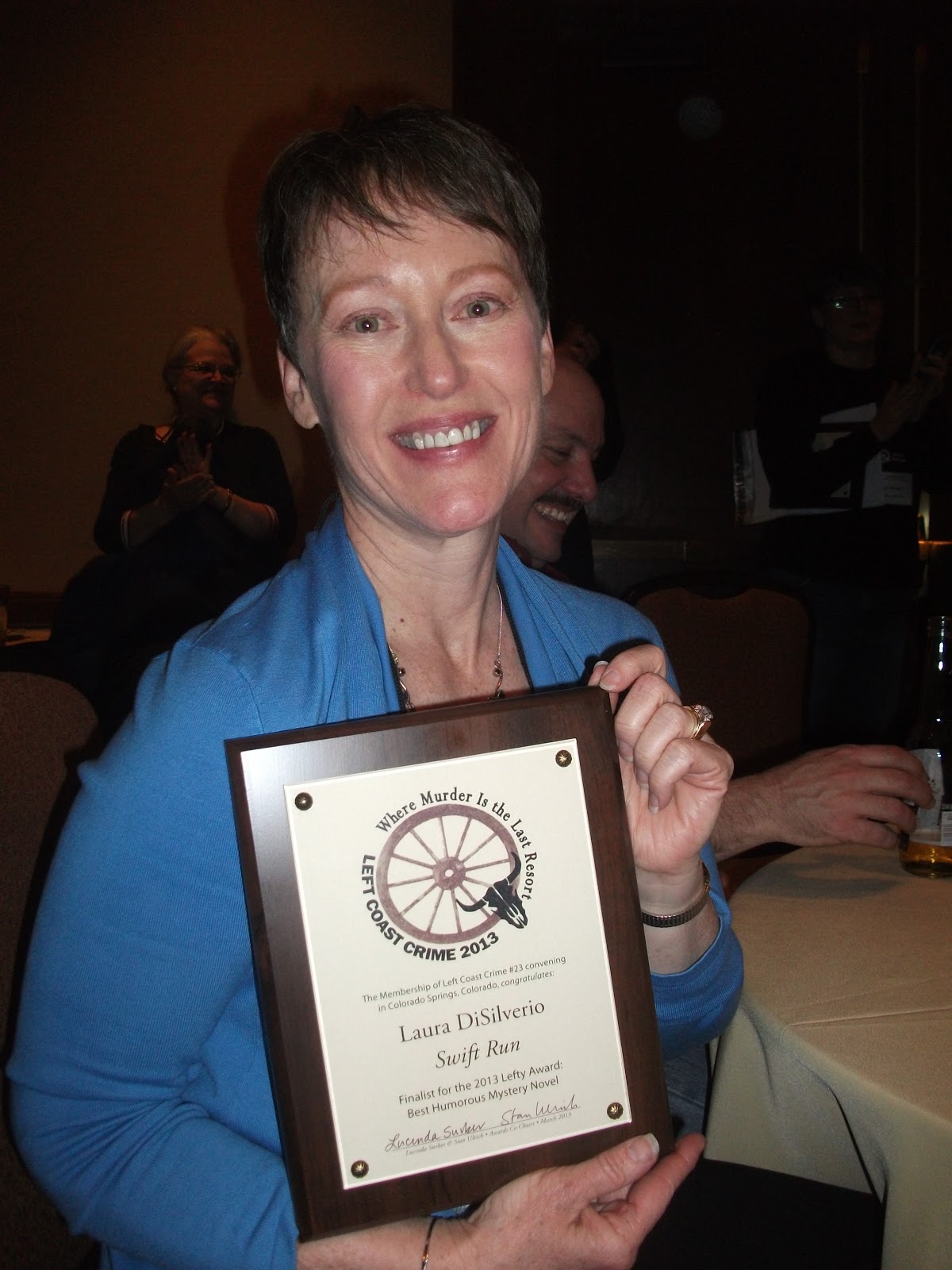
I was just talking to Laura Disilverio (click) about this at Left Coast Crime at the weekend; apparetly ballroom dancing is like dog vs cat as far as characters and authors go.  Laura has the hardest time persuading readers of her dancing mystery series (most recent Homicide Hustle) that she's - whisper - making it all up, and not fitting the writing in around travel to professional tournaments in the ballroom world or at least the daily grind of foxtrot lessons in her studio.


But then I have my troubles in separating writer and characters too.  My friend Jess Lourey (click)  writes the gripping yet hilarious murder-by-the-month series (most recently December Dread) and in my head the heroine, Mira, is Jessie, so much so that when Jessie talks about her dog, I feel bad that she's showing such favouritism and hardly mentioning her cat.  Her fictional cat.  Dammit, her protagonist's fictional cat!


The funniest example of a writer herself not being able to separate her interests from her characters is another friend of mine Cathy Cassidy, (click) a UK children's writer and a vegetarian of many years' standing.  Cathy just can't stand to write a meat-eating protagonist.  Her books are full of kids and adults from all walks of life in all sorts of extreme situations, all ordering mushrooms and chips in British chippies, or eating quorn sausages and quiche.  It's so much a moral issue for Cathy that she couldn't have a sympathetic character chomping into a chicken leg for the Pullitzer prize.


It makes me love her (and miss her) but it's a good thing she doesn't write mysteries; we'd all know in the first chapter whodunnit.  Him over there with the bacon cheeseburger.  Call the cops.
 

Thursday, March 14, 2013

Superstition is the way.

I was going to say I don't have any writing rituals that would count as superstitions; all I have are sensible working practices.  But, while looking around my office for examples, I noticed my pens.

I use blue Bics.  Bic Cristals.  But that's not a ritual, right?  That's a preference.  They're a design classic, for a start - evidence: they're in MOMA.  Also, they don't leak like Hi-techpoints and other fancy-schmancy pens when you take them on a plane.  Finally, they smell like pens should.  Not that I sniff my pens. 

But the reason they caught my eye is this:


When I say I use blue Bics, I really mean I like to have a full pen-holder of them, as well as the one I'm using, one in my bag and a packet of new ones in my desk drawer.  And it gets worse.  The three back slots in the pen-holder - a sea-washed brick picked up on Prestwick beach in the late eighties - contain a red Bic for corrections (under the Dandy Gilver fingerpuppet), a black Bic for occasional scanned government forms (under the Bury Her Deep gravestone) and a pencil (under the Bunty Dalmatian).

Now, the black-pen-under-blackish-gravestone and red-pen-under-red-Dandy look either neatly orgnanised or slightly anal, depending on your point of view, but at this point you probably think the pencil-under-Dalmatian is completely random.  A devil-may-care detail that balances out the rest of it.  Not so:


It's really quite a Dalmatiany pencil under there. 

So.  Writing superstitions.  Hello, my name is Catriona and although I can write in my office, by the fireside, on the porch, in bed, in coffee-shops, in the Ethel Merman quiet room of the Davis Public Library, in departure lounges, hotel rooms and on planes, I can only do it if I know that on my desk there are five blue Bic Cristals in their slots against a backdrop of red, black and pencil finger puppets.  Don't judge me.

Thursday, February 28, 2013

Dandy Gilver and The Cannibal Kitten Smasher?

Perhaps not.  Writing a series of detective stories about an amateur sleuth in the 1920s keeps me well away from the bit of the genre where we all start to wonder where it's going to end.  The tone would be a joke; worse than a sado-masochism series by an an author who couldn't use plain terms for genitals.  No, wait!  Bad example.  But you know what I mean.

Which is not to say I've never had complaints.  There was one time when someone at a reading said - in very schoolmarmish tones - that she hoped I wasn't going to be poking fun at religion again.  AGAIN?  It turns out she didn't like the line in Bury Her Deep (DG3) where I said "The Church of Scotland gets by on a little doctrine and a lot of scones."  I persuaded her that it was affectionately meant and we parted friends.

I imagine that most people's threshold is set a wee bit higher than that, but we've all got one.  I wouldn't have a problem with serial killers if the muse ever dragged me that way; they're so vanishingly rare in real life and so effulgently ubiquitous in fiction that (to me) they've become almost as cartoonish as zombies and vampires.

[TRIGGER]

But if the muse started whispering a tale of serial rape in my ear I'd sing "La-la-la can't hear you" until she shut up again.  Partly that's because serial rapists are not rare and their victims are all around us.  Hence my trigger warning.  And likewise paedophila.  Empathy for survivors who might be kicked back to their worst moments by my writing would always stop me dead: there's a world of difference between being "offended" and being hurt.

Serious stuff.  So to finish, I'm sharing a video (click here) that always makes me laugh: three people, extremely offended.  Or as they would have it . . .

Thursday, February 14, 2013

Mix thoroughly and bake for fourteen years

I've never written a short story.  See you in two weeks.

Kidding.  Just because I've never written a short doesn't mean I've never come up with plots that would be perfect for them.  But when I do, I call the idea a sub-plot and lay it aside until another one comes along that complements it.  Then both of them are set aside until a third spark ignites and maybe a fourth.  Then there's a big sprawling complicated cast of thousands novel ready to go.

The master of this kind of of labyrinthine plotting in the mystery genre is Kate Atkinson (if you haven't read Case Histories and its three sequels you're in for a treat and three more treats to follow).

I'm no Kate Atkinson, but my June release, As She Left It, is the result of years of sub-plot collection.

On summer holiday in France in the mid-90s, driving to the boulangerie one morning, I had an idea about an elderly jazz trumpeter with pneumonia who needs a stand-in.  This character  - Fishbo Gordon - is in the book.  In my head, in fact, the story was called "Fishbo's Puffer" for years.

Then in about 2005 I saw a magnificent bed in an antique shop in Castle Douglas and bought it:


It was a bed with a puzzle, a puzzle which - refracted through the mind of a mystery writer - became a secret, a secret which became another sub-plot in what was now a third of a novel.

A year later, in Leeds, on an all-girls weekend, two friends and I met a little old lady wandering around in the street (and wandering around in a gently mythical version of reality too), took her home and contacted her carers.  It was a tiny incident and would have made an effective short story but I don't write short stories.  So this little old lady joined the jazz trumpeter and the bed-with-a-secret and the book was halfway to being afloat.

That weekend gave me the setting too; As She Left It is set in a short dead-end street of old red-brick houses in Leeds; in my friend Diane Nelson's house, in fact, where we were staying that weekend.  The wonderful design department at Midnight Ink captured the mood of the story perfectly with this jacket:


but I promised Diane that I'd show the real street too - much less gothic and grim.


In 2009, I was writing Dandy Gilver and not thinking about Fishbo at all, but one day in Tesco, watching the online shoppers filling trolleys with groceries for strangers, I got to thinking about how much you could tell about someone's life if you did their shopping and how those shoppers must live somewhere local and I wondered if they did their neighbours' shopping for them and what if they worked out that their neighbours were . . .

Another short-story-sized plotlet that was modern and dark went into the cauldron and now my protagonist had a job as well as a house and I had four linked tales to tell.  It was time to start writing and I felt more than usually sure that I knew where this one was going

Imagine my surprise when, a little way into the first draft, the red bricks of that dead-end street started whispering a completely new story in my ear.  It turns out, after years of preparation, that the main plot of As She Left It is none of the above.  But the bed, the trumpeter, the little old lady and the neighbour's secret are all in there too and I've still never written a short story.

Thursday, January 31, 2013

It's not ranting if somebody asked you.

Okay, first, Elmore Leonard on said.  I agree.  In spades.  In the bucket of biggest available backhoe.  With exceptions.  I wouldn't turn to see if the ghost of Henry Fowler was creeping up behind my desk-chair if I wrote shouted, whispered, called back up the cliff towards where she was waiting, asked or answered for example.  But said is best and order a bigger backhoe for how much I agree about modifying it with adverbs.  Except for crisply.  I just love this, although I never wrote it myself when it was available.  (It's copyrighted now for Julian Fellowes to use in Violet, the Dowager Countess of Grantham's stage directions (since it's how she says everything.))

Now for my personal top three unbreakable rules.  I apologise in advance for seething.

3.  sneaky attributive adjectives bundled in to wreck orderly action sentences instead of rolling up their sleeves, going predicative and getting clauses or even sentences of their own.  For example:
  • She hit her head on the floor when she fell (orderly action sentence). 
  • She hit her permed and highlighted head on the polished hardwood floor as she fell (now wrecked with sneaky attributive adjectives). 
  • Her head looked softened by her perm and was golden with highlights but hit the floor like a rock anyway as she fell, bouncing off the hardwood and leaving a smear of blood on its polished surface.
Wait!  Don't click away and tell yourself you'll avoid non-Alan-Orloff Thursdays from now on.  I know that sentence is now a multi-vehicle pile-up of awfulness.  That's the point.  Who cares about her hair at this moment and who (except house buyers and realtors) ever care hardwood floors?  That's why permed, highlighted, hardwood and polished can't have their own clauses and that's why they shouldn't try to sneak in elsewhere.


2.  This is about description too.  No exceptions, no contextual considerations, just no.  Never - never - have a character look at themselves in a mirror early on in the first chapter and describe their looks.  Don't.  When was the last time you looked in a mirror and thought to yourself that your eyes were brown and your nose was small and straight?  Don't ever.  If someone you knew sighed in exasperation at that annoyingly wayward curl and tucked it behind her ear with a rueful grin, wouldn't you want to punch her in the neck?  Just don't. 


1. This is my tip-top of all time writing no-no (and the reason I used Fowler instead of Strunk and White earlier).  It's rude, it's wrong, it's stupid, it's generic he.  It's the daft idea that you can use he, him and his to talk about all of humanity: e.g. Man breastfeeds his young.  Strunk and White reckoned he or she is clumsy, singular they is illiterate and so generic he is the only choice left and, besides, only silly-billies will complain. 

Well, call me demanding, but I'll take my writing advice from someone who's not flummoxed by an evolving pronoun system.  See, the silliest, most ignorant thing about saying number agreement trumps gender agreement . . . is that number agreement has shifted once before and the sky didn't fall.    You used to be plural; the singular was thouYou was also more polite; thou was more intimate.  Politeness won.  You became singular/plural and thou dropped out of use. 

I can just imagine the mediaeval grammar mavens reaching for the smelling salts.  Woah!  Changes in the pronoun system! Number distinction lost!  You-ing social inferiors instead of thou-ing them!  Will English survive?  It will.  It did.  And it will again.  Anyway, we've got y'all, youse and y'guys coming along to do some of the plural grunt work again.  (I wonder if Strunk and White would have welcomed them.)

Rant over. 

Thursday, January 17, 2013

Kisses and cocktails and a little light jazz.

How much sex and violence do I weave in?  Are you accusing me of writing crafting cozies?  I couldn't weave with a gun to my head.  Or crochet.  Or knit.  I've often said that the greatest technological leap in the evolution of modern humans happened the day someone looked at a sheep -a sheep! - and said "I've had a brilliant idea.  Why don't we . . ."

Some of my friends on the other hand . . .

Okay, enough willful misunderstanding of the question.  Honestly?  When it comes to the Dandy Gilver mysteries, very little.  These are my hommage to the golden age and I don't put anything in them that you wouldn't have been found in Dorothy L Sayers, Margery Allingham or Josephine Tey (although I'm not sure I ever have managed a tone as dark, bleak and just plain nasty as some of Allingham's - how these ever got the cozy title, I'll never know). 


So, it's an extra constriction, to be sure, along with the requirement for an early murder, a late solution, and some red herrings, but if we minded constriction we would hardly be writing in this genre, would we?  The compensation for me in the Dandy stories is that no one has a mobile phone, there is no forensics and I never have to write one of those desk-bound google scenes.  When Dandy Gilver and her sidekick Alec Osborne dig for background they do it in dusty church vestries or the mahogany-lined offices of shipping agents or what have you, with scope for all manner of Dickensian walk-ons.  

But now I've started writing modern stand-alone suspense too.  In the first one, As She Left It the story didn't throw up much in the way of either graphic sex or explicit violence.  It was a relief not to have to keep checking the vocabulary in the Shorter Oxford for anachronisms, mind you, and I may have gone slightly F-tastic with the curses just because, for once, there was nothing stopping me. 
In the new one (working title The Day She Died) the story does involve sex and violence and I've followed the characters into the bedroom and out again as well as watching the bones shatter and the blood drip from quite close-up too.  It's still being edited.  Maybe some of the squelching (sexual and violent) will end up on the cutting room floor.  If so, it'll be because, as Chris said yesterday, the story is better without it.  We'll see.


Thursday, December 20, 2012

Who's a Friend of the Big Bad Wolf?

What an interesting question.  I managed to avoid nearly an hour of horrible first draft production, staring out of the window, thinking about it.

And the answer is . . . well, sort of. 

I write seatopants-style so very often the one I thought dunnit turns out not to have in the end and I suppose you could say switching a character from "murderer" to "non-murderer" is a bit of a moral upgrade.


One time I really did turn someone from a moustache-twirling, cape-swirling baddy (bwah-hah-hah, all that) to a bunny-hugging (well, bunny-shooting since it was the 1920s and this person was a countrydweller but let's not quibble) poppet.  But I did it after the character was dead so there wasn't much in it for them.

Usually though, it's a question of ever-increasing complexity.  I can't decide whether it's a drawback or a side-benefit of writing a series that minor comic characters grow and deepen over the course of a few books so that you can't use them for cheap laughs any more.

Dandy Gilver's husband, Hugh, was pretty much a stuffed shirt in the first book or two, but as I've written about his childhood, his reaction to his wife being in danger, his fears for his teenage sons as the clouds of war begin to gather, I've grown fonder of him and developed a grudging respect.  In the last two books I've given him a moment of glory to off-set the fact that I still laugh at his fossilised take on the world.

And actually,as I write this I remember that a few years ago, in a different frame of mind, and under a pseudonym (although not very far under: it was Catriona McCloud) I wrote a slightly cross-genre, tricky to decribe and therefore tricky to keep in print, puzzle novel called Straight Up which had a massive shift along the scale of sympathy for one of the characters.


I'm being cryptic because tis is the season and so I've decided to give a couple of copies of Straight Up away (should anyone want one).  In short, if you'd care to read a crime/road/buddy caper about lies, fibs, whoppers, tall tales and total bull in which a depressed florist takes on Hollywood and wins (kind of), just comment and I'll draw names  at the end of today. (With regret, US only.)

Whatever you're reading on the days off next week, though, have a wonderful feast/rest/holiday, won't you.


Thursday, December 6, 2012

Imaginary Friends

“How much do you know about a character’s back story before you write word one?  Or do you just wing it?”

Any question along the lines of “How much careful, painstaking, industrious _____ do you do or do you just _____?” is always going to go the same way with me.  “Just” is the operative word.
Some call it organic; some call it shambolic; I call it the Benny Hill method, as I’ve said before.  Brakes off at the top of the hill and go (bathtub optional).

And it’s so organic/shambolic, the bathtub goes whizzing down so fast, that very often I can’t answer questions about method at all.  I really don’t know. 
At the moment, however, it’s all quite fresh in my mind because I’m 1500 words into a new story, not part of my series.  So since a week past Monday I’ve invented three main characters and thirteen minor ones.

Here’s what I know about the big three, five pages in. 
I know their first and last names, no idea what middle names if any.  I know roughly how old they are but I’ll need a perpetual calendar of the 20th century at some point to work it out properly.   I know where one of them lives in precise detail, floor plan of her house, all that.  I know what city the other two live in and that one has a house and one a flat.  I’ll need to go out for a stroll with Google’s wee orange man later. 

I don’t know where any of them were born, but I know they crossed paths in their youth, so I’ll need to sort that out too.   I know the marital status of one, have got a bit of a clue (the name of an ex-girlfriend) about another, have got not the first clue about the third.   If his wife turns up while I’m writing, I’ll know then.   I do know what jobs they do; none of them is a cop, detective, sleuth or pathologist.

How did I find out?  By writing their evolving names over and over again on sheets of scrap paper and thinking about them.  I’m riffling through the heap of paper now and it really is just names.  This is the first time I’ve realised that.
One final thing: I know exactly what they look like (found out by repeatedly writing their names (does this sound as bonkers as it feels to me?)) and by about 30,000 words it’ll start to annoy me that I’ve never seen them.  Then I go looking for pictures of them.  Since this is a modern story I’ll trawl the internet, magazines, newspapers, yearbooks, anywhere I can think of, until I find them.  (When I’m writing Dandy Gilver, set in the 1920s, I have to use old photos. )

And I’ll know them when I see them.  I’ll recognise them.  Then I’ll photocopy or print out the pictures, staple them to pieces of card and prop them up on my desk while we all write the rest of the story together.  Writing isn’t lonely if you’re not actually alone. 
Cx