Showing posts with label #Cathy Ace. Show all posts

Thursday, November 12, 2020

We’ll Always Have Albany from James W. Ziskin

 Give us some of your funniest and most memorable stories from traveling to book festivals

This week’s topic takes me back to my very first writers conference. It was September 2013, and I was attending Bouchercon in Albany, NY. My debut novel, Styx & Stone, was set to be released three weeks later, and I knew nobody, except fellow author Lynne Raimondo. Our editor, Dan Mayer, had introduced us via e-mail, and Lynne provided me with my first blurb. She and I met for dinner in a restaurant not too far from the Empire State Plaza,  and we became great friends. We’ve remained close ever since.

Many people in the mystery and crime writing community recall Albany with disdain. But not me. I loved it. Maybe because I grew up about thirty miles from there. The setting was familiar and a bit nostalgic. I remembered class field trips to the brand-new museum at the Empire State Plaza when I was a kid. If I’m honest, I must admit that the place hadn’t changed since the late sixties when I’d first visited. Nothing had been updated.

The Empire State Plaza was the brainchild of Governor Nelson Rockefeller. He was reportedly moved to action after Princess Beatrix, the future queen of the Netherlands, visited Albany in 1959. The governor was embarrassed by the squalor of the state capital. The project to transform downtown Albany took more than ten years to complete, and included razing about a hundred acres of Albany’s South End to make room for the Empire State Plaza and the Egg. (If anyone is interested, I included a brief tour of the South End neighborhood in A Stone’s Throw, my sixth Ellie Stone mystery. The year is 1962.)


At Bouchercon 2013, most complaints from the attendees had to do with the lack of a centralized location. There was no hotel large enough in the area to accommodate the throngs of writers and readers, so people were scattered. The venue itself left something to be desired. The panels were held in windowless rooms below street level, deep inside the Empire State Plaza. It felt as if we were in a bunker. And since the bulk of the conference took place on the weekend, when the usual state workers were off, there were few options for food at the site.

But by far the loudest grumbling from the attendees was that there was no convenient bar where the faithful could gather to socialize. As anyone who’s ever attended Bouchercon—or other writers conferences, for that matter—knows, the bar is the place to meet, even if you don’t drink. So it’s natural that people came away from Albany feeling somewhat deprived of the social side of the event.

I happened to have been staying with relatives about twenty minutes away, so, for once, I was not parking myself in the bar, since I was driving back and forth to the conference. As I mentioned above, I knew no one anyway. So I wasn’t complaining. I was having an amazing time. It reminded me of my first few days as a freshman in college. I was uninitiated and naive, but loving every minute.

I may not have known anyone when I arrived, but I did by the time I left Albany. Wonderful people. The very first writer I met was Barry Lancet. We hit it off immediately, perhaps because we were newbies. I also met Sara J. Henry and Michael Sears the first day. And my dear, dear friend and fellow 7 Criminal Mind, Cathy Ace.


With Cathy Ace at Monterey

My editor at Seventh Street Books, Dan Mayer, made sure that his authors all got to know each other at Albany. That’s when I first met my fellow 7 Criminal Mind Terry Shames. She’s one of my favorite writers, and we’re fast friends to this day. We all had a great lunch together (if you don’t count Mark Pryor’s presence...) Just kidding. He’s a great guy and a fabulous writer.


L-R Lynne Raimondo, Mark Pryor, me, and Terry Shames in Albany


My editor, Dan Mayer, also introduced me to Louise Penny in Albany. She was with her dear husband, Michael, who has since passed away. Louise was so gracious, and when I saw her again at Bouchercon Toronto in 2017, she said she remembered meeting me in Albany. I was thrilled. Here I am with Louise and the oh-so-talented Art Taylor in Toronto. We were celebrating our Macavity Award wins.

L-R, me, Louise Penny, and Art Taylor, Bouchercon Toronto 2017

I may not have funny stories from my first writers conference, but I can say that it was a life-changing experience for me. I found so much inspiration and so many new friends. Since 2013, I’ve become a regular at the major conferences. I look forward to the day when we can all meet again in person.


Wednesday, August 21, 2019

...and start all over again (some Big News today!) by Cathy Ace

Two jobs for me today - answer the "set question" and tell you about a bit of news...

So, news first: over the summer I've negotiated the reacquisition of all the rights to my Cait Morgan Mysteries (except English language print, which remains with the original publisher). This means I can now relaunch the digital versions of all eight novels. The first Cait Morgan Mystery was published in 2012 - that's seven years ago (where does the time go?) and the eighth came out in 2016. The books have, necessarily, been given a great deal less attention than new publications by the publisher, and I felt I could give them the attention they deserve. So - to "relaunch" the books - I am offering the first in the series, THE CORPSE WITH THE SILVER TONGUE - at a flash-sale price of $2.99 USD (or your local currency equivalent) on amazon, Kobo and Nook digital platforms. If you haven't "met" Cait Morgan yet, this might be the best time to do it...here's a handy-dandy link to allow you to access, sample and buy the book, should you feel so inclined. Thank you! (Link: click here.)

Now that the Blatant Self Promotion is done, here comes the real stuff...

Craft: Readers often read the opening few lines or page to a book before deciding to buy. What makes an opening sentence stand out above the rest? Give examples of openings, including your own, that you believe work brilliantly. Any tips or lessons learned for new authors about what to avoid on that first page?


I LOVE bookstores...and did even before they sold my books!
I’ve been a reader for a lot longer than I’ve been an author, and I certainly read the opening of a book to work out if it’s going to engage me. So, yes, I expect potential readers of my work to do the same…and it terrifies me! I am keenly aware of how critically important it is that the opening few pages of a book allow the reader to “sample” the book they are making a decision about, so the opening has to be not only engaging but also true to the rest of the book, because if they buy (and buy into) the book in its first few pages then the style/tone cannot really change after that because they will be (rightly) annoyed…no one wants to have a bait and switch scam run on them. That being said, I am a reader who likes to sample a couple of chapters rather than a couple of paragraphs; I find that amazon’s “Look Inside” feature is just about perfect, and I cannot recall buying a book I haven’t “Looked Inside” before purchase/borrow from the library (even if I order a print copy through my local bookstore, though it's much more common for me to now read on my Kindle).

In terms of crime fiction, Martina Cole’s debut novel Dangerous Lady drew me in with its opening chapter which is a heart-rending, no-holds-barred description of the start of a new life within a poor family in 1950 (OK, I’ll admit this might have something to do with the birth of the eponymous character taking place exactly 10 years before my own!) link here:  https://amzn.to/2KMHsR5 Openings have a LOT of work to do! 


Using my own work as an example, I’ll share with you the opening chapters of my debut novel, The Corpse with the Silver Tongue. I realize it’s not really for me to say, but I do think they capture the essence of the character of Cait Morgan, as well as providing a total, and pretty-quick-out-of-the-gate, traditional murder mystery set-up: here’s a link, but the first two paras are below. https://amzn.to/2Kvw2CC

This book's just $2.99 USD right now....HINT, HINT!!
The chatter among the dinner guests was bubbling along nicely, when Alistair Townsend suddenly clutched at his chest, made gurgling sounds and slumped into his bowl of escargots. Reactions around the table varied: his wife told him to stop messing about, one of his guests looked surprised, one a little concerned, and a couple were quite cross. All of which led me to suspect that “How to react when one’s host drops dead at the dinner table” is not tackled in any modern etiquette books.
    I was the only one who leapt up, rushed to Alistair’s side, and shouted that someone should call an ambulance. Silly of me, really. Any fool could have seen he was dead before his face hit the garlic butter. I felt I had to do something, because everyone else was glued to their seats, agreeing with Tamsin Townsend that her husband was putting on some sort of attention-seeking show for us all.

I must emphasize that it's NOT just an opening sentence that grabs me. I need more than that, but that doesn't stop me from working “extra hard” on the opening of a book (there’s no such thing really…writing every sentence of every book is hard!). Then I rewrite it more than any other part of the book. I think I’m right when I say it’s always been the most-rewritten and the last-to-be-finalized part of every book I’ve written. Most recently I reworked the opening to my latest novel of psychological suspense, The Wrong Boy, many, many times. Here are some of the versions of the opening paragraphs I worked through – from what went out to early-blurbers to what finally appeared:

Version #10?) End-August (ARC)

John Watkins pulled back the heavy bedroom curtain, and scraped a hole in the frost on the inside of the glass with his thumbnail. ‘Somebody’s lit a fire over on the hill above the village.’

His wife tutted her annoyance at him letting in the cold, but didn’t bother to say anything – there was no point. ‘All the way up there? Surely not.’

‘They have. Come and take a look.’ Brass rings clattered as John dragged the worn brocade aside to expose more frozen panes.

Dilys gripped her steaming mug of tea as she shuffled across the room to peer out. The moon hung in the coal black sky, its light glistening on the sea. She turned her gaze to the hillside, which rolled to meet the beach below. ‘They’re up by the old RAF listening station, by the looks of it.’

V15?) End-October (CORRECTED PROOF)

John Watkins hooked open the gap in the bedroom curtains and wiped away the frost feathering the inside of the glass. ‘I thought that’s what I could see. Somebody’s lit a fire on the hill above the village.’

His wife tutted her annoyance at him letting in the cold. ‘All the way up there? Surely not.’

‘They have. Come and take a look.’ Brass rings clattered as he dragged the worn brocade aside. He breathed hard on a couple of panes to clear them.

Dilys gripped her steaming mug of tea as she shuffled across the room. The moon hung in the coal black sky, its light glistening on the sea. She peered up at the hillside, which rolled to meet the inky beach below. ‘They’re up by the old RAF listening station, by the looks of it.’

V18?) Mid-November (‘PROBABLY’ FINAL)

John Watkins hooked open the gap in the bedroom curtains, and wiped the inside of the frost-feathered glass with his pajama sleeve. ‘I thought that’s what I could see. Somebody’s lit a fire on the hill above the village.’

His wife tutted her annoyance at him letting in the cold. ‘All the way up there? No.’

‘Yes. Come and take a look.’ Brass rings clattered as he pulled at the worn brocade. He breathed hard on a couple of panes to clear them.

Dilys gripped her steaming mug of tea with both hands as she shuffled across the room. The moon hung in the coal black sky, and glistened on the coal black sea. Her eyes shifted from the sparkling surf to the inky hillside above. ‘That’s up by the old RAF listening station, by the looks of it.’

V20?) Definite FINAL FINAL!

John Watkins hooked open the bedroom curtains and wiped the frost-feathered window with his pajama sleeve. ‘I thought that’s what I could see. Somebody’s lit a fire on the hill above the village.’

His wife tutted her annoyance at him letting in the cold. ‘All the way up there? No.’

‘Yes. Come and take a look.’ Brass rings clattered as he pulled at the worn brocade. He breathed hard on a couple of panes to clear them.

Dilys gripped her steaming mug of tea with both hands as she shuffled across the room. The moon hung in the coal black sky, and glistened on the coal black sea. Her eyes shifted from the sparkling surf to the inky hillside above. ‘That’s up by the old RAF listening station, by the looks of it.’

AS you can see, getting the opening “right” is a painful, and slow process – for me, in any case. If you’d like to read more, here’s a link: https://amzn.to/33vii25

Other authors have also captured me with a few pages and have then delighted me through multiple volumes. I could give you a long list of them, but I think that’s missing the point – which is that an author either speaks to the reader in question, or they don’t; they and the reader are in tune with each other, or they aren’t. Yes, an author might write a book or two that doesn’t “click” for even a dedicated fan, but we forgive them that, because they “come back to us” with another title.

Thus, to sum it up, I think what I’m referring to here is what reviewers call “voice”; the “voice” of the author is what we react to – positively or negatively – within the reading of a chapter or so. We know by then whether we’re going to be happy to listen to that voice telling us its tales. I have tried reading books that have sold in their millions, or won many awards,  to find I’m not drawn in at all, while I have fallen for voices that have reached far too few readers and have received too few plaudits. It’s absolutely a matter of personal taste. So I won’t say “try this list” or “don’t bother with these” because it will be very much a hit and miss affair. Instead, I’ll urge you to use the technique of reading a couple of chapters of the work of authors whose work you don’t know, hoping you’ll find a voice that reaches you in a way that makes you want to listen.

Finding a new author whose work you enjoy is the happiest discovery I can imagine – please venture forth to a local library, bookstore…or even the “Look Inside” feature on amazon…and have at it! Happy dipping in!

If you'd like to find out more about Cathy's work, you can click here. 


Wednesday, August 7, 2019

Agents? Provocative! by Cathy Ace


Business: Do you have, or have you ever had, an agent? Depending on your experience, mount an argument for or against having one.


This is how it’s supposed to go:

1) find an agent

2) get said agent to sell manuscript to publisher for loadsamoney

3) sit back and accept the plaudits, watch the dosh roll in, polish your awards and beam every time your name appears on all the bestseller lists

But, here in the real world, that’s not how it goes at all, it seems.


When I'd written and self-published a collection of short stories and another of novellas I tried to find an agent, because I believed that was the best route to get my books to a wider audience. I wrote to agents one at a time, rather than en masse, only to first receive a reply of "I am about to retire, so I'm not interested in your work". A while later I had lunch with another agent who told me he was more interested in representing a sex therapist who'd recently snagged a regular spot on local TV and was about to write a book than my work. All of that took about six months. Gah!


Then I saw a story in a local newspaper about an event being organized at a nearby theatre, inviting authors to sign up, to read from their work and participate in an interview. I got in touch with the organizer, took part – really enjoyed it – and there met an author who connected with the company that had recently published his non-fiction book...he’d heard they were on the lookout for mystery authors! After six months or so they invited me to submit a manuscript for a novel, which was finally published in March 2012 as my first Cait Morgan Mystery – The Corpse with the Silver Tongue.

Having thus managed to find a traditional publishing house – albeit a tiny, independent Canadian one – prepared to publish a novel without my having an agent…then another…then another, I put finding an agent lower on my list of priorities.


By the time I was writing my third novel I realized I had better give some thought to the “agent question” again. I’ve always worked hard to try to understand the business of publishing, and – as far as I could see – the most critical role played by an agent was to get a manuscript in front of a publisher who wouldn’t otherwise look at it (because why would publishers deal directly with authors when they can work through the filter of agents?). However, I didn’t need a new publisher – I had one, right?


But…what if I ever wanted another publisher, maybe for a different series? I found the person who became my agent via a fellow author I met at Bouchercon in Albany (in 2014). Both will remain nameless. Yes, the agent found a home for my new series – The WISE Enquiries Agency Mysteries – and with a well-established publishing house where my work was initially well-supported. But my agent simply passed my manuscripts to the publisher having given me a few comments I usually didn’t find very helpful.  


The services agents can offer can be wide, and varied – some specialize in critical editorial feedback prior to submission, some are great with foreign/TV/movie/international/format rights, some work with authors to allow their career-molding advice to deliver real benefits. I believe they should excel in one or two of these fields, though it might be a bit much to expect them to do well at all. I had found one who didn't want to give me input in any of those areas. I am now “un-agented” again – the response I got from my agent when I sent a letter firing them was along the lines of “I’m not surprised”. Really, Sherlock?


So – bearing in mind the fact I have had a less than wonderful experience with my one and only agent – I can tell you this…

I know authors whose relationships with their agents are longstanding and truly supportive; I also know authors who've been through several agents – always hoping they’ve found the right fit – and have been disappointed each time. 

Maybe – like me, to be fair – they didn’t really know what they were looking for – or needed – to start with. I have heard it said that you don’t need to like your agent, you just have to be happy with what they achieve for you…so knowing what that is will help when/if you search for one. 

One tip – check what agents achieve for authors they currently represent, but – whenever possible – also ask those authors how the relationship is going for them.


At the moment I am not looking for another agent; I have indie-published my last three titles and they are doing better than I could have hoped. It's been a steep learning curve to reach the point I'm at this week (I have successfully negotiated the return of the rights to my Cait Morgan Mysteries - in every form but English language print....long story!...and I'm about to relaunch the digital collection of books - YAY!). 


If (when?) this level of satisfaction with the Indie world changes, I'll follow the sage advice of Jane Friedman, who (IMHO) gives some of the best advice to writers and authors that's available online! Here's the link I'd start with: https://www.janefriedman.com/find-literary-agent/

If you'd like to find out more about my traditionally published, and self published books - click here.


Wednesday, March 20, 2019

You've got to pick a pocket or two... by Cathy Ace


CRAFT: Which writing advice tropes do you follow, and which do you ignore in your books and short stories?


“A literary trope is the use of figurative language, via word, phrase or an image, for artistic effect such as using a figure of speech. The word trope has also come to be used for describing commonly recurring literary and rhetorical devices, motifs or clichés in creative works.” Wikipedia


These days the word “trope” is often used to mean “cliché”, so I’ll take it in that form for the purposes of today’s post, which is therefore going to be all about this: it’s important to know what the clichés of your sub-genre are, so you can use them, play with them, or avoid them. Rather than talk about lots of them (and there are a good number, whatever your sub-genre) I’m going to pick on one, and talk about that in depth. It’s close to my heart, having been one of the pivotal factors when I was writing THE WRONG BOY, my most recent novel.


Having become “known” for writing a traditional whodunit series and a cozy PI series, it was a bit of a risk to write a psychological suspense standalone. I know this. So why on earth did I do it, instead of just writing another Cait Morgan Mystery, or another WISE Enquiries Agency Mystery? In all honesty, because I HAD to do it. The story had been squirming around inside my head for some time, but I had to fulfill contracts before I could focus on it…then I did.


If you’ve ever read (or even heard of) Gone Girl, The Girl on the Train, etc. etc. you’ll know that the concept of “the unreliable narrator” is all the rage!  I've loved that premise since I first read THE MURDER OF ROGER ACKROYD, so decided to read across the sub-genre of psychological suspense for about nine months, and found myself an entire football-stadium full of these liars…but have to admit I got a bit fed up with them all, having seen too much drug-taking, alcohol consumption, somehow-induced amnesia, pure willfulness, and some truly bizarre physical and mental illnesses being employed to make the unreliability “play” better. 
Hallie Ephron's favorite book by Agatha Christie!
You see, for me as a reader, I began to open books expecting unreliability, and then the trope loses its edge. 


So – how did I plan to deal with it? Use it? Ignore it? Well, my approach was to write THE WRONG BOY from five distinct viewpoints – each one being “unreliable” in their own way, because each person possessed different knowledge about the facts, and none could see the whole picture not only of what was going on around them, but also of themselves.


I also enjoyed playing with the other key trope in this area I knew readers would expect – twists, turns and reversals. That was great fun! 


Oh, and one other thing, I called it The Wrong BOY, despite the fact the three core characters are female…because…well, you know, there are a LOT of books with girl, woman, wife, sister, daughter, mother etc. etc. in the title, and that was another trope I didn’t want to use – so I played against that one from the start, with the titular “Boy” only being shown to the reader through the eyes of other characters until the end of the book. 

Maybe you'll consider reading my work? You can find out more about me, and it, here:  http://www.cathyace.com/

Wednesday, March 6, 2019

Inspiring people... by Cathy Ace


With "half" of Annie Parker!
LIFE: Do family and friends and their lives become fodder for your stories and, if so, do they ever recognize themselves and complain?


I suppose the most honest answer to this question is that every single person I have ever known or met – even fleetingly – has, in some way, become food to nourish my writing. I write about people, and people are my fascination in life. I cannot help but observe, filter, and eventually use everything I see and experience. 


I base some main, and most subsidiary characters, on a synthesis of several people I know in real life. Those whose physical characteristics stick with me and get used might be less well-known to me, but those whose psyches I dredge, and elaborate upon, tend to be closer. They don’t usually recognize themselves a) because I have physically “disguised” them, and b) because few of us are sufficiently self-aware to see ourselves as others do. If they do recognize themselves, or if I tell them about how they have become part of one of my characters they have - every one of them...so far - been delighted.

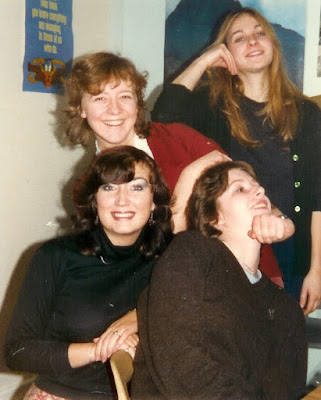
1981: One of these flatmates inspired "part of" Carol Hill in the WISE Enquiries Agency Mysteries


So, yes, people I know do, in and of themselves, inspire my characters. What about their life stories? To a certain extent, yes. But I have often found that truth is far stranger than any fiction that would prove acceptable to readers, so I quite often have to “tone it down” or leave out parts of lives, because readers just wouldn’t “buy it”. For example, I have a friend who is a total “disaster magnet”. Maybe you know someone like that too? Someone whose entire life has been beset by truly dreadful things – most of which have been beyond their control. People DO get struck by lightning more than once in their life. For me the fascination is why they ended up in circumstances where that was even a possibility…and by that thread often hangs a story about poor or at least questionable choices…

Another thing I have done is to use some real names of people, with their blessing...though sometimes with a funny outcome. If you've read THE CORPSE WITH THE PLATINUM HAIR you'll have met Arthur Sauber and his wife Joan. Here I am with the real Arthur and Joan Sauber; they thought it was hilarious that the character bearing Arthur's name was the finance controller for a Vegas casino, as neither of them has ever placed a bet in their lives!
With Joan & Arthur Sauber in 2008
I was inspired by a few real people, and a real place, when I wrote THE WRONG BOY...but I cannot tell you about the people. At. All. So here's the real place - Rhossili in Gower, near Swansea. This is the original of the photo used on the cover of the book.


Photo by Emma Mugford
Please consider reading my books? You can find out more about me and my work here: http://www.cathyace.com/