Dandy Gilver is a unenthusiastic wife, a half-hearted mother, upper-class, a city-lover, relies on sevants to do everything from cooking her meals to choosing her clothes. I'm married to my best friend, don't have kids, working-class, country-bumpkin, grow some of my own food but cook all of it from scratch and am usually wearing something from at least a thrift store if not a dumpster.
And here's the kicker. She loves dogs and I love cats.
Oh and she hasn't had the action-packed hair-colour past that I've been through either.
Safe to say Dandy's not me. But does my stand-alone character, Opal Jones, share my interests?
The whole of As She Left It takes place in a few pretty fraught weeks in Opal's life, with not much time for macrame and yoga. And it's just occurred to me that I don't think she switches on a radio or telly or plays a single track of music in the entire book. She does give up on Ikea as a source of furniture and goes to a charity shop instead, so with a bit of a stretch I suppose you could say we're both bargain-hunters. Or mean anyway.
I was just talking to Laura Disilverio (click) about this at Left Coast Crime at the weekend; apparetly ballroom dancing is like dog vs cat as far as characters and authors go. Laura has the hardest time persuading readers of her dancing mystery series (most recent Homicide Hustle) that she's - whisper - making it all up, and not fitting the writing in around travel to professional tournaments in the ballroom world or at least the daily grind of foxtrot lessons in her studio.
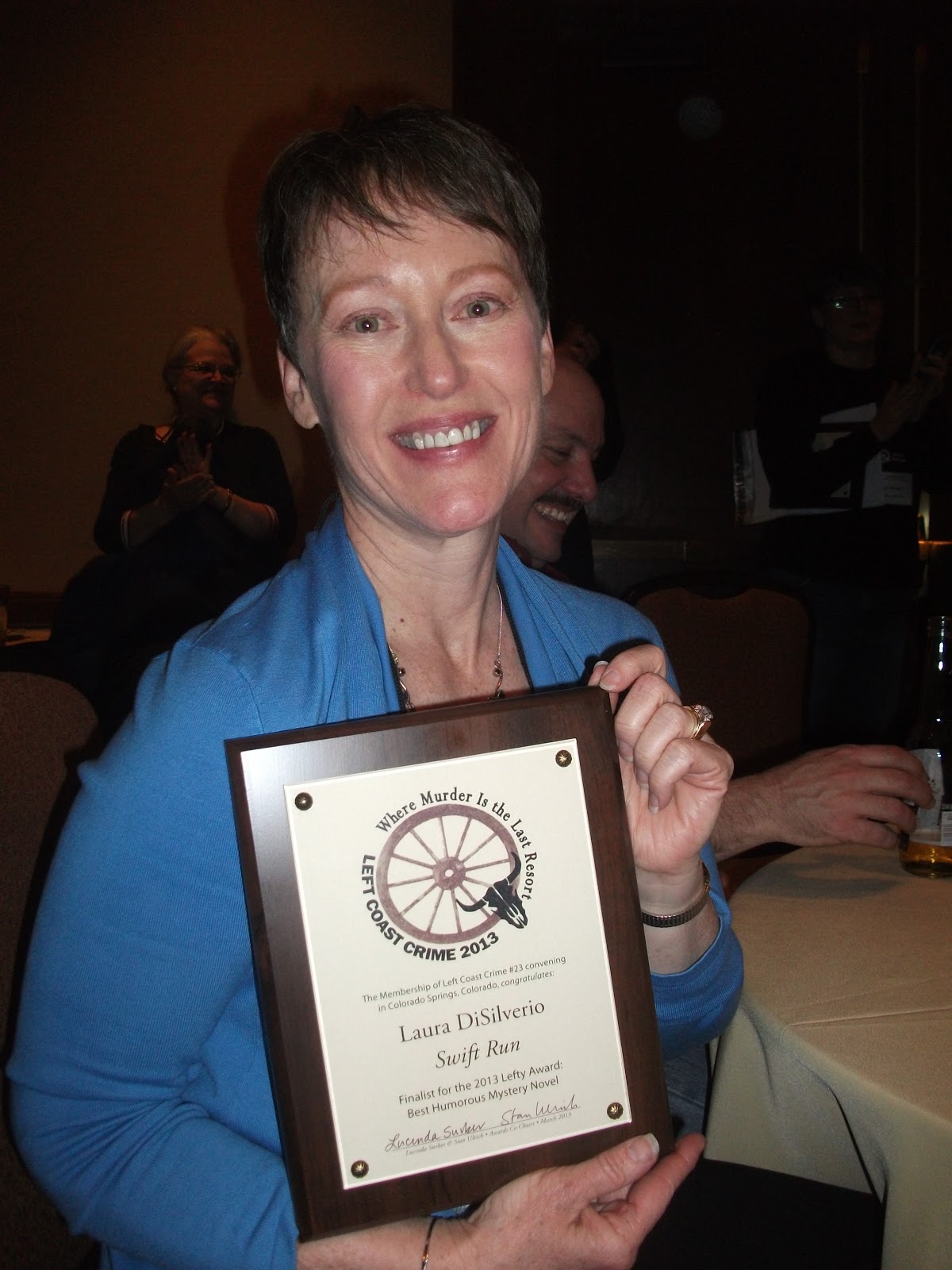
But then I have my troubles in separating writer and characters too. My friend Jess Lourey (click) writes the gripping yet hilarious murder-by-the-month series (most recently December Dread) and in my head the heroine, Mira, is Jessie, so much so that when Jessie talks about her dog, I feel bad that she's showing such favouritism and hardly mentioning her cat. Her fictional cat. Dammit, her protagonist's fictional cat!
The funniest example of a writer herself not being able to separate her interests from her characters is another friend of mine Cathy Cassidy, (click) a UK children's writer and a vegetarian of many years' standing. Cathy just can't stand to write a meat-eating protagonist. Her books are full of kids and adults from all walks of life in all sorts of extreme situations, all ordering mushrooms and chips in British chippies, or eating quorn sausages and quiche. It's so much a moral issue for Cathy that she couldn't have a sympathetic character chomping into a chicken leg for the Pullitzer prize.
It makes me love her (and miss her) but it's a good thing she doesn't write mysteries; we'd all know in the first chapter whodunnit. Him over there with the bacon cheeseburger. Call the cops.
Thursday, March 28, 2013
Thursday, March 14, 2013
Superstition is the way.
I was going to say I don't have any writing rituals that would count as superstitions; all I have are sensible working practices. But, while looking around my office for examples, I noticed my pens.
I use blue Bics. Bic Cristals. But that's not a ritual, right? That's a preference. They're a design classic, for a start - evidence: they're in MOMA. Also, they don't leak like Hi-techpoints and other fancy-schmancy pens when you take them on a plane. Finally, they smell like pens should. Not that I sniff my pens.
But the reason they caught my eye is this:
When I say I use blue Bics, I really mean I like to have a full pen-holder of them, as well as the one I'm using, one in my bag and a packet of new ones in my desk drawer. And it gets worse. The three back slots in the pen-holder - a sea-washed brick picked up on Prestwick beach in the late eighties - contain a red Bic for corrections (under the Dandy Gilver fingerpuppet), a black Bic for occasional scanned government forms (under the Bury Her Deep gravestone) and a pencil (under the Bunty Dalmatian).
Now, the black-pen-under-blackish-gravestone and red-pen-under-red-Dandy look either neatly orgnanised or slightly anal, depending on your point of view, but at this point you probably think the pencil-under-Dalmatian is completely random. A devil-may-care detail that balances out the rest of it. Not so:
It's really quite a Dalmatiany pencil under there.
So. Writing superstitions. Hello, my name is Catriona and although I can write in my office, by the fireside, on the porch, in bed, in coffee-shops, in the Ethel Merman quiet room of the Davis Public Library, in departure lounges, hotel rooms and on planes, I can only do it if I know that on my desk there are five blue Bic Cristals in their slots against a backdrop of red, black and pencil finger puppets. Don't judge me.
I use blue Bics. Bic Cristals. But that's not a ritual, right? That's a preference. They're a design classic, for a start - evidence: they're in MOMA. Also, they don't leak like Hi-techpoints and other fancy-schmancy pens when you take them on a plane. Finally, they smell like pens should. Not that I sniff my pens.
But the reason they caught my eye is this:
When I say I use blue Bics, I really mean I like to have a full pen-holder of them, as well as the one I'm using, one in my bag and a packet of new ones in my desk drawer. And it gets worse. The three back slots in the pen-holder - a sea-washed brick picked up on Prestwick beach in the late eighties - contain a red Bic for corrections (under the Dandy Gilver fingerpuppet), a black Bic for occasional scanned government forms (under the Bury Her Deep gravestone) and a pencil (under the Bunty Dalmatian).
Now, the black-pen-under-blackish-gravestone and red-pen-under-red-Dandy look either neatly orgnanised or slightly anal, depending on your point of view, but at this point you probably think the pencil-under-Dalmatian is completely random. A devil-may-care detail that balances out the rest of it. Not so:
It's really quite a Dalmatiany pencil under there.
So. Writing superstitions. Hello, my name is Catriona and although I can write in my office, by the fireside, on the porch, in bed, in coffee-shops, in the Ethel Merman quiet room of the Davis Public Library, in departure lounges, hotel rooms and on planes, I can only do it if I know that on my desk there are five blue Bic Cristals in their slots against a backdrop of red, black and pencil finger puppets. Don't judge me.
Thursday, February 28, 2013
Dandy Gilver and The Cannibal Kitten Smasher?
Perhaps not. Writing a series of detective stories about an amateur sleuth in the 1920s keeps me well away from the bit of the genre where we all start to wonder where it's going to end. The tone would be a joke; worse than a sado-masochism series by an an author who couldn't use plain terms for genitals. No, wait! Bad example. But you know what I mean.
Which is not to say I've never had complaints. There was one time when someone at a reading said - in very schoolmarmish tones - that she hoped I wasn't going to be poking fun at religion again. AGAIN? It turns out she didn't like the line in Bury Her Deep (DG3) where I said "The Church of Scotland gets by on a little doctrine and a lot of scones." I persuaded her that it was affectionately meant and we parted friends.
I imagine that most people's threshold is set a wee bit higher than that, but we've all got one. I wouldn't have a problem with serial killers if the muse ever dragged me that way; they're so vanishingly rare in real life and so effulgently ubiquitous in fiction that (to me) they've become almost as cartoonish as zombies and vampires.
[TRIGGER]
But if the muse started whispering a tale of serial rape in my ear I'd sing "La-la-la can't hear you" until she shut up again. Partly that's because serial rapists are not rare and their victims are all around us. Hence my trigger warning. And likewise paedophila. Empathy for survivors who might be kicked back to their worst moments by my writing would always stop me dead: there's a world of difference between being "offended" and being hurt.
Serious stuff. So to finish, I'm sharing a video (click here) that always makes me laugh: three people, extremely offended. Or as they would have it . . .
Which is not to say I've never had complaints. There was one time when someone at a reading said - in very schoolmarmish tones - that she hoped I wasn't going to be poking fun at religion again. AGAIN? It turns out she didn't like the line in Bury Her Deep (DG3) where I said "The Church of Scotland gets by on a little doctrine and a lot of scones." I persuaded her that it was affectionately meant and we parted friends.
I imagine that most people's threshold is set a wee bit higher than that, but we've all got one. I wouldn't have a problem with serial killers if the muse ever dragged me that way; they're so vanishingly rare in real life and so effulgently ubiquitous in fiction that (to me) they've become almost as cartoonish as zombies and vampires.
[TRIGGER]
But if the muse started whispering a tale of serial rape in my ear I'd sing "La-la-la can't hear you" until she shut up again. Partly that's because serial rapists are not rare and their victims are all around us. Hence my trigger warning. And likewise paedophila. Empathy for survivors who might be kicked back to their worst moments by my writing would always stop me dead: there's a world of difference between being "offended" and being hurt.
Serious stuff. So to finish, I'm sharing a video (click here) that always makes me laugh: three people, extremely offended. Or as they would have it . . .
Thursday, February 14, 2013
Mix thoroughly and bake for fourteen years
I've never written a short story. See you in two weeks.
Kidding. Just because I've never written a short doesn't mean I've never come up with plots that would be perfect for them. But when I do, I call the idea a sub-plot and lay it aside until another one comes along that complements it. Then both of them are set aside until a third spark ignites and maybe a fourth. Then there's a big sprawling complicated cast of thousands novel ready to go.
The master of this kind of of labyrinthine plotting in the mystery genre is Kate Atkinson (if you haven't read Case Histories and its three sequels you're in for a treat and three more treats to follow).
I'm no Kate Atkinson, but my June release, As She Left It, is the result of years of sub-plot collection.
On summer holiday in France in the mid-90s, driving to the boulangerie one morning, I had an idea about an elderly jazz trumpeter with pneumonia who needs a stand-in. This character - Fishbo Gordon - is in the book. In my head, in fact, the story was called "Fishbo's Puffer" for years.
Then in about 2005 I saw a magnificent bed in an antique shop in Castle Douglas and bought it:
It was a bed with a puzzle, a puzzle which - refracted through the mind of a mystery writer - became a secret, a secret which became another sub-plot in what was now a third of a novel.
A year later, in Leeds, on an all-girls weekend, two friends and I met a little old lady wandering around in the street (and wandering around in a gently mythical version of reality too), took her home and contacted her carers. It was a tiny incident and would have made an effective short story but I don't write short stories. So this little old lady joined the jazz trumpeter and the bed-with-a-secret and the book was halfway to being afloat.
That weekend gave me the setting too; As She Left It is set in a short dead-end street of old red-brick houses in Leeds; in my friend Diane Nelson's house, in fact, where we were staying that weekend. The wonderful design department at Midnight Ink captured the mood of the story perfectly with this jacket:
but I promised Diane that I'd show the real street too - much less gothic and grim.
In 2009, I was writing Dandy Gilver and not thinking about Fishbo at all, but one day in Tesco, watching the online shoppers filling trolleys with groceries for strangers, I got to thinking about how much you could tell about someone's life if you did their shopping and how those shoppers must live somewhere local and I wondered if they did their neighbours' shopping for them and what if they worked out that their neighbours were . . .
Another short-story-sized plotlet that was modern and dark went into the cauldron and now my protagonist had a job as well as a house and I had four linked tales to tell. It was time to start writing and I felt more than usually sure that I knew where this one was going
Imagine my surprise when, a little way into the first draft, the red bricks of that dead-end street started whispering a completely new story in my ear. It turns out, after years of preparation, that the main plot of As She Left It is none of the above. But the bed, the trumpeter, the little old lady and the neighbour's secret are all in there too and I've still never written a short story.
Kidding. Just because I've never written a short doesn't mean I've never come up with plots that would be perfect for them. But when I do, I call the idea a sub-plot and lay it aside until another one comes along that complements it. Then both of them are set aside until a third spark ignites and maybe a fourth. Then there's a big sprawling complicated cast of thousands novel ready to go.
The master of this kind of of labyrinthine plotting in the mystery genre is Kate Atkinson (if you haven't read Case Histories and its three sequels you're in for a treat and three more treats to follow).
On summer holiday in France in the mid-90s, driving to the boulangerie one morning, I had an idea about an elderly jazz trumpeter with pneumonia who needs a stand-in. This character - Fishbo Gordon - is in the book. In my head, in fact, the story was called "Fishbo's Puffer" for years.
Then in about 2005 I saw a magnificent bed in an antique shop in Castle Douglas and bought it:
It was a bed with a puzzle, a puzzle which - refracted through the mind of a mystery writer - became a secret, a secret which became another sub-plot in what was now a third of a novel.
A year later, in Leeds, on an all-girls weekend, two friends and I met a little old lady wandering around in the street (and wandering around in a gently mythical version of reality too), took her home and contacted her carers. It was a tiny incident and would have made an effective short story but I don't write short stories. So this little old lady joined the jazz trumpeter and the bed-with-a-secret and the book was halfway to being afloat.
That weekend gave me the setting too; As She Left It is set in a short dead-end street of old red-brick houses in Leeds; in my friend Diane Nelson's house, in fact, where we were staying that weekend. The wonderful design department at Midnight Ink captured the mood of the story perfectly with this jacket:
but I promised Diane that I'd show the real street too - much less gothic and grim.
In 2009, I was writing Dandy Gilver and not thinking about Fishbo at all, but one day in Tesco, watching the online shoppers filling trolleys with groceries for strangers, I got to thinking about how much you could tell about someone's life if you did their shopping and how those shoppers must live somewhere local and I wondered if they did their neighbours' shopping for them and what if they worked out that their neighbours were . . .
Another short-story-sized plotlet that was modern and dark went into the cauldron and now my protagonist had a job as well as a house and I had four linked tales to tell. It was time to start writing and I felt more than usually sure that I knew where this one was going
Imagine my surprise when, a little way into the first draft, the red bricks of that dead-end street started whispering a completely new story in my ear. It turns out, after years of preparation, that the main plot of As She Left It is none of the above. But the bed, the trumpeter, the little old lady and the neighbour's secret are all in there too and I've still never written a short story.
Thursday, January 31, 2013
It's not ranting if somebody asked you.
Okay, first, Elmore Leonard on said. I agree. In spades. In the bucket of biggest available backhoe. With exceptions. I wouldn't turn to see if the ghost of Henry Fowler was creeping up behind my desk-chair if I wrote shouted, whispered, called back up the cliff towards where she was waiting, asked or answered for example. But said is best and order a bigger backhoe for how much I agree about modifying it with adverbs. Except for crisply. I just love this, although I never wrote it myself when it was available. (It's copyrighted now for Julian Fellowes to use in Violet, the Dowager Countess of Grantham's stage directions (since it's how she says everything.))
Now for my personal top three unbreakable rules. I apologise in advance for seething.
3. sneaky attributive adjectives bundled in to wreck orderly action sentences instead of rolling up their sleeves, going predicative and getting clauses or even sentences of their own. For example:
2. This is about description too. No exceptions, no contextual considerations, just no. Never - never - have a character look at themselves in a mirror early on in the first chapter and describe their looks. Don't. When was the last time you looked in a mirror and thought to yourself that your eyes were brown and your nose was small and straight? Don't ever. If someone you knew sighed in exasperation at that annoyingly wayward curl and tucked it behind her ear with a rueful grin, wouldn't you want to punch her in the neck? Just don't.
1. This is my tip-top of all time writing no-no (and the reason I used Fowler instead of Strunk and White earlier). It's rude, it's wrong, it's stupid, it's generic he. It's the daft idea that you can use he, him and his to talk about all of humanity: e.g. Man breastfeeds his young. Strunk and White reckoned he or she is clumsy, singular they is illiterate and so generic he is the only choice left and, besides, only silly-billies will complain.
Well, call me demanding, but I'll take my writing advice from someone who's not flummoxed by an evolving pronoun system. See, the silliest, most ignorant thing about saying number agreement trumps gender agreement . . . is that number agreement has shifted once before and the sky didn't fall. You used to be plural; the singular was thou. You was also more polite; thou was more intimate. Politeness won. You became singular/plural and thou dropped out of use.
I can just imagine the mediaeval grammar mavens reaching for the smelling salts. Woah! Changes in the pronoun system! Number distinction lost! You-ing social inferiors instead of thou-ing them! Will English survive? It will. It did. And it will again. Anyway, we've got y'all, youse and y'guys coming along to do some of the plural grunt work again. (I wonder if Strunk and White would have welcomed them.)
Rant over.
3. sneaky attributive adjectives bundled in to wreck orderly action sentences instead of rolling up their sleeves, going predicative and getting clauses or even sentences of their own. For example:
- She hit her head on the floor when she fell (orderly action sentence).
- She hit her permed and highlighted head on the polished hardwood floor as she fell (now wrecked with sneaky attributive adjectives).
- Her head looked softened by her perm and was golden with highlights but hit the floor like a rock anyway as she fell, bouncing off the hardwood and leaving a smear of blood on its polished surface.
2. This is about description too. No exceptions, no contextual considerations, just no. Never - never - have a character look at themselves in a mirror early on in the first chapter and describe their looks. Don't. When was the last time you looked in a mirror and thought to yourself that your eyes were brown and your nose was small and straight? Don't ever. If someone you knew sighed in exasperation at that annoyingly wayward curl and tucked it behind her ear with a rueful grin, wouldn't you want to punch her in the neck? Just don't.
1. This is my tip-top of all time writing no-no (and the reason I used Fowler instead of Strunk and White earlier). It's rude, it's wrong, it's stupid, it's generic he. It's the daft idea that you can use he, him and his to talk about all of humanity: e.g. Man breastfeeds his young. Strunk and White reckoned he or she is clumsy, singular they is illiterate and so generic he is the only choice left and, besides, only silly-billies will complain.
Well, call me demanding, but I'll take my writing advice from someone who's not flummoxed by an evolving pronoun system. See, the silliest, most ignorant thing about saying number agreement trumps gender agreement . . . is that number agreement has shifted once before and the sky didn't fall. You used to be plural; the singular was thou. You was also more polite; thou was more intimate. Politeness won. You became singular/plural and thou dropped out of use.
I can just imagine the mediaeval grammar mavens reaching for the smelling salts. Woah! Changes in the pronoun system! Number distinction lost! You-ing social inferiors instead of thou-ing them! Will English survive? It will. It did. And it will again. Anyway, we've got y'all, youse and y'guys coming along to do some of the plural grunt work again. (I wonder if Strunk and White would have welcomed them.)
Rant over.
Thursday, January 17, 2013
Kisses and cocktails and a little light jazz.
How much sex and violence do I weave in? Are you accusing me of writing crafting cozies? I couldn't weave with a gun to my head. Or crochet. Or knit. I've often said that the greatest technological leap in the evolution of modern humans happened the day someone looked at a sheep -a sheep! - and said "I've had a brilliant idea. Why don't we . . ."
Some of my friends on the other hand . . .
Okay, enough willful misunderstanding of the question. Honestly? When it comes to the Dandy Gilver mysteries, very little. These are my hommage to the golden age and I don't put anything in them that you wouldn't have been found in Dorothy L Sayers, Margery Allingham or Josephine Tey (although I'm not sure I ever have managed a tone as dark, bleak and just plain nasty as some of Allingham's - how these ever got the cozy title, I'll never know).
So, it's an extra constriction, to be sure, along with the requirement for an early murder, a late solution, and some red herrings, but if we minded constriction we would hardly be writing in this genre, would we? The compensation for me in the Dandy stories is that no one has a mobile phone, there is no forensics and I never have to write one of those desk-bound google scenes. When Dandy Gilver and her sidekick Alec Osborne dig for background they do it in dusty church vestries or the mahogany-lined offices of shipping agents or what have you, with scope for all manner of Dickensian walk-ons.
But now I've started writing modern stand-alone suspense too. In the first one, As She Left It the story didn't throw up much in the way of either graphic sex or explicit violence. It was a relief not to have to keep checking the vocabulary in the Shorter Oxford for anachronisms, mind you, and I may have gone slightly F-tastic with the curses just because, for once, there was nothing stopping me.
Okay, enough willful misunderstanding of the question. Honestly? When it comes to the Dandy Gilver mysteries, very little. These are my hommage to the golden age and I don't put anything in them that you wouldn't have been found in Dorothy L Sayers, Margery Allingham or Josephine Tey (although I'm not sure I ever have managed a tone as dark, bleak and just plain nasty as some of Allingham's - how these ever got the cozy title, I'll never know).
So, it's an extra constriction, to be sure, along with the requirement for an early murder, a late solution, and some red herrings, but if we minded constriction we would hardly be writing in this genre, would we? The compensation for me in the Dandy stories is that no one has a mobile phone, there is no forensics and I never have to write one of those desk-bound google scenes. When Dandy Gilver and her sidekick Alec Osborne dig for background they do it in dusty church vestries or the mahogany-lined offices of shipping agents or what have you, with scope for all manner of Dickensian walk-ons.
But now I've started writing modern stand-alone suspense too. In the first one, As She Left It the story didn't throw up much in the way of either graphic sex or explicit violence. It was a relief not to have to keep checking the vocabulary in the Shorter Oxford for anachronisms, mind you, and I may have gone slightly F-tastic with the curses just because, for once, there was nothing stopping me.
In the new one (working title The Day She Died) the story does involve sex and violence and I've followed the characters into the bedroom and out again as well as watching the bones shatter and the blood drip from quite close-up too. It's still being edited. Maybe some of the squelching (sexual and violent) will end up on the cutting room floor. If so, it'll be because, as Chris said yesterday, the story is better without it. We'll see.
Thursday, December 20, 2012
Who's a Friend of the Big Bad Wolf?
What an interesting question. I managed to avoid nearly an hour of horrible first draft production, staring out of the window, thinking about it.
And the answer is . . . well, sort of.
I write seatopants-style so very often the one I thought dunnit turns out not to have in the end and I suppose you could say switching a character from "murderer" to "non-murderer" is a bit of a moral upgrade.
One time I really did turn someone from a moustache-twirling, cape-swirling baddy (bwah-hah-hah, all that) to a bunny-hugging (well, bunny-shooting since it was the 1920s and this person was a countrydweller but let's not quibble) poppet. But I did it after the character was dead so there wasn't much in it for them.
Dandy Gilver's husband, Hugh, was pretty much a stuffed shirt in the first book or two, but as I've written about his childhood, his reaction to his wife being in danger, his fears for his teenage sons as the clouds of war begin to gather, I've grown fonder of him and developed a grudging respect. In the last two books I've given him a moment of glory to off-set the fact that I still laugh at his fossilised take on the world.
And actually,as I write this I remember that a few years ago, in a different frame of mind, and under a pseudonym (although not very far under: it was Catriona McCloud) I wrote a slightly cross-genre, tricky to decribe and therefore tricky to keep in print, puzzle novel called Straight Up which had a massive shift along the scale of sympathy for one of the characters.
I'm being cryptic because tis is the season and so I've decided to give a couple of copies of Straight Up away (should anyone want one). In short, if you'd care to read a crime/road/buddy caper about lies, fibs, whoppers, tall tales and total bull in which a depressed florist takes on Hollywood and wins (kind of), just comment and I'll draw names at the end of today. (With regret, US only.)
Whatever you're reading on the days off next week, though, have a wonderful feast/rest/holiday, won't you.
And the answer is . . . well, sort of.
I write seatopants-style so very often the one I thought dunnit turns out not to have in the end and I suppose you could say switching a character from "murderer" to "non-murderer" is a bit of a moral upgrade.
One time I really did turn someone from a moustache-twirling, cape-swirling baddy (bwah-hah-hah, all that) to a bunny-hugging (well, bunny-shooting since it was the 1920s and this person was a countrydweller but let's not quibble) poppet. But I did it after the character was dead so there wasn't much in it for them.
Usually though, it's a question of ever-increasing complexity. I can't decide whether it's a drawback or a side-benefit of writing a series that minor comic characters grow and deepen over the course of a few books so that you can't use them for cheap laughs any more.
Dandy Gilver's husband, Hugh, was pretty much a stuffed shirt in the first book or two, but as I've written about his childhood, his reaction to his wife being in danger, his fears for his teenage sons as the clouds of war begin to gather, I've grown fonder of him and developed a grudging respect. In the last two books I've given him a moment of glory to off-set the fact that I still laugh at his fossilised take on the world.
And actually,as I write this I remember that a few years ago, in a different frame of mind, and under a pseudonym (although not very far under: it was Catriona McCloud) I wrote a slightly cross-genre, tricky to decribe and therefore tricky to keep in print, puzzle novel called Straight Up which had a massive shift along the scale of sympathy for one of the characters.
I'm being cryptic because tis is the season and so I've decided to give a couple of copies of Straight Up away (should anyone want one). In short, if you'd care to read a crime/road/buddy caper about lies, fibs, whoppers, tall tales and total bull in which a depressed florist takes on Hollywood and wins (kind of), just comment and I'll draw names at the end of today. (With regret, US only.)
Whatever you're reading on the days off next week, though, have a wonderful feast/rest/holiday, won't you.
Thursday, December 6, 2012
Imaginary Friends
“How much do you know about a
character’s back story before you write word one? Or do you just wing it?”
I don’t know where any of them were born, but I know they crossed paths in their youth, so I’ll need to sort that out too. I know the marital status of one, have got a bit of a clue (the name of an ex-girlfriend) about another, have got not the first clue about the third. If his wife turns up while I’m writing, I’ll know then. I do know what jobs they do; none of them is a cop, detective, sleuth or pathologist.
Any question along the lines
of “How much careful, painstaking, industrious _____ do you do or do you just _____?” is always going to go
the same way with me. “Just” is the
operative word.
Some call it organic; some call it
shambolic; I call it the Benny Hill method, as I’ve said before. Brakes off at the top of the hill and go
(bathtub optional).
And it’s so organic/shambolic, the
bathtub goes whizzing down so fast, that very often I can’t answer questions
about method at all. I really don’t
know.
At the moment, however, it’s all quite
fresh in my mind because I’m 1500 words into a new story, not part of my series. So since a week past Monday I’ve invented three main characters and
thirteen minor ones.
Here’s what I know about the big
three, five pages in.
I know their first and last names, no
idea what middle names if any. I know
roughly how old they are but I’ll need a perpetual calendar of the 20th
century at some point to work it out properly.
I know where one of them lives in precise detail, floor plan of her
house, all that. I know what city the
other two live in and that one has a house and one a flat. I’ll need to go out for a stroll with
Google’s wee orange man later. I don’t know where any of them were born, but I know they crossed paths in their youth, so I’ll need to sort that out too. I know the marital status of one, have got a bit of a clue (the name of an ex-girlfriend) about another, have got not the first clue about the third. If his wife turns up while I’m writing, I’ll know then. I do know what jobs they do; none of them is a cop, detective, sleuth or pathologist.
How did I find out? By writing their evolving names over and over
again on sheets of scrap paper and thinking about them. I’m riffling through the heap of paper now
and it really is just names. This is the
first time I’ve realised that.
One final thing: I know exactly what
they look like (found out by repeatedly writing their names (does this sound as
bonkers as it feels to me?)) and by about 30,000 words it’ll start to annoy me
that I’ve never seen them. Then I go
looking for pictures of them. Since this
is a modern story I’ll trawl the internet, magazines, newspapers, yearbooks, anywhere
I can think of, until I find them. (When
I’m writing Dandy Gilver, set in the 1920s, I have to use old photos. )
And I’ll know them when I see them. I’ll recognise them. Then I’ll photocopy or print out the
pictures, staple them to pieces of card and prop them up on my desk while we
all write the rest of the story together.
Writing isn’t lonely if you’re not actually alone.
Cx
Thursday, November 22, 2012
"I've prepared and handled raw food?"
. . . as Goldie Hawn says in bewildered tones, in Overboard, that towering piece of cinematic majesty.
Dandy Gilver would be much the same. Cook, to Dandy is a noun. Cook, is Mrs Tilling, and you can find some of her recipes below stairs on the Dandy Gilver website.
As for giving
thanks? “My dear, I don’t think so, do
you? One shouldn’t gush with emotion in
public.”
Not
me. I love Thanksgiving. I don’t really get it, but I love it. It’s a four-day weekend and there’s lots of
food. (For a hilarious take on this
holiday from a UK point of view, see Simon Wood, who blogged about it yesterday.)
This is
my third since moving here. First time out I was on Martinelli’s
duty. Impossible to get wrong. Last year I served my apprenticeship on
appetisers. Possible to get wrong, but
no one cares because Thanksgiving dinner is all about the main course and the
truckload of sweet things to follow.
But this
year? Oh-ho, this year I have been
promoted to – drum roll – green bean casserole.One with fresh beans, crimini mushrooms, sour cream, onions that I’ll caramelise in my cast-iron frying pan for two hours with nutmeg and garlic, and chicken stock that I made with three chicken carcasses and handfuls of herbs and which is in my freezer in small batches against just this eventuality.
And the
other one. You know the one I mean.
Now, I
feel very affectionate towards the idea of mixing together products and calling
it cooking – what a friend on Facebook this week called “the Midwestern Lutheran
church-basement pot-luck tradition”.
Some of my happiest evenings in Scotland ended with an after-dinner game
using the Amish Barn Cookbook I brought home from a winter in Ohio.
No one
ever guessed the seven ingredients in Amish waldorf salad. Foodie friends would say – very airily – “Well,
celery, apples and walnuts. Let’s get
them out of the way.” And I’d say, “Nope.” Endless fun.
That
Thanksgiving in Ohio was also the time Neil and I wondered if the stores were
open the day after the holiday and drove out to a mall to see. It seemed quite busy. We laugh about it now.
Happy
Thanksgiving, everyone.
Wednesday, November 7, 2012
What, no sex?
“How much of your character's political and religious belief do you put in a book or do you shy away from those topics?” was the question and it’s a good one. What’s amazing is how quickly that question – whenever it’s asked – becomes “How much of your political ideology and religious fervour should you cram down a reader’s throat like a shift-worker on a foie-gras-goose farm?”
As I pointed out, commenting on Reece’s posting on Monday (before I realised I should keep my mouth shut so’s I’d have something to say on Thursday), no one ever thinks having a character kill their entire family with a nutmeg grater is a suggestion for how readers should live their real lives.
Well, anyway, I've got it easy. Dandy Gilver’s political beliefs – the unthinking Toryism of the Brtish upper class in the 1920s – and her religious beliefs – the unthinking high-church Christianity of the British upper class in the 1920s – are not mine to cram.
Not everyone gets that, mind you. In pre-facebook days, once or twice a reading group or lunch club invited that delightful Dandy Gilver’s fragrant creator to speak and were horrified to have the likes of me roll up.
And once I was accused of being an apologist for social stratification because I write about “toffs coming along and solving the problems of the plebs.” Needless to say my accuser hadn’t read any of my books.
To tell the truth, drip-drip-drip bias in fiction bothers me as much as it did that angry if uninformed class-warrior. Three examples:
In Enid Blyton, the rich kids were always taller, stronger and braver than Edgar the cook’s son, who always snivelled and went to pieces at the first whiff of danger. Also they were clean-limbed. What does that even mean? What would someone look like who was dirty-limbed?
I had to stop reading Jonathon Kellerman’s The Butcher’s Theatre because all the Israelis were tall, strong and brave (and probably clean-limbed too) and all the Palestinians were low-down cheating scalliwags. Who smelled bad – yes, really.
Every week when the X-Files was on I’d think: “Come on. Just once. Let the scientific explanation be right. Just one week and then back to all the spookety-woo next time.” Not one single time did Scully ever carry the day for reason, though. In this case, I watched every episode in every season, just to make sure.
So, in conclusion, politics and relgious belief are just another part of a character’s make-up to me and if they’re key they need to be depicted with the same reckless devotion to the demands of the story as everything else. But when an author builds a world, you don’t half get a good look at the builder too.
Wednesday, October 24, 2012
Curtains
And when it's time to ring them down.
When I got a publication deal for the first book in a detective series - or rather when I got a publication deal for a detective novel and was asked whether it was a series (see below) - my agent told me loud and clear that I had to write at least six.
(Below. When an interested publisher asks you if you see it becoming a series, it's the crimewriter equivalent of a Hollywood casting director asking if you can ride horses. You say yes without missing a beat and work out how later.)
Why six? Because, my agent told me, that's how many episodes there are in a serving of BBC Sunday night telly. (Do US agents tell new American writers to shoot for twenty two?)
It was a bit of a joke to my friends and family, but then fan me flat if, just after No. 6 came out, the BBC didn't go and option it. I'd mess that neat bit of plotting up with a problem or two if I was in charge. I'm glad I'm not.
So the first half of my answer to the question of when to retire a series character is not until you've written six (if it's British and/or has any kind of bonnets or shawls about it anyway.)
How about the other end? How long can you rumble on?
I wouldn't want to end up like Agatha Christie. In Dead Man's Folly (1956), thirty six years after she introduced her Belgian detective Hercule Poirot, she introduced the character of Ariadne Oliver, a writer of detective stories, who is pig sick of her Finnish detective, Sven Hjerson and wishes he was dead or at least not Finnish anyway.
I started Dandy Gilver off in 1922 and I'm just editing the 1930 story now. I've got a great idea for 1936, which looked a hilarious distance off when I started and now seems like it might be just round the corner. I've got a cracker for 1972 too. Dandy would be eighty six. Just a spring chicken compared to Poirot.
When I got a publication deal for the first book in a detective series - or rather when I got a publication deal for a detective novel and was asked whether it was a series (see below) - my agent told me loud and clear that I had to write at least six.
(Below. When an interested publisher asks you if you see it becoming a series, it's the crimewriter equivalent of a Hollywood casting director asking if you can ride horses. You say yes without missing a beat and work out how later.)
Why six? Because, my agent told me, that's how many episodes there are in a serving of BBC Sunday night telly. (Do US agents tell new American writers to shoot for twenty two?)
It was a bit of a joke to my friends and family, but then fan me flat if, just after No. 6 came out, the BBC didn't go and option it. I'd mess that neat bit of plotting up with a problem or two if I was in charge. I'm glad I'm not.
So the first half of my answer to the question of when to retire a series character is not until you've written six (if it's British and/or has any kind of bonnets or shawls about it anyway.)
How about the other end? How long can you rumble on?
I wouldn't want to end up like Agatha Christie. In Dead Man's Folly (1956), thirty six years after she introduced her Belgian detective Hercule Poirot, she introduced the character of Ariadne Oliver, a writer of detective stories, who is pig sick of her Finnish detective, Sven Hjerson and wishes he was dead or at least not Finnish anyway.
I started Dandy Gilver off in 1922 and I'm just editing the 1930 story now. I've got a great idea for 1936, which looked a hilarious distance off when I started and now seems like it might be just round the corner. I've got a cracker for 1972 too. Dandy would be eighty six. Just a spring chicken compared to Poirot.
Thursday, October 11, 2012
A Dandelion by one particular other name . . .
. . . is "pee-the-bed". Something that didn't occur to me until after I'd called my new series detective Dandelion (aka Dandy) Gilver, because her parents were devotees of William Morris and the Arts and Crafts movement, the type who'd think a wildflower was a wonderful thing.
Gilver, Dandy's name since she married Hugh Murdoch Cathellen Gilver, is believably Scottish (I know McGilvers and Gilverys) but not actionable, since I made it up out of GIL (Scots for servant) and VER (Latin for truth). So she's a dandy servant of truth i.e. good detective.
Be assured I don't go into that much depth and cunning for everyone. Ordinarily, I love naming characters precisely because flashy results for little effort are the best bit of writing.
So for the first names - what Dandy in Scotland in the 1920s would call Christian names - I use Naming Baby by Eugene Stone, a fine little volume inherited from my grandmother after she used it (presumably) to come up with James,Walter, Peter, Annie and Minnie.
For what I call second names, US speakers call last names and Dandy would call surnames, I used to flip through the weekly Galloway News. There was much fun to be had with McSporrans and McHaggises, McGurks and McGoggs and McGilihooleys. I couldn't use them all, obviously; that many micks and macks would send readers cross-eyed, so the second names in the books are never an accurate reflection of what a batch of Scottish names would actually be. (Think California towns starting with San or Santa and you'll get the idea).
A related - if irrelevant - problem is that if I buy an address book outside Scotland it never has enough space under the Ms and I have to steal some of the N pages to cram in clan McPherson, clan-in-law McRoberts and all my McKenzie, McKie, McLean, MacDougall, MacKay and McKinnon pals. It must be the same in Ireland with Os.
These days I do it online. There are no fewer daft Scottish names but there is always the danger of finding yourself, two hours later, deep in the bowels of Youtube, watching a cat stuck in an urn.
The most fun I ever had naming characters was in a circus setting for The Winter Ground: Topsy Turvey the acrobat, Tiny Truman the dwarf clown and the flying Prebrezhenskys, a Risley act.
Tiny Truman was named after what was called, at the head of a paragraph on the Finger Lakes in the Rough Guide to New York State, Tiny Trumansburg. I know the town was named after the president and the guide was commenting on its size, but I loved the idea of a big town named after someone called Tiny.
The most frustrating bit of naming characters is that, in being realistic, you have to ignore endless real-life examples just too outlandish to appear in fiction: I used to have a colleague called Zip Dominion; a mature student whose parents, in the 1950s, saw no reason not to call her Gay Cocks (but get these feminist credentials - she didn't change it when she married!); the local indie bookshop in Davis is run by the magnificently monikered Alzeda Knickerbocker; or what about Madison Bumgarner of the Giants? (I'll tell you what about him - Go, As!) And I'll never forget the day I learned of Diana Ross's decision to grace her beautiful little girl with the fragrant . . . Chudney. Oy.
Let's finish off back in fiction; Chudney couldn't happen there.
My favourite fictional name of recent times is the hero of Daniel Friedman's stellar debut Don't Ever Get Old. He's a curmudgeonly octogenerian Memphis Jewish ex-detective and his name is Buck Shatz, which makes me laugh every time I see it. I'm just sophisticated that way.
Be assured I don't go into that much depth and cunning for everyone. Ordinarily, I love naming characters precisely because flashy results for little effort are the best bit of writing.
So for the first names - what Dandy in Scotland in the 1920s would call Christian names - I use Naming Baby by Eugene Stone, a fine little volume inherited from my grandmother after she used it (presumably) to come up with James,Walter, Peter, Annie and Minnie.
A related - if irrelevant - problem is that if I buy an address book outside Scotland it never has enough space under the Ms and I have to steal some of the N pages to cram in clan McPherson, clan-in-law McRoberts and all my McKenzie, McKie, McLean, MacDougall, MacKay and McKinnon pals. It must be the same in Ireland with Os.
These days I do it online. There are no fewer daft Scottish names but there is always the danger of finding yourself, two hours later, deep in the bowels of Youtube, watching a cat stuck in an urn.
The most fun I ever had naming characters was in a circus setting for The Winter Ground: Topsy Turvey the acrobat, Tiny Truman the dwarf clown and the flying Prebrezhenskys, a Risley act.
Tiny Truman was named after what was called, at the head of a paragraph on the Finger Lakes in the Rough Guide to New York State, Tiny Trumansburg. I know the town was named after the president and the guide was commenting on its size, but I loved the idea of a big town named after someone called Tiny.
The most frustrating bit of naming characters is that, in being realistic, you have to ignore endless real-life examples just too outlandish to appear in fiction: I used to have a colleague called Zip Dominion; a mature student whose parents, in the 1950s, saw no reason not to call her Gay Cocks (but get these feminist credentials - she didn't change it when she married!); the local indie bookshop in Davis is run by the magnificently monikered Alzeda Knickerbocker; or what about Madison Bumgarner of the Giants? (I'll tell you what about him - Go, As!) And I'll never forget the day I learned of Diana Ross's decision to grace her beautiful little girl with the fragrant . . . Chudney. Oy.
Let's finish off back in fiction; Chudney couldn't happen there.
My favourite fictional name of recent times is the hero of Daniel Friedman's stellar debut Don't Ever Get Old. He's a curmudgeonly octogenerian Memphis Jewish ex-detective and his name is Buck Shatz, which makes me laugh every time I see it. I'm just sophisticated that way.
Thursday, September 27, 2012
Broth by more than one cook?
by Catriona.
Hello, everyone. I'm delighted to be here and honoured to have been asked and since I'm oh so very much not one of the mehegamoths (how I wish that was actually a word) who can employ minions to "co-author" their books, I'm going take a bit of this first post to introduce myself.
But to stay on-topic for a wee while . . . I love some co-authored (with no scare quotes) books: PJ Tracey, the mother and daughter team behind the MONKEEWRENCH series; PJ Parrish, the sisters who gave us LOUIS KINCAID and JOE FRYE, and Nicci French, the husband and wife team (how will they manange to co-author after the inevitable divorce, is what I wonder) responsible for a slew of creepy stand-alones including the fabulous KILLING ME SOFTLY.
But as far as I know I've never read any "co-authored" by mehegamoth and minion books - although Joyce Carol Oates is pretty prolific and she's got that sinewy look of someone who could kill you with her pinkie - so you never know.
Would I do it? An ever-expanding universe of no. I write with my office door shut, locked and duct-taped round the edges. Never been in a critique group, never shown my first draft to anyone, never told anyone, including my agent and editor, what it's about until it's finished. Control freak? Until the first draft is chipped out of the ground, as his Kingness puts it, freakishly and controllingly so.
With one exception. Years ago my father told me he had an idea for a children's picture book, but thought I'd make a better job of writing it up than him so he was going to hand it over to me. I thought for a minute about employing the standard response I give my mother when she asks me for something: "What have you ever done for me?"
But, A. who could say no to either of these two and (ii) I'd never written a picture book and how hard could it be?
Quite hard. Mark Haddon, author of THE CURIOUS INCIDENT OF THE DOG IN THE NIGHT-TIME once said, in one of those endless snarkfests about whether writing for children is easier than writing for adults (nearly as bad as the one about whether genre fiction is as good as literary fiction) that only an idiot would say there's no skill difference between Ulysses and Here Comes Spot. But I found telling a story in thirty-two pages with no more than twenty words on each page a lot harder than knocking out a chapter of prose.
Maybe I shouldn't have had a societal breakdown arc, a heart-warming buddy arc and a climactic fire scene all in a seven-hundred-word story about talking buckets. You tell me.
It's as yet unpublished, after going into development at Usborne and never coming out again. It joins a radio sitcom that went into develpoment at the Comedy Store in the UK, and is still in there as far I know, and a monograph of my PhD that went into development at Routledge, painted itself the same colour as the wall behind it and stood very still for ten years until everyone had forgotten and stopped looking.
Development is a bad place for me.
But if mehegamothdom ever comes a-calling, and I turn into one of those lucky sods with publishers begging for their shopping lists to bring out as a Little Book of Groceries for the holiday season, I won't need minions to help me cash in. I've got four picture books all hot to trot and three sitcoms with treatments for the first season and scripts for episode one, as well as that page-turning PhD.
But I was supposed to be introducing myself. Recovering academic, born blonde (but a lot has happened since then), co-owner of the ugliest ranch-house ever built and twenty scruffy acres in northern California (people from home say: "Oooh, California!" with shining eyes, and I say: "Did you see Erin Brockovich? That was California.") cat-lover, Project Runway enthusiast, dumpster-divin' fool, novice cake-maker, master cake-eater. What else? Trek, Beatles, Spike (as opposed to Wars, Stones, Angel) and not even as high-brow as all that sounds, I'm sad to say.
Pleased to meet you.
Hello, everyone. I'm delighted to be here and honoured to have been asked and since I'm oh so very much not one of the mehegamoths (how I wish that was actually a word) who can employ minions to "co-author" their books, I'm going take a bit of this first post to introduce myself.
But to stay on-topic for a wee while . . . I love some co-authored (with no scare quotes) books: PJ Tracey, the mother and daughter team behind the MONKEEWRENCH series; PJ Parrish, the sisters who gave us LOUIS KINCAID and JOE FRYE, and Nicci French, the husband and wife team (how will they manange to co-author after the inevitable divorce, is what I wonder) responsible for a slew of creepy stand-alones including the fabulous KILLING ME SOFTLY.
But as far as I know I've never read any "co-authored" by mehegamoth and minion books - although Joyce Carol Oates is pretty prolific and she's got that sinewy look of someone who could kill you with her pinkie - so you never know.
Would I do it? An ever-expanding universe of no. I write with my office door shut, locked and duct-taped round the edges. Never been in a critique group, never shown my first draft to anyone, never told anyone, including my agent and editor, what it's about until it's finished. Control freak? Until the first draft is chipped out of the ground, as his Kingness puts it, freakishly and controllingly so.
With one exception. Years ago my father told me he had an idea for a children's picture book, but thought I'd make a better job of writing it up than him so he was going to hand it over to me. I thought for a minute about employing the standard response I give my mother when she asks me for something: "What have you ever done for me?"
But, A. who could say no to either of these two and (ii) I'd never written a picture book and how hard could it be?
Quite hard. Mark Haddon, author of THE CURIOUS INCIDENT OF THE DOG IN THE NIGHT-TIME once said, in one of those endless snarkfests about whether writing for children is easier than writing for adults (nearly as bad as the one about whether genre fiction is as good as literary fiction) that only an idiot would say there's no skill difference between Ulysses and Here Comes Spot. But I found telling a story in thirty-two pages with no more than twenty words on each page a lot harder than knocking out a chapter of prose.
Maybe I shouldn't have had a societal breakdown arc, a heart-warming buddy arc and a climactic fire scene all in a seven-hundred-word story about talking buckets. You tell me.
It's as yet unpublished, after going into development at Usborne and never coming out again. It joins a radio sitcom that went into develpoment at the Comedy Store in the UK, and is still in there as far I know, and a monograph of my PhD that went into development at Routledge, painted itself the same colour as the wall behind it and stood very still for ten years until everyone had forgotten and stopped looking.
Development is a bad place for me.
But if mehegamothdom ever comes a-calling, and I turn into one of those lucky sods with publishers begging for their shopping lists to bring out as a Little Book of Groceries for the holiday season, I won't need minions to help me cash in. I've got four picture books all hot to trot and three sitcoms with treatments for the first season and scripts for episode one, as well as that page-turning PhD.
But I was supposed to be introducing myself. Recovering academic, born blonde (but a lot has happened since then), co-owner of the ugliest ranch-house ever built and twenty scruffy acres in northern California (people from home say: "Oooh, California!" with shining eyes, and I say: "Did you see Erin Brockovich? That was California.") cat-lover, Project Runway enthusiast, dumpster-divin' fool, novice cake-maker, master cake-eater. What else? Trek, Beatles, Spike (as opposed to Wars, Stones, Angel) and not even as high-brow as all that sounds, I'm sad to say.
Pleased to meet you.
Subscribe to:
Comments (Atom)


