Friday, February 27, 2015

A Room with a View

Do you pull down your shades and shut out the world when you write? Or are you motivated by a city view? A view of nature? What is the ideal landscape for your creativity?

by Paul D. Marks

I don’t think I have an “ideal” landscape, but I do like to see something appealing and engaging outside the window, whether a busy cityscape from a high-rise or a view of the hills or a country scene.

That said, I’ve written in places where there wasn’t much of a view.  Just the stucco wall of the apartment next door or even worse the inside wall of my apartment and no view of anything. But I didn’t like that much. Don’t like having nothing to look at, and when that was the case I would put pictures on the walls that would “inspire” me. In our last house, we had a pretty nice view...but it was on the back side of the house and my office was on the front side, looking out at the street. So the walls there were decorated largely with Edward Hopper prints – good for writing mysteries and noir. But some of the time I’d write on the laptop in the kitchen or family room where I could look out at the view. Which was nice...except for the time the hills across the way were blazing and smoke was furling up. And then hoping the fire wouldn’t jump over to us.

In our current house, I can see the canyon and hills in the distance from my office. It’s quiet and peaceful most of the time. Sometimes I just look out the window, especially at night when I can see lights dancing in the distance, across the canyon. And on the walls here are mostly rock and movie posters, lobby cards, album covers. But what happens with them much of the time is that they just blend into the background and I don’t really see them. Other times they stand out and I can enjoy them and get inspiration from them. But mostly I just look out the windows.


My office might be a cluttered mess, but I can block that out. Having something serene outside to look at calms me and gives me the peace of mind I need to get into that Zen writing state (he said with only a hint of sarcasm, at least about the Zen).

I do like our view here, but Robin’s view is to die for. Can’t compete with that. Very nice!

And, while I do like something to look at out the window, I also like to “shut the world out” when I write, not in a visual sense. But in a sense of quiet. I need quiet, for reasons I won’t bore you with. I’ve lived in places where there was construction going on next door or across the alley. Sometimes eighteen hours a day. Once the vibrations from the construction were so bad that when I tried to play a record the needle would skip across it, making a sound as irritating as fingers on a blackboard.

When I haven’t had quiet, I would play music to mask the background sounds. Mostly the music turned to white noise.

And unlike Susan, who thrives on external stimulation, I can’t write well or at all in public places. I’m just too distracted by everything going on around me. I want to drink and chat and have fun. So I like retreating to my clean, well-lighted place, to borrow a phrase.


Thursday, February 26, 2015

Me and Mrs Woolf

I have a room of my own.


As you see, it's tricked out in my habitual sleek minimalism, plus a few essential photos of Charlie's Angels and the like. It's the second room I've had since I started writing (same desk, different continental mass) and most of the time it works pretty well. I'm side on to the window and it faces the front so there's traffic. Larry next door goes to get hay for the horses twice a week, for a start. But being the last but one house up a dirt road doesn't lead to much in the way of distraction.

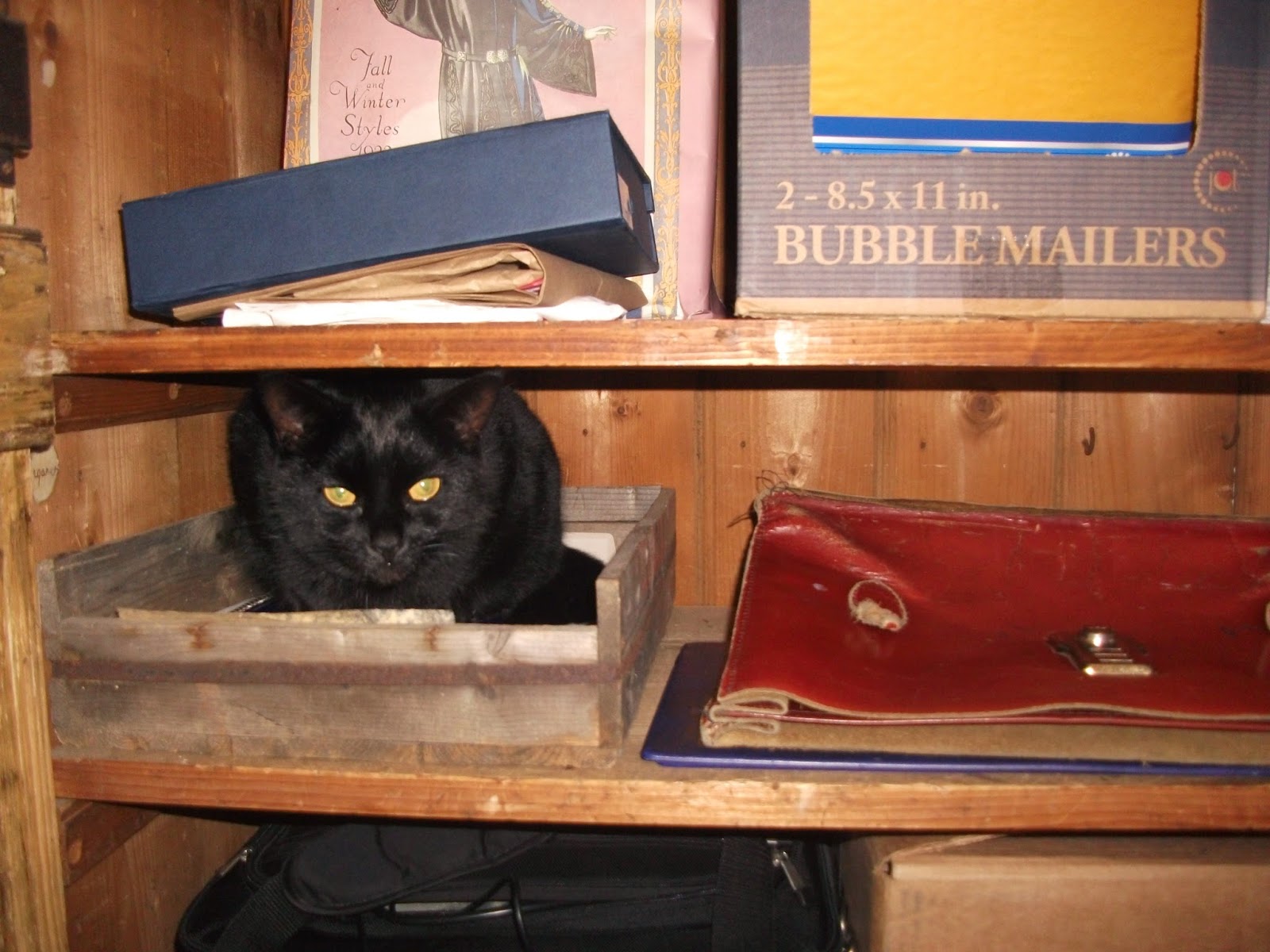
There's a cat:


but I've filed her. Occasionally there are woodpeckers trying to get into the eaves or wild turkeys blatantly scratching up seedlings. And one time - well, two times - a snake came in off the porch. Then there was the day of the frog in the waterbutt, the mouse in the cat dish (worried but too full to climb out) and the possum in the cow trough (very dead), but mostly it's just me.

There's no music except for about two hours a year, when I finish a book and print it. Then I put on either ELO's Mr Blue Sky or (recently) Pharrell's Happy (judge away; I don't care) as loud as it'll go and dance around as the inkjet whirrs and the warm pages curl out.

This is why I'll never go on a writers' retreat. Every one I've ever heard of is less retreaty than my real life. Sometimes there are other people.  Brrrr.

And yet sometimes, for no reason I've ever been able to identify, I need to go to Mishka's instead.


It can be at any stage of any draft, any time of any day - suddenly the quiet room with everything I need and the low keyboard for wrist comfort becomes unbearable and what's required is a crowded coffeeshop full of students ordering nonsensical drinks very slowly (liquorice soy chai latte, people? Seriously?) where I can hunch over a laptop with my wrists like hairpins, no reference books and Mariachi classics playing.

I have good and bad writing days at home but the words always pour out at Mishka's.  If anyone knows why, I'd love to hear.


Monday, February 23, 2015

Why I May Have to Live on an Airplane

"Do you pull down your shades and shut out the world when you write? Or are you motivated by a city view? A view of nature? What is the ideal landscape for your creativity?"

- from Susan

It is a good question. I’ll share what I’ve learned about what doesn’t work. What does work is an evolving solution.

Looking at anything that I could or should do or dream about doing instead of writing is not a great idea: laundry, cookie jar, iPhone, stack of bills, photos of Hawaii…not smart.


The spines of 800 crime fiction books by some of the best authors in the world, thoughtfully arranged so that I can be reminded every time I raise my eyes how far inferior what I’m typing at this moment is from their worst sentences…not the best spur to creativity.

Any view of any piece of outdoors under my control and that, therefore, needs my attention before it is ruined by rain, drought, sun, shade, or mealy bugs…my fingers itch just typing this.

A beach out my window?…Forget it. I’m miles away in my head instantly and will be out the door in five.

All of this is to say, obviously, that I’m easily distracted. It’s odd, really, because I’m a spectacularly bad typist, must look at the keys to have any hope of hitting the right ones, then look at the screen to see what my free throw percentage was for that paragraph. (So far, I’m only about 60% on this essay.) My eyes are constantly in use, so how do I see all those distractions?


When I moved to my wonderful house, I finally had a room just for work. I set it up so I face a whiteboard, bookshelves behind and to the sides, window to the right, a whole floor away from food. The best outcome so far is that I’m burning more calories running up and down stairs.

So what works? Two places really work wonderfully, and from what I’ve heard other writers say, they’re not surprises: airplanes and coffee cafes. Something about the quality of the noise, the lack of potential delight by interacting, and the tight radius of my space has an effect on my powers of concentration. Since I have a deadline coming up, I’m thinking about installing chairs around me, finding a tape loop of 50 voices talking at once, and maybe tilting the whiteboard so I can barely operate the keyboard. If that’s too hard, I’ll head to Peet’s!


Friday, February 13, 2015

Writing is easy. You just open a vein and bleed.*

How do you hammer out your first drafts? Have you ever used NaNoWriMo or the 3-Day Novel Contest, or a similar group motivation effort, to get your first draft done?


by Paul D. Marks

No.

No.

And no.
10569090_633761050065065_5779383253084797733_n

Should I quit while I’m ahead and just leave it at that? No, why not put my foot in it more:

I’m too much of a hermit and an individualist to do the group thing. I like to sit in my cave and just write. And I’m pretty disciplined, so I don’t need those things to motivate me. But whatever works for any particular writer is what they should do.

As to how I hammer out my first drafts – I sit myself in a chair, usually at my desk, and write. I’m a pantster, so I write by the seat of my pants. Early drafts are just sort of stream of consciousness...but with some purpose in mind ‘cause I do have a story idea and some characters I’m working with. And I tend to do a lot of drafts because the early ones are so all over the place. But with each I see the story and characters developing. And often the characters change the nature of the story or at least the direction it’s going in.
I usually spend time goofing on the internet before I actually get down to the business of writing. A better procrastination tool has never been invented. It makes you feel like you’re working when you’re really just looking up the lyrics to that song you heard the other day. Or if you really want to feel like you’re working you can actually do some research that might make it into your story. Or, you can go on Facebook and post clever memes or watch silly cat videos. Then you know you’ve done a good day’s work. Of course, with two cats I can watch my own cat videos, live every day.

When I teach on occasion, the thing I find with students is that they’re all gung ho...until it comes time to actually do the work. Everybody, it seems, thinks they’re a writer or at least wants to be. The difference between people who are writers and the wanna-bes is usually no more than sitting oneself down and doing it, improving your writing over time, and then having the persistence to keep doing it in the face of rejection, which can be devastating.

Maybe NaNoWriMo or other things like it are useful to some people, help them get motivated and give them word counts to reach for. But ultimately, whether you just sit your ass in a chair or use NaNoWriMo or one of the other methods to motivate you, it still comes down to just sitting your ass in the chair and doing it.

Okay, ‘nuff said. Now I’m off to watch cute cat videos.

*attributed to Red Smith, Hemingway and others, but I think Red Smith is the one who said it

* * *

Well, a little bit o’ personal news. We have a new family member. He weighs in at about 85 or 90 pounds. And is one big guy. He makes our other dog look smallish, and she isn’t. No name for him yet. Got him from Westside German Shepherd Rescue in LA, a no-kill shelter, last Sunday. He’s about three years old. So now we’re back up to our full contingent of two cats, two dogs. The cats are still getting used to him... And, unfortunately, our other dog, Pepper, hurt her knee ligament on Monday and had an operation Wed. Her injury had nothing to do with the New Guy. He was in the house with me and she was running in the yard. She’s home now and recuperating. Here’s the New Guy’s debut pic. You can’t really tell how big he is in this pic, but I think of him as Gigantor.

New Dog - Buster von Basall -- picked up 2-8-15

Thursday, February 12, 2015

typing and weeping

How do you hammer out the first draft and have you ever participated in Nanowrimo?

I was a few books in before I heard of Nanowrimo and I was already superstitious about changing things in case the whole soufflé collapsed, so the answer to the second bit is "no".

About the first bit, though . . .

The ideal is 2000 words a day, 5 days a week, for 10 weeks, giving a 100K first draft in under a season. It doesn't always work out. More likely is 3000 confident words a day to start with, typed with brio and a song in the heart, then what my husband calls the Big Early Wobble, when I select four or more of the following remarks and combine them in any order:
  • I can't do this
  • This time it's real
  • I've never understood less about a story
  • I don't know who these characters are
  • There's no colour
  • It's too thin
  • This isn't a world
  • This has never happened before
  • I have never felt like this before
  • Why do you always tell me I always do this?
Neil counters with a handful chosen from among these rejoinders:
  • Yes, you have
  • Yes, pretty much word for word
  • Not just last time, every time
  • I bet it'll be okay
  • Why not write it and see if maybe it's okay
  • I honestly believe it might be okay
  • Yes, but I really think you have
  • Yes, you totally have, you crazy lunatic
But here's the thing. The book I'm writing right now is 57K words long after [trots over to calendar to count] 24 working days. Hey!

So now I have to decide between a. faking a late Big Early Wobble and b. doing without one altogether. Truth be told I'm worried that without the BEW the book won't be any good. I'm having a Midway Meta-Wobble.

But I think, all things considered, I'll just bash on, typing and weeping. I'm quite fond of some of the characters in this one - they make me laugh - and as well as that I'm not sure what's going to happen next and I'm interested to find out. In fact I stopped typing today at the end of a pretty torrid scene with the words [trots over to other computer to remind self]:

"The colour drained from D----'s face until she was candle-white and her lips were almost blue.
'What is it?' I asked her."

Right now, I have no idea and that's why I love being a pantser. I'd bet my morning coffee that when I sit down and start typing tomorrow I'll realise what it is and it'll be something hidden away in what I've already written, like an Easter egg, waiting to pop up in the story. It feels like magic.

Once I've written another three drafts, fixed the glitches, killed the stinky bits, smashed the Easter eggs and sprinkled the crumbs from beginning to end of the story, maybe some of it'll look a wee bit like magic too.


Monday, February 9, 2015

Getting to The End Faster

Q: How do you hammer out your first drafts? Have you ever used NaNoWriMo or the 3-Day Novel Contest, or a similar group motivation effort, to get your first draft done?

-from Susan

I don’t. Hammer, that is. I peck and squirm and occasionally lose myself in the story, but I’m not one of those authors who crow on Facebook that they banged out 2,500 words before lunch, again. NaNoWriMo is a great idea and I’ve followed it via Alexandra Sokoloff’s enthusiastic online coaching during the month of November, but the closest I came was writing 45,000 words in a determined effort last year to finish a novel set in France. I holed up in a cottage on Kauai (yes, I know, tough life) for three weeks, banned from being in the sun from 10 a.m. until 4 p.m. at least, and told myself I would not come home without getting to “The End.”


What I learned in that push was that there are big benefits to tackling a book-length manuscript that way. You aren’t as likely to lose the threads of the plot, to call the characters by different names from one scene to the other, and you're more likely to maintain a stylistic rhythm throughout the writing. You can let the story itself – not just the writing – flow at a faster pace if you’re not spending as much time re-reading the last chapters to get into the head space of your protagonist, villain, whatever. And, of course, you get to the end sooner, no small benefit. Disclaimer: I had already written about half of the book, threw away about 25,000 words that were torqued into something other than what I had in mind, and arrived with about 20,000 that I felt were strong, so I wasn’t starting from page one.

Another thing I learned is that I am more likely to keep writing without losing concentration when I’m not at home in my cozy study, with easy access to my kitchen, laundry basket, charming cats, and garden. It seems nuts to pack up and head to the Peet’s coffee house in town when I’ve gone to such trouble and expense to, finally, have a room arranged solely to foster creativity and writing output, but if I can’t do better at resisting the urge to jump up and do anything else but tackle the empty page, I may have to. It’s either that or head back to Kauai. I wonder if I can write off a trip like that? Note to self: Ask accountant and try not to deflate when he starts to laugh.


Friday, January 30, 2015

Flaws and All

Many readers say that they prefer a protagonist with flaws to a model of perfection. Did you intentionally give your protagonist flaws, and if so, what are they? What flaws are you uncomfortably with (i.e., substance abuse, misogyny, etc.)

by Paul D. Marks

                        ...get rid of my flaws and there would be no one left.
                                                           ―Sarah Vowell, Take the Cannoli

philip-marlowe-private-eye-blackmailers-dont-shoot-red-powers-boothe-vhs-cover-artMany of my characters are flawed one way or another. Some of them with major flaws like racism, others with everyday flaws like vanity or envy. I think we’re long past the days where the good guys wear white hats, don’t cuss, don’t smoke and don’t throw people off the tops of buildings. And if you look at the examples below I think you’ll see that I’m not “uncomfortable” with much in terms of flaws. Not because I like these traits, but because I think they’re real. And if I want my characters to ring true they have to have real flaws because no one is perfect.

Phillip Marlowe, the quintessential knight errant private eye, was misogynistic, racist and more, just as a matter of course. But he was also a product of his times. We notice it today when we read Chandler, but I’m sure many people reading those stories when they first came out wouldn’t have thought anything of it. Nor do I think Chandler would have given it a second thought or consciously put it in his stories. It was just the zeitgeist of the times (if I’m not being redundant). But today, when most of us write characters with these traits we are doing it on purpose to make a point of one kind or another and to round out the character.

White Heat cover -- Paul D Marks -- D26--smallThe two main characters in my novel White Heat are both seriously flawed. Duke, the main character, is a screw-up in more ways than one, only that’s not the word he uses to describe himself. His partner, Jack, is majorly flawed. He a racist – at least on the surface. He says things that maybe other people only think. But a lot of them do think those things. If you only listened to Jack talk you’d think he was a really bad guy, but if you watch his actions, you see that it’s not that simple. Jack is also a good guy. He may say the wrong thing, but he pretty much does the right thing. In Jack’s case actions definitely speak louder than words.

White Heat takes place in and around the 1992 “Rodney King” riots in Los Angeles. And, though it’s a mystery, it deals with many racial issues and concerns – which are still relevant today. So the book is sort of a prism on today, though set in the not-too-distant past. I was so concerned by the raw nature of some of it that I put a disclaimer in the beginning of the book. I put the disclaimer in, but I also left in the raw language and actions of the characters. But I was still nervous about how people would react. Luckily the reaction was pretty positive on all fronts and the book ended up winning a Shamus award.

I also see Jack as the little devil on Duke’s shoulder, like you would see in the old cartoons. Jack is sort of Duke’s alter ego, the bad side of Duke, the nature he must fight. And he does. But why, one might wonder, would Duke even be friends with Jack? Because, besides their personal history, Duke sees beyond Jack’s  posturing to the real Jack underneath and maybe that person isn’t quite what the surface person comes off as. We all say things we regret, and sometimes do things we regret. Jack pretty much does the right thing, even if he spouts off the wrong thing. And ultimately we are all flawed and can relate to the flaws in others. It makes the characters more human, more accessible. And more real.

51-50 Psycho Noir ZeltsermanThe main character – a cop – in 51-50, a story first published in Dave Zeltserman’s Hard Luck Stories – Psycho Noir edition (so the edition title alone might tell you something about the character), now in my LA Late @ Night story collection, shoots a gang banger out of sheer frustration, not because of a life-threatening situation. The cop is unraveling throughout the story, the pressures of life on the street are too much for him to deal with anymore. The story was written and published some years ago, but again is relevant in light of what’s been happening in the country today. The cop is not a bad guy. He wants to do the right thing. But dealing with the stress of the streets and the thugs he has to deal with just wears him down.

Ray Hood (Last Exit to Murder anthology) is an aging rocker in Dead Man’s Curve, his glory days as a road guitarist for Jan and Dean are long behind him. He’s selfish, he does bath salts (not the kind you put in the tub), he doesn’t appreciate what his sister is trying to do for him. Definitely not a model of perfection. And he wants to get back in the game. To that end he will do just about anything.

In Poison Heart (Deadly Ink 2010 anthology), Winger is a crime beat photographer, who can’t adjust to the modern world and has become jaded by all the violence he sees in the real world. So he decides to take things a step further and goes way beyond the bounds of the law to get a good pic, selling his soul (so to speak) in the process. Another desperate character who will do desperate things to stay on top and be a modern-day Weegee. Again, his flaws are the petty flaws we all have, but he takes them to another level. A more personal level of envy and the desire to be on top and what he’s willing to do to be there.

My Enemies Have Sweet Voices features the “typical” noir-guy flaw – he falls under the spell of a woman who convinces him to kill for her. But his real fatal flaw is that he betrays the trust of his best friend by asking him to help him hide the body.  His weakness is that he picks lust over loyalty to his friend, while his friend is loyal and helps him with the body, no questions asked. But there is a bigger price he has to pay for it later. (Coming later this year in the Coast to Coast: Murder From Sea to Shining Sea anthology from Down and Out Books. Anthology title is tentative.)f08bdd34413d865ac5b973afddeacf4d

Howling at the Moon (November 2014, Ellery Queen): This one’s a little different in that the character is not a bad person. Not selfish or suffering from envy or any of the other seven deadly sins: lust, gluttony, greed, sloth, wrath, envy, pride  But he is disaffected and has separated himself from his American Indian roots, especially after coming home from the war in Iraq. He ultimately does something we might think is immoral, but we empathize with him and understand why he does it. Nonetheless, he becomes a flawed person by the actions that he takes.

Most of my characters are flawed because people are flawed. I don’t necessarily set out to write a character with this or that flaw, but the character comes to life in the writing and develops those flaws, just as people do as they go through life. Ultimately, I think the reason most of us like flawed protagonists is that we can relate to them more.  They are more like us. Not perfect, not saints, more like real people, just trying to get by in a flawed world.

Thursday, January 29, 2015

Flaws for the Flaunting

I'll start by answering the second bit of the question: what flaws would I shy away from?

Ignoring the kind of flaw that's really sociopathy - I mean, you couldn't introduce someone with "This is Crispin. He stamps on kittens but he has a lovely tenor singing voice"- I think the only flaw I'd find it hard to write would be if someone was boring.  It's difficult to show boringness properly without actually just *being* boring.

(In real life, a crushing bore can be hilarious if you've got someone's eye to catch and you're both thinking the same thing; then you actively *want* the bore to keep going until you know what kind of replacement showerhead she had to get in the end, or whether the journey was longer or shorter taking the freeway; or how many touchdowns there were at the bottom of the ninth innings at the last Knicks game.)

Dandy Gilver (my 1920s detective character) has quite a dull husband, but I only ever show short snatches of him and it's more that he's excited about unexciting things than that he drones on.

Dandy herself has flaws and foibles that are more fun to write. I always get a kick out of people who don't have much self-awareness: snobs who think they're approachable; spoiled brats who think they're stoical; dictators who think they're solid members of the team. Dandy Gilver's total lack of insight about herself is one of her main flaws, but it's also pretty authentic for a character of her class at that time, when inward reflection would have been seen as feeble and shaming.

The other flaw that I think is central to Dandy Gilver - and probably saves her from being insufferable - is not at all authentic for a toff in the 20s. (This is the first time I've thought about it; I'm grateful to whoever asked this question and forced me to).

A key feature of very powerful people is their incredible self-confidence and, no matter how silly they look to us now, the British upper classes of the 20s and 3os had a great deal of power.

No doubt if Dandy had stayed in her own world - a pretty empty world of house parties and charity work - her confidence would have grown as she grew older and she'd have turned into a splendid old trout.

But she took up detecting and more is now asked of her than her upbringing equipped her for. She has to think on her feet and make it up as she goes along.  She regularly gets it wrong too and so she has learned the value of caution and has even - unheard of! - learned to doubt herself sometimes.

I've always been clear that Dandy Gilver is not me, but we have the self-doubt in common. I'm right now having a minor panic because I've just discovered something I didn't know about her and I'm currently writing the first draft of her latest story. What if this knowledge make it impossible to write about her anymore without it being clunky? What if answering this question is the equivalent of looking down from the high wire? What if me realizing that she's making it up as she goes along stops me being able to the same?

Writing: it's not a short-cut to serenity.


Monday, January 26, 2015

Ophidiophobia, Anyone?

Q: Many readers say that they prefer a protagonist with flaws to a model of perfection. Did you intentionally give your protagonist flaws, and if so, what are they? What flaws are you uncomfortably with?

-from Susan

Was Nancy Drew perfect? I don’t recall, but I do remember even at 10 thinking she was a little too Goody-Two-Shoes for me. I write about human beings and human beings aren’t perfect. I’m also an avid reader and I want even silly protagonists to be flawed. In fact, the silliness may BE the flaw.

What does get a little old is the lonely P.I. with a sour attitude, a half-empty whiskey bottle and a serious smoking habit. It’s more fun to think up unusual flaws like phobias no one’s heard of, or addictions we can relate to, or peculiar passions. As a reader and writer, I may not be able to slip entirely into the protagonist’s skin as she stares quivering out the window at the pouring rain (Pluviophobia) or runs screaming from the kitchen when her host opens the white refrigerator door (Leukophobia), but I’m not wild about snakes (Ophidiophobia)* so I have some idea of what the poor person is going through. And, if you’re a writer, can you imagine the scenarios possible with problems like these?

What don’t I like? Sexual sadists, serial killers, child killers, sociopaths, pedophiles, hit men, the cruelest in the human race. 


Remember the killer in the backseat of Marge’s patrol car at the end of “Fargo”? She looks at him in the rearview mirror, from the safety of her sanity and embedded place in society and can’t fathom him. I feel like Marge. I do read and watch some pretty scary stories, partly because the writing or filming is so good, and partly because I don’t want to be a wimp or so far removed from what’s popular that I don’t understand the market or the times. But I can’t write those characters because a) I don’t know what goes on in their heads; and b) I don’t think I want to know.

Dani O'Rourke is a modern woman with problems a lot of us can sympathize with: Her divorce left her insecure; she struggles with 10 pounds that refuse to leave her waistline; she is a little cynical about some of the situations she finds herself in at work; and she can't seem to find a loving partner. Nothing earthshaking, but enough to keep her off balance and distracted when trouble pops up.

There are so many flaws that make people vulnerable, that can drive them nuts or cause them to lose all perspective and yet not make them monsters. Those are the flaws I hope to uncover and use as a writer, and read about and enjoy as a reader.


With thanks to: http://phobialist.com/reverse.html#D-