Wednesday, February 9, 2022

The Lessons We Learn (from the questions we ask): Catriona interviews Liz Milliron

Catriona writes: I am trampling over all the lines in hobnailed boots here. For a start, it's not my day (it's not even my week) - so thanks to Dietrich for stepping aside. And then, I didn't let our returning guest - Liz Milliron - loose on the QotW. Instead, I floated an "interview" as the form of her guest post. But you know what? Even that was just me asking what I wanted to know about the Home Front Mysteries, which I love. Who could resist a woman making planes for Bell in 1940s Buffalo (by day) and solving crimes when the sun goes down? Not me.

But, I usually go on the basis that what I want to know when I'm in reader-mode (or fangirling to be more accurate) is probably what others want to know too. So . . . here goes:

C:Hey! Betty’s back! And that is cause for great rejoicing. Could you introduce the new book?

L: Sure thing and thanks for having me! The Lessons We Learn opens a few months after the end of book two. It’s March of 1943 and Betty is still working at Bell, but she’s got her side-hustle as a private investigator going. When the story starts, we learn that Lee’s father, John Tillotson, is missing. Lee is not particularly upset about this. Why? Well, his father isn’t a great guy, to tell the truth. It’s not all his fault. He had an accident the previous summer and to deal with the pain he started drinking heavily. And he’s not a nice drunk, either. Lee finds home life a lot more peaceful with his dad gone and he’d just as soon things stay that way. Of course, it’s not so simple. Not long after Lee’s birthday Mr. T turns up dead and we soon learn it’s murder. Lee soon catches the attention of the police, and not in a good way. It’s up to Betty to find out what’s really going on and keep her best friend from spending the rest of his life behind bars.

C: The setting of the series is a joy. Is the research getting easier as you get deeper into the series?

L: Yes and no. The good part is I have a lot of stuff I can reuse in terms of setting. I don’t need to do quite so much for slang or clothing. I do need to keep tabs on what was going on in WWII, but I’m not writing a book about the war, so I don’t need to spend hours researching history.

However, I try to use something interesting about Buffalo in every book. This time around it was Central Terminal, the Fruit Belt neighborhood, and the area by the grain elevators. Those aspects always require more research than I planned on doing (I tried kind of winging it in this book with near-disastrous results so no more of that).

I suppose I could make it easier by not wanting to use a lot of the facts I learn about history and Buffalo, but where’s the fun in that?


C: So with all that focussed research into fresh aspects, how far do the books stand alone? Is there a series arc?

L:The mysteries are pretty well contained in that each book deals with one crime (or related set of crimes) and the Bad Guy gets his or her comeuppance in the end. I hope I do a decent job with character backstory as well (at least my critique group says I do), so a reader could pick up any of the three books and not be lost. In that sense, the books aren’t connected at all.

But while there isn’t a series arc per se, there is definitely a character arc and I’ve been planning it from the beginning. I think that journey is pretty interesting and I know watching the characters grow and change is what keeps me coming back to my favorite series.

If a reader does start with this book, they can completely enjoy the story without reading the first two. However, I hope they are interested enough in Betty and her friends to go back so they can enjoy seeing that growth.


C: I'm glad you brought up the characters. Betty's back-up are a splendid bunch. But do your feelings about specific characters (I’m assuming you have feelings about them!) change from book to book?

L:Oh definitely. Lee has been the guy Betty could count on for the first two books, but he frustrated me quite a bit this time around (You know how it is – you put a character on the page and the next thing you know, he’s making his own decisions.). But I forgave him by the end.

What really surprised me in this book was Detective Sam MacKinnon. I didn’t intend for him to have as big a role as he did, but he kind of insisted. Very stubborn of him and a little infuriating. I’ve always seen him as a friend to Betty, but by the end of this book I realized he’s a true mentor and just as invested in her success as a detective as anyone in her family – and maybe even more so.

C: So, circling back to the plot of The Lessons We Learn, specifically. Can you talk a bit about the decision to kill off Mr T? (I am trying to care. I am failing: you wrote the impact of his behavious too well!)

L:This question makes me realize my decision to kill off Mr. Tillotson had less to do with him and more to do with Betty. I knew this book would complete her growth (see the answer about character arcs above) and I wanted a high-stakes investigation for her - proving the innocence of her childhood friend. Perhaps I knew this subconsciously when I set up Mr. T as an abusive drunk in the last book. But even though Mr. T doesn’t appear on the page (his one line of dialogue is hearsay), I learned a lot about him while I wrote. Enough that I kinda felt bad about killing him. Had I stayed out of his life, he might have been able to redeem himself.

It also makes me realize that no matter which series I’m writing, that first victim has to evoke some kind of emotion for my characters. Why would they care? Even when the victim is not a particularly nice person, there has to be some motivation beyond “I’m getting paid to do this.” It doesn’t mean the detective has to like the dead person. Maybe the victim exposes a greater wrong that has to be corrected. I think that’s generally my thought process in selecting Victim #1 and starting the story.

There are also people I don’t set out to kill, but…it happens. I’ve had a couple of occasions where I really liked a character, but he or she winds up getting killed. Because I’m not a plotter, I’m never quite sure when it will and hopefully my readers are caught off guard, too. There’s always a feeling of regret for these deaths. “Sorry, I don’t want to kill you, but I have to.” 

This is not to say I haven’t written characters I’ve enjoyed killing because I have. There are characters I’ve invested with some terrible personality flaw or they are just horrible people and I take satisfaction in dealing them their just desserts. As I heard Reavis Wortham say once, “Some people just need killing.”

C: Trust him! Wasn't that once a genuine defence in  . . . Texas (I'm semi-guessing)? "Needed killin"! It's things like that that mean I never ever wish I lived in the past. I'm happy just writing about it, and reading about it in books like THE LESSONS WE LEARN. Thank you for giving us a peek at the process, Liz.

BIO: Liz Milliron is the author of The Laurel Highlands Mysteries series, set in the scenic Laurel Highlands of Southwestern Pennsylvania, and The Homefront Mysteries, set in Buffalo, NY during the early years of World War II. She is a member of Sisters in Crime, Pennwriters, and International Thriller Writers. A recent empty-nester, Liz lives outside Pittsburgh with her husband and a retired-racer greyhound. http://lizmilliron.com   


Tuesday, February 8, 2022

Brave New Publishing World


Terry here:

The question we are talking about this week is: We seem to have moved from “unprecedented times” to “a constantly fluid situation”. What did you learn in 2021 about the “new normal” of the business of being an author that you’re going to use to help your future career, and please tell us what you’re planning for 2022. 

“New normal” has been a fluid situation for as long as I can remember in the publishing industry. It seems like nothing stays the same. In contrast to the dramatic changes with the inception of the ebook revolution, I don't think that much changed last year. 

 When I first started sending out manuscripts, looong before I had studied the craft enough to be accepted by agents/publishers, here’s how I understood the process would go. 


THEN: 

1) You sent your typewritten book to agents. Through the mail. With enough postage for it to be returned if it was not accepted. 

2) An agent accepted the book without spending much time on editing. If they rejected it, it arrived back on your doorstep like a dead rat, without fanfare. 

3) If accepted, agent sent the book to an acquiring editor at publishing houses, with minimal “notes.” And the agent rarely got back to you with information about what was going on. 

4) Book was kept for months at a time before being accepted or rejected. 

5) Meanwhile, author got back to work on next book. 

6) Book was accepted. Contract was signed—a contract with sometimes loose wording. 

 7) Book was edited. Cover was designed without regard to the author’s input. 

8) Author reworked book per editorial notes. 

9) Book was published as hardcover or mass market paperback. If hardcover, six months later, it came out as mass market paperback. 

10) Publisher took care of marketing, promotion, lining up bookstore events. 

11) Editor worked with author to develop the next book. 

 In other words, the author wrote the book, the agent peddled it, and the publisher published it and did the marketing and promotion. 


What about self-publishing? It was rare—and then you had to pay to have it published as if you were a major publisher. 

 What about ebooks? No such thing. 

 What about trade paperback books? Only for “literary” fiction from small, precious houses. 
*** 

 NOW, in our publishing world: 1) Manuscript is submitted to agents in e-form. If you’re lucky, the agent sends you a real rejection; otherwise, silence. If you’re really lucky, agent accepts the manuscript. 

 2) Agent edits manuscript heavily. You work with agent to get it ready for submission. 

3) Agent sends to publishers. A good agent keeps you informed of responses from publishers. 

4) Acquiring editor bestows on you the miraculous gift of a contract. An iron-clad contract. 


5) Agent goes over contract, negotiates on your behalf. 

6) Edits get done. Cover gets designed, sometimes with author’s consent; sometimes not. 

7) Meanwhile, author gets started on another book, knowing at some point s/he will have to take time out for business. 


8) Book is published in hardcover, trade, mass market, and/or ebook.

 9) Publisher assigns an in-house “publicist” to do book promo—usually consisting of tweets and Facebook posts and to get trade reviews. 

10) Author gets to work setting up bookstore events, begging for extra reviews, begging for blurbs, whipping up buzz on social media, sending out newsletters, setting up library events, going to conferences and trying to get visibility through panels and talks. In other words, the author writes the book, the agent edits the book, the publisher publishes the book…and the author then has to do a lot of the promotion. 


 OR Author goes independent and does everything the agent and publisher does.

In 2020 a lot of publishers/editors/agents pulled back because of the shock of being isolated at home. But in 2021, it seems like publishing was back in gear. 

 Except that my personal relationship with publishing changed. Because I decided to cut ties with my previous publisher a year before the pandemic started, I was in a particularly difficult situation last year. I had to face either finding a publisher who would be willing to take on my Samuel Craddock series midway, or publish myself. Meanwhile, my long-time agent and I decided our relationship had run out of gas. 
So last summer I was without an agent as well.

I dithered for several months, getting conflicting advice about publishing independently vs. going with a known publisher. People were passionate on both sides of the fence. Author friends were kind and thoughtful, and did everything they could to encourage me—on both paths. It didn’t help that during this time I moved from the Bay Area to Los Angeles. I have some advice about that: don’t move. 

Eventually, I realized that every time I thought about publishing on my own, I felt gloomy. As hard as it was to consider getting a new agent and a new publisher, I decided that was best for me given my chaotic life. I was fortunate to join forces with agent Kimberley Cameron, and she got to work right away placing the Craddock series. And she was successful. That's right. 

Except I can't talk about it yet. Stay tuned for news of what will be coming to fruition in 2022. Terry

Sunday, February 6, 2022

Finding a New Normal

We seem to have moved from “unprecedented times” to “a constantly fluid situation”. What did you learn in 2021 about the “new normal” of the business of being an author that you’re going to use to help your future career, and please tell us what you’re planning for 2022.

Brenda Chapman here.

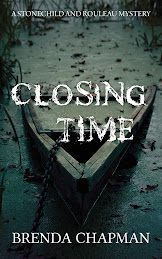
The impact of the pandemic on the book industry is difficult to analyse, but easier to see on a personal level. Initially, the lockdown meant that all the public appearances, the launch and media interviews I had planned for Closing Time were off the table. As the pandemic stretched on, I learned about Zoom and Instagram and Facebook live and the benefits of reaching readers through social media. Authors rallied and began holding virtual events. As Crime Writers of Canada Director for Ottawa/Eastern Ontario, I  initiated a series of interviews with authors from this region. We all pivoted and adapted.

As we're into the third year of the pandemic, we're still adapting. I have the first book in a new series, Bllnd Date, A Hunter and Tate Mystery, being released March 1st, and the launch will be virtual. I haven't lined up any appearances and will rely on social media to get the word out. I've been fortunate to have my neighbourhood newspaper, Kitchissippi Times, run an article in the February edition about my writing, and I'll propose interviews with a few other local news outlets, even if virtual, something I've also been fortunate enough to experience this past year.

Visiting bookclubs through Zoom in other cities has also proven to be a new opportunity, arising out of the pandemic. I have one coming up next month, having already visited two this year. One group of women gathered outdoors around a fire with glasses of wine with a screen set up for my call. A fun way to meet readers across the country (potentially world) that I never would have dreamed of before Covid lockdowns.

I joined Sisters in Crime after the pandemic started and have sat in on a lot of Zoom webinars (also by Crime Writers of Canada, The Writers Union of Canada and Capital Crime Writers), enjoying the learning experiences and the chances to connect with other writers about the craft. One session was about marketing and I purchased Book Brush as a result. I've used this program a lot to make ads, something I never would have contemplated before.


Another benefit from our new virtual world has been seen in the public libraries. Readers around the world are taking out electronic books in record numbers. I've been surprised to find the two books from my Stonechild and Rouleau series to be in the top ten borrowed audiobooks for 2021 in several countries, including the U.K., Australia, New Zealand, the U.S. and Canada. People like the convenience of checking out a book without having to leave home.

All this to say, the new normal for writers has changed drastically, in some ways making getting one's book noticed more difficult. However, if a book does rise above the crowd in the virtual environment, the opportunities to reach more readers are there. It's still sad that three years into the pandemic, we can't meet readers in person or attend events, including book conferences. It'll be a mighty fine day when we can safely congregate to talk books and once again raise a glass together.

Friday, February 4, 2022

How to write a series character* - by Josh Stallings

 * and other things I wish I knew.


Q:How do you handle the passage of time and the aging of characters in your series?


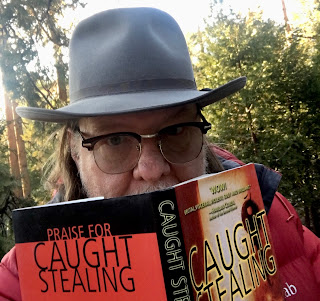
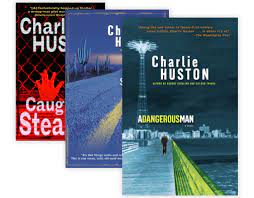
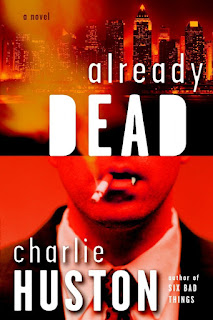
As a reader my favorite series are ones that pick up relatively close to where the last book ended. I also like books that carry an emotional continuity from experiences in the last book into the next book. In Charlie Huston’s Henry Thompson novels (Caught Stealing, Six Bad Things, A Dangerous Man) he starts with a Hitchcockian everyman who is mistaken for a thief. His journey is rough and violent and by the end of the trilogy Hank is a hardened killer and a dangerous man. These are hardboiled novels that are a study of what it takes to turn a person into a hard boiled character. No one starts out like Richard Stark's Parker, although most often these characters are dropped fully formed into their novels. What Huston did was show you how a cruel and violent world created them.  


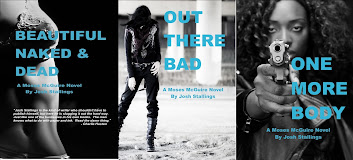
My Moses McGuire books (Beautiful Naked & Dead, Out There Bad, One More Body) are a hardboiled exploration of sex as commerce in America. Each book takes you deeper into the skin trade, starting with strip clubs and legal Nevada brothels and ending with a girl grabbed off the streets of LA and trafficked into prostitution. This wasn’t originally my plan, I followed the research as I wrote. The people I interviewed led me to search out news articles and that led me to talk to more people in the sex trade. The more I learned, the angrier I got, and the angrier the books got. Moses starts out thinking he’s a knight in dented armor. Throughout the books he discovers he is part of the problem. He grows in slow fits and starts. He also accumulates scars physical and emotional. I have been asked to write more Moses books, but I just haven’t the heart to put him or me through the anger and pain it would take.


The nature of hardboiled is grab your protagonist by the neck and beat the hell out of them for as long as they can take it. So if you choose to track them with emotional and physical continuity book to book, they won’t survive too many volumes. Charlie Huston found a smart cheat with his Joe Pitt Case Books. These are hardboiled detective books set in a New York full of vampires. Having a vampire protagonist allowed Huston to beat the heck out of Joe Pitt book after book, knowing it’s next to impossible to kill the undead.          

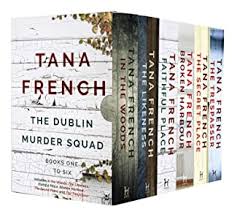
Tana French with her Dublin Murder Squad books has found an intriguing highbred that delivers the familiarity of a series and allows the emotional arc of a stand alone. Instead of following one main detective, each book takes a different member of the squad and gives them their own novel. So brilliant, wish I’d thought of it.


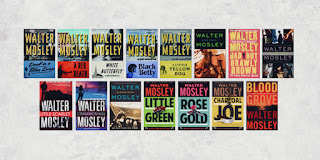
In the Easy Rawlins series Walter Mosley not only tells the story of one man’s life he also tracks the history of the black experience in Los Angeles. Starting with Devil in a Blue Dress set in 1948, he follows it up with A Red Death set in 1953, the next is set in 1956, then he jumps to 1961. Some of the later books take up just after the last ended. These time jumps between novels seem to be dictated by both wanting to show certain periods in LA history and to explore Easy’s growth over a longer time span. This unconventional timeline allows the series to play out like a saga, while book to book it reads like a domestic mystery series. We follow Easy’s personal life, watch his adopted children grow up, relationships flourish and fall apart.


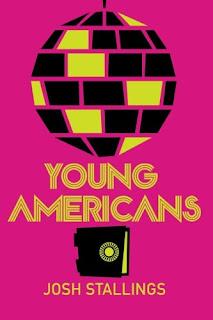
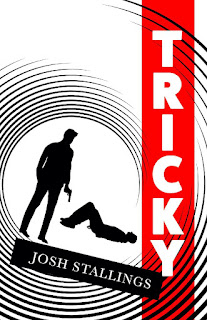
One of the great things about reading a series — regardless of the form — is that feeling of catching up with old friends. You generally know what you’re getting into from the start. You know the players and roughly the turf. I would love to write a long running series but I’m not sure it’s in my wheelhouse. Then again I’m surprised that the guy who wrote Moses McGuire, also wrote Young Americans, a sexually fluid disco heist romp, and then Tricky, a heartfelt police drama that is about neurodiversity and the possibility of redemption. My currant MS will definitely be the start of a long running series… or the first in a trilogy… or maybe a stand alone… One of those, for sure. Stay tuned and we’ll discover together what the hell is going on in the mind of Josh Stallings.


Thursday, February 3, 2022

And soon it'll be Christmas, by Catriona

 Q: How do you handle the passage of time and the aging of characters in your series?

Okay, I should probably be answering this with respect to the Dandy Gilver series, which is fifteen books long now and spans 1922 - 1938. And I do want to say two things about the world of Gilverton. 

First, how the hell did Dandy and I start out the same age, collaborate on a book a year, and end up with her younger than me?

Second - advice for new writers starting out - if you are going to have a series that progresses year by year, book by book, do not give your heroine a seven-year-old dog in the debut. Honest to God, the long phone calls between Editor Suzie and me about how we were going to send Bunty to her rest! Option one was have her save the day and go out in a blaze of glory at the end of the denouement chapter. (As Suzie pointed out, though, "blaze or no blaze, you turn to the next page and you've still got a dead dog". Option two was to have her die between books and say very little. (This felt cold.) Option three was to have her live forever. (But, even though the Dandy Gilver books are not gritty realism, this felt like a step too far.) So we went for Option four: put a mention in the postscript to book nine (when Bunty is sixteen) that this was her last case; then start book ten with the information that Bunty II is currently snuggled under her mother's flank in a cosy basket, waiting for Dandy to find her; then have Dandy and Bunty II meet by the book's conclusion. Meantime, you'll understand, I killed three fictional humans more or less without a backward glance. I know my crowd.

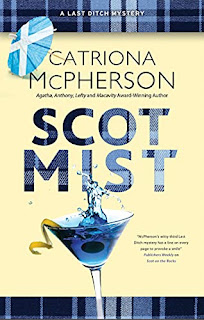
Anyway. what I really want to focus on to answer this question is the Last Ditch Motel series. It's four books long and it covers just under two years so far, but - here's the thing - book four came out on Tuesday! Yay for SCOT MIST!

Passage of time is not the primary consideration at the Ditch, but it's in the mix now for very specific reasons. I start each of these books on a holiday - SCOT FREE opens as the fireworks go off on the Fourth of July; SCOT AND SODA begins with a Halloween party; SCOT ON THE ROCKS sees Lexy alone on Valentine's Day; and the first scene in the forthcoming and as-yet-untitled Lexy 5 is the motel kitchen on Thanksgiving morning. 

Then there's SCOT MIST, book 4, which begins on anti-holiday, the day least like a holiday than any other day I've ever lived through in California, namely Friday the 13th of March 2020, when the governor shut Disneyland and extended the tax-filling deadline, and the Ditchers got ready for lockdown.

Not a lot of time passes in SCOT MIST. It finishes on Saturday the 21st of March 2020. But the decision to write a closed-circle mystery about strangers thrown together by the pandemic had a real, and unforeseen, knock-on effect. (New writers this is for you too. Save yourselves and don't do what I've done without knowing you're doing it.)

The thing is, having put Lexy and her pals in the real world where COVID happened for this book, I was trapped there. See what I mean? I couldn't decide to let the Ditchers exist in a pandemic-free - like how Schitt's Creek is a world without homophobia - because I'd already said otherwise. I'd spent a whole book on it. Short of Bobby stepping out of the shower, that was that.

So, when Editor Carl and I were talking about book five - Thanksgiving, remember?, we had to choose between Thanksgiving 2020, still in the pits of COVID, long pre-vax, or Thanksgving 2021 where, thanks to the science-based attitudes of the Ditchers and the possibility of outdoor life in California even in November, the pandemic wouldn't have to be such a presence. 

How to decide. How to decide . . . 

How did we decide? Well, here's a clue: Thanksgiving is nine months after March. Geddit? Nine months. (If you want to check your guess and see the start of this new sub-plot at the Last Ditch, SCOT MIST is available now. Lots of places. Including here)

Cx


Wednesday, February 2, 2022

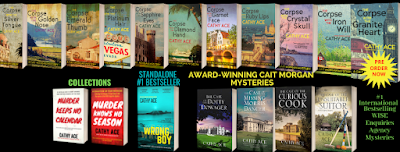
Where (or WHEN) are they now? by Cathy Ace

Q: How do you handle the passage of time and the aging of characters in your series?

Oh, this is an interesting one... 

On my wall...

When I wrote THE CORPSE WITH THE SILVER TONGUE, the first Cait Morgan Mystery and my first novel, I set it to take place “now”.

To be precise, the “now” I set it in was 2012, which is when the book was published. That meant I calculated the birth years of my main and subsidiary characters to be the ages I wanted them to be in the book. I always do this, even if a character’s specific age isn’t mentioned, because – as part of my planning process – I like to/need to work out what that character’s childhood would have been like, based upon their place of origin and birth year. As an aside, this also helps me choose the right types of names for my characters, based upon popularity/fashion where and when they were born.

My second book was published a year later, and was set about a year later – so far, so good. No problems. But time began to slip by book 5, and by book 12 (due out in April 2022) well, let’s just say that Cait Morgan and Bud Anderson are now way out of whack with reality (ultimately, they’ve aged about three years over the past ten years)…but I still write the books set “now”.

Why? Well, I had to make a decision: whilst I hoped I’d still be writing about Cait and Bud ten years later, I sort of didn’t really believe I would be, so the question of ageing did occur to me, but I reckoned I could cross that bridge when I came to it. And having come to it, and having had to cross it...I find I don’t really mind that this slippage has occurred, because I know my readers have enough intelligence to cope, and I don’t believe (oh my, I really hope not!!!) that the early books have become anachronistic…so far.

However, mindful of the fact I know people are reading books written a hundred years ago for the first time (welcome to the fold, those discovering Agatha Christie in the 2020’s), and seeing the sales of that first novel of mine are increasing year on year, I know folks can cope really well with ages, ageing, and the shifting sands of time – and all they have to do is check the copyright date to see when each book was written if they question something in “that timeline”. I’ve never wanted to write books set in the past – I have always wanted to, and always shall, write books that are contemporary for their publication date, and I truly believe readers can cope with how that impacts the "age" of the recurring characters.


Has this caused any problems for readers? The only one I’ve spotted is that some readers have referred to how Cait and Bud still act as though they’re on honeymoon “after all these years”. Now, I’m aiming to portray a solid, loving partnership, where each person values and really does adore the other (whilst recognizing each has flaws)…so I do my best to “remind” readers in each book how long they’ve been married. For example: even by book 12 they’ve only been married for a little over two years, which – for Cait, who was in her late-forties when she became a bride for the only time in her life – IS, in fact, still the honeymoon period. (FYI: I married for the only time when I was 44, and our honeymoon period is…well, we’re still in it, as far as I’m concerned, and always will be – lots of lost years to make up for!) 


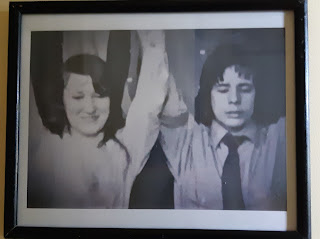
We met in January 1972, 50 years ago! This is us in 1975.
He proposed in 1976. We married in 2004.
It's a LONG story!!!
 (NB: arms in the air because we're performing on stage in this photo)

If/when I write another WISE Enquiries Agency Mystery I shall jump in right after the ending of the fourth book, however many years have passed in real time by then, and the next psychological suspense book I have planned featuring retired Detective Inspector Evan Glover and his wife Betty will pick up a few months after THE WRONG BOY, even though – again – years will have passed in real time.


I’ve learned to not refer to global occurrences in the "present" of the book, only in backstories (no pandemic being mentioned, anywhere, ever, for example) to allow readers to feel less pulled out of the story and into time-sensitive issues as they are reading, and I hope that helps as the years pass. Fingers crossed, folks will be discovering Cait and Bud in another ten years’ time, when the first book will be twenty years old…and hopefully those new readers won’t mind, as current readers don’t appear to, that the passage of time is treated as a flimsy construct, with which they don’t have to overly concern themselves. I just hope they’re happy to curl up with a puzzling closed-circle whodunnit, trying to sort the clues from the red herrings alongside my protagonists!

If you think now's the time to catch up with Cait and Bud - knowing there's a new book coming very shortly - you can find out all about them at my website: http://www.cathyace.com/ 

COVER REVEAL COMING FEBRUARY 7TH AT DRU ANN'S BOOK MUSINGS https://drusbookmusing.com/

AND VIA MY NEWSLETTER! 


Tuesday, February 1, 2022

As Time Goes By

How do you handle the passage of time and the aging of characters in your series (if you don't write a series, speak to this in terms of your preference as a reader)? Are your characters living in a short span of time while many years pass in our world? Does time pass at roughly the same pace as the publication of each book? Or do you have a different method?

From Frank

I write a number of different series ("gritty crime fiction from both sides of the badge," after all!) but I tend to handle the passage of time the same in all of them. Simply stated, time passes, though often not at the same rate as in the real world. The characters feel the ravages of the passage of time and the cumulative weight of the events they experience.

To keep this short, I'll only touch on one series, my main one.

The River City series, first published in 2006, begins in 1994. It is now 2022 in the real world. In the seven River City books so far, we've made it to 2004. That's seven books, ten years of fiction time. The eighth book will jump forward to 2008, so we'll be at eight books, fourteen years. This jump is partly due to my desire to "catch up" with this series, eventually getting it to the present day.

Might be a while.

Ten years might not sound like a long time to some of you. But it represents half of my policing career. And there have been significant changes to characters over that period.

[Massive Spoilers Follow]

Veteran officer Thomas Chisolm went from the hero mentor to being viewed by the new generation as a dinosauer, and he retired in 2004.

Once imagined as the series lead, Stefan Kopriva went from a brash young officer to disgraced ex-cop (and to his own series, Stefan Kopriva Mysteries) and cautionary tale for other officers.

Connor O'Sullivan went from jokey sidekick to thoughtful friend of his best friend's widow to a sergeant trying to live his best life while respecting the past.

And Katie MacLeod emerged as the core of the series, an officer who has endured crisis after crisis, not afraid to confront her own vulnerability but also refusing to be beaten by it. She's shown incredible courage and tenacity but has grown weary as well. Once considering herself "Patrol for life," she has recently taken a promotion to detective and will be embarking on a new stage of her career in the next (8th) book, set in 2008 (released later in 2022).

These are just a few of the changes that time and events have ushered in for these characters. There are a slew of other examples. In a series that is rooted in realism, I felt it was important to show that the passage of time and the weight of events have an impact on people. Stress is both acute and chronic. And people change.

I get the desire writers (and readers) have to keep a character much the same, to not mess with a winning formula. But the worlds I've created, including River City, just don't allow for that. Time has to be let in, and the events that occur each outing must continue to be dealt with. That's just the way it is.

I have a pretty good idea what is going to happen to these long-time characters as this series catches up to present day. And because life is cyclical, new characters come on the scene. I'm excited to share the ultimate fates of those characters who were already on stage in 1994 (River City time) and to explore the paths these new additions will take.

----------------------------------------------

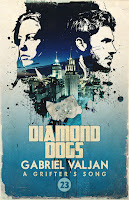
BSP! Do you need a healthy balance in your crime fiction? Something to offset your consumption of cozies, police procedurals, and private eye stories? How about a little of A Grifter's Song? This is a series involving a couple who are grifters on the run from the mob. Every episode is a complete story of a con, set in a different location, written by a different author.

I created and edit this series (and sometimes contribute). It begins with The Concrete Smilewhich introduces Sam and Rachel, a pair of con artists who love two things -- each other and the game. As they are about to discover, however, the game isn't free. And when their scam involving the owner of a concrete company takes longer than it should, the threat of the pursuing Philly mob grows. Will they score and get away or end up wearing a concrete smile?   

The series continues even as we speak. Today marks the release of Gabriel Valjan's Diamond Dogs, episode #23 of this series. Sam and Rachel are trapped in Newark, NJ, in a snowstorm. They are offered hospitality by a veteran grifter who recognizes them as one of his own kind. What begins as a little storytelling over dinner turns into an offer from this diamond dog -- would they be willing to make one last run with him?

This series is in its fourth season and will continue with episodes from Trey R. Barker, Vincent Zandri, Kat Richardson, Paul Garth, and Hilary Davidson dropping the first of each month (March-July). 

Monday, January 31, 2022

Tempus fugit, or not

 Q: How do you handle the passage of time and the aging of characters in your series? Are your characters living in a short span of time while many years pass in our world? Does time pass at roughly the same pace as the publication of each book? Or do you have a different method?


-from Susan


Good question. My answer is couched in the fact that I have written two series, one with three books (the Dani O’Rourke series) and one with two so far (the French Village novels). I haven’t had to deal with what is a good question for a long-term series I wish I had.


I have let time pass, although not in the same measure as each book is published. For the first series, I let a few months go by between events because I couldn’t see how a normal person could reel from one shocking incident to another unless she was a police officer or someone else who comes across murder victims as part of daily life. I needed to keep the tension between Dani and her former husband fresh, though, so the time elapsed couldn’t drag out too long. He could be a pest, but not a mentally unstable stalker! Because there are only three books, no one’s had time to get old or for me to force them to drink an elixir of youth to keep going.


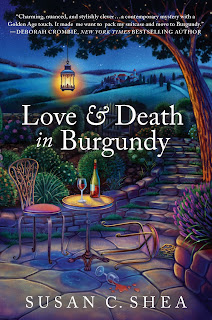
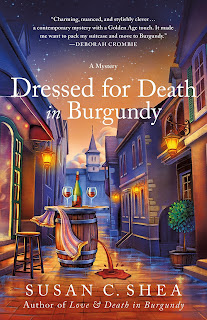
I conceived the French series as stories set in seasons that were, in a sense, characters. The first in high summer in pastoral Burgundy was a time for spending days and – importantly – nights outdoors, flowers in full bloom, meals on a dappled, sunlit patio, excursions to the summer flea markets. It helped significantly with the plot and to show my characters in three dimensions. The second was set during the two weeks before Christmas, a very different season and setting. People inside more, their shopping different, their chores and priorities relevant to the winter holiday. I needed cold and wet to push them toward and away from each other as the plot demanded. And I wanted Christmas Eve as a resolution and a grace note for the little town. If there had been a third, it would have taken place in April, when spring is bursting forth, farmers are sowing alfalfa and the winter-born calves are getting frisky. 


The publisher agreed, witness the distinctly seasonal covers. 


Time, in my books, is an important device so I let time pass or hold it back for the purpose of storytelling. I don’t know what I’d do if there were ten French Village mysteries or if Dani O’Rourke’s life was upended by crimes in the art world every month! Many of my Minds colleagues do have much longer running series, so I’m looking forward to hearing from them. I’ve read their books and they do it smoothly enough that I don’t think about the passage of time since the previous adventure.


Friday, January 28, 2022

I Have A Request

Over the past several years, the US has become objectively more polarized politically. Have you accounted for this in your recent work in any way? If so, how?

Posted by Abir


My writing is political. Every book I have written and almost every short story or article has a kernel of politics at its heart. Political issues, in the general sense of how the world is, and is governed: the inequalities and the injustices, are the animus for most of my writing; the fuel which propels and compels me to write.


It’s been fascinating to read the posts of my fellow writers on this blog, and it’s clear that while some are motivated by some of the same factors as me, others use their writing as a means of escape from political issues. Isn’t it interesting how the act of writing achieves different things for different people? At the heart of it though, I think writing is a form of therapy. For me I write about political issues as a way of exorcising my own demons and dissipating my own rage.


My writing to date has been set in the past, specifically in 1920s colonial India, so the issues of polarization, seen most clearly in the United States, but certainly not limited to it – witness the Brexit split in the UK and the general and ugly rise of populism everywhere from Brazil to Hungary to India – have not been something I’ve had to focus on yet. However, the book I’m writing currently is set in the USA and deals in part with such issues. 


The polarization of political discourse in America, seen from across the Atlantic, is something fascinating and troubling. To that end, I have a request to make of the readers of this blog and my fellow writers. I’d love to hear your thoughts on what’s going on in America at the moment. What do you think are the reasons for the rise in polarization, and what does the future hold? Of course, there are two sides to every story and I want to try understand both sides of it.


Please do leave me your opinions in the comments section below, or if you prefer, you can e-mail me at info@abirmukherjee.com . I'll do my best to respond to everyone who writes to me.


Cheers!


Abir

Thursday, January 27, 2022

What’s Old is New Again from James W. Ziskin

Over the past several years, the US has become objectively more polarized politically. Have you accounted for this in your recent work in any way? If so, how?


This week’s question is one I’d rather avoid. I have strong views on politics, but have come to realize that arguing my side publicly does not convince or convert people who disagree with me. The country has become so divided that I truly fear for its future. Civility, if it ever was present in our political culture, has certainly dried up now. Insults, intransigence, racism, violence, and real threats to our democracy are the norm these days. I find it all distressing.

That said, I will try to give an adequate answer all the same.

Like Dietrich, I write stories that take place in the past. Ellie Stone, the protagonist of my mysteries set in the early 1960s, is a fierce liberal. She cares about those less fortunate than herself, and does not abide prejudice or injustice. She prefers to punch up rather than down. And she comes from a family grounded in academics and the arts. Her childhood vacations were spent at a mountain lake in a sort of leftist collective with other like-minded intellectuals. She campaigned for JFK in 1960.

And while the world was certainly a different place in the early sixties, some social and political issues of that era remain at the fore to this day. I have addressed some of those topics in my books, for example antisemitism, racism, and misogyny, as well as violence and discrimination against the LGBTQ+ community. In Ellie, I’ve tried to paint a picture of an engaged, aware young woman of her time. To ignore social issues in my books would amount to a blinkered view of history.

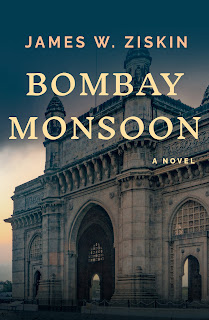
My next novel, Bombay Monsoon (December 6, 2022), is set during the 1975 Emergency in India. At the eleventh hour, just as Prime Minister Indira Gandhi was about to be forced from office, she engineered a virtual coup (Emergency) under the guise of protecting India from “internal and external” threats to the nation. Civil liberties, due process, and freedom of the press were all suspended during the Emergency. Mrs. Gandhi threw her political opponents in jail. And, of course, she held onto power. 

The Emergency lasted nearly two years. When Mrs. Gandhi finally lifted the edict, she was promptly voted out of office. Three years later, she returned to power and led the country until her assassination by her own bodyguards in 1984. 

As I researched and wrote Bombay Monsoon, I couldn’t help thinking of Richard Nixon, who, one year before Mrs. Gandhi’s Emergency, had reluctantly resigned from office. I wondered what might have happened if he’d attempted a coup similar to Mrs. Gandhi’s to retain power. In Bombay Monsoon, my protagonist broods over that very question. He’s disappointed that Mrs. Gandhi failed to rise to even Nixon’s level of integrity.

And, lest anyone believe that a coup such as the Emergency—a transparent subversion of democratic process and attack on the rule of law—could only happen in a place like India, I point with sadness to the events of January 6, 2021. I shudder to think how close we came to our own American “Emergency.”


Wednesday, January 26, 2022

A fine line

Over the past several years, the US has become objectively more polarized politically. Have you accounted for this in your recent work in any way? If so, how?


by Dietrich


Most of my novels are set in times gone by, so the stories have nothing to do with the current political or social climate.


That said, I do allow my characters to shake out their own views, political or otherwise. No matter what the setting, the stories are told from the point of view of the characters, and these imaginary folk have to be free to express themselves. Their thoughts, words and deeds have to be authentic, character-revealing, and they have to move the story along in some way.


I don’t have to agree or disagree with them. And yes, there are certainly sensitive issues at play these days. However, while staying conscious to what’s going on in the world today, in times when even Mr. Potato Head’s had his noggin on the block, it may be easy for a writer to become overly cautious. 


So, I have to ask, can one lose the art in the effort of weighing and measuring?


My aim is to engage readers and take them on a journey while immersing them in a time and place. Tiptoeing around the words and censoring could lead to less than believable passages. And readers can become detached from the story when certain elements just don’t ring true. 


To some degree, most of us in the real world are flawed. Who hasn’t misstepped or misspoken? And characters in a novel have to be like this to be credible. Choices they make reveal something deeper about their integrity or the lack of it. However misguided they may be at times, I take care to stay out of the way and let the story unfold, allowing for the characters to find redemption or succumb to unwelcome consequence –– just like in real life. 


“I’d rather be a lightning rod than a seismograph.”

Tom Wolfe, The Electric Kool-Aid Acid Test

Tuesday, January 25, 2022

Fiction, or Politics


Hi, Terry Shames here. This week we are talking about politics, and whether we tackle our country’s increasingly strong political polarization in our books. 

 I am outspoken on social media about politics. More than once I’ve had a reader tell me they think I should keep quiet lest I lose some readers. Sorry, but if lose readers over what I consider the most important issue of our time—our continued existence as a Republic--so be it. 

 But what I do in my personal life on social media is not equal to what I do when I write fiction. I write to entertain and explore. And I enjoy reading those authors who do the same. If they stray into didactic territory, I can go along for a bit, but once they cross a line into preaching or author intrusion, they leave me behind. Or I leave them behind. Either way, I think that breaks the writer/reader connection, and I, for one, won’t go there. 

 Polarization in politics is not new, although the current version seems more radical than it has been in over a century. Using my fiction to talk about people and their issues seems more useful than taking a political point of view in novels. 

 I write about a small town in Texas. As a political lightning rod, it doesn’t get much “hotter” than Texas, especially if you are a woman. Merely saying that I write books set in Texas sometimes brings an uncomfortable reaction from prospective readers. I picture what would happen if I wrote overtly about politics in my series. I imagine coming home to find people with pitchforks; guns; and vats of tar and feathers, milling around outside my house—whichever way I would pitch. That isn’t to imply that I am a both-sides-ist. Anyone who knows me knows I think Democrats, however imperfect, are the party of people who are serious about solving problems, and that Republicans, however perfect, are the party of cruelty and greed. 

 So, now that I’ve enraged 40% of the readers here, I will repeat that I don’t tackle politics per se in my books. I do tackle social issues: greed; religious hypocrisy; the poor treatment of veterans in this country; gun culture; sexual abuse; racial issues; and police corruption and brutality. 

The bottom line is that we all write in a political atmosphere whether we do so overtly or not. And I’m not just talking about writers in the crime-writing field. But in particular, we write in a genre in which the police are frequently corrupt, incompetent or indifferent; in which the justice system has little regard for the truth and/or has little interest in the despair of those who run afoul of the system; in which religious leaders turn a blind eye to abuse; in which male domination is a given; and so on. To the extent that writers shine a light on these issues, they are writing about politics. Writers who tackle domestic abuse, for example do so with the understanding that such abuse continues, sometimes with the tacit approval of the police, and often without sufficient laws to punish such abuse, the result of political indifference. 

 There’s another angle to this, though. I’ve read more than one thriller in which the protagonist disdains legal means for attaining justice, in favor of vigilante justice. I root for them because they are on the side of the injured. It’s a case of the ends justifying the means. And that’s a slippery slope. 

I have had to put down books in which the writer obviously has a political ax to grind and s/he has the characters carry the political water, mouthing political stances that have little to do with the book’s plot, and everything to do with the author’s opinions. Not that I don’t stoutly defend their right to espouse those opinions, even if I abhor them. But it makes for poor fiction reading, at least for me. So I will continue to tackle hard subjects, but I’ll let real life or non-fiction serve the political arena.

Sunday, January 23, 2022

Politically Speaking ...

Over the past several years, the US has become objectively more polarized politically. Have you accounted for this in your recent work in any way? If so, how? 

Brenda Chapman at the keyboard.

This week's question is a difficult one for me. I live in Canada (Ottawa) and my books are placed squarely in this country. I shy away from politics as a rule in my stories although I touch on many topical issues. All this to say that the political polarization in the U.S. hasn't had an impact on my writing.

This isn't to imply that I haven't watched in fascination/horror/unease as political shenanigans have taken place to the south of our border over the past while. What transpires in the U.S. always has a significant impact on my country, whether good or bad. Canada's political system, while vastly different, often mirrors the polarized perspectives and antagonism of the Democrats and the Republicans. For the most part though, Canadians are less inclined to identify with one party all the time, or to try to convert others to their system of beliefs to the degree that many Americans appear to do. 

The question might be why I don't focus on politics in my crime fiction since my stories are set in modern day for the most part. While I'm writing about crime and murder (not exactly easy topics), these are whodunits at their core and escapist reading. If you're like me, the political realm is depressing and keeps me up at night, if I let it.  I'm offering readers a break from all that.

If I ever do delve into politics for the sake of a story, I'd likely write about Canada's situation. This isn't something I'm planning though, but I could see a character being involved in politics since I live in our nation's capital city. I also worked in the federal government for over eighteen years and have a good grasp on the inner workings. Time will tell if I decide to mine those experiences.

website: www.brendachapman.ca

Facebook & Instagram: BrendaChapmanAuthor

Twitter: brendaAchapman


Friday, January 21, 2022

How to Handle Muther-trucking Criticism - By Josh Stallings

 Q: Taking negative/critical feedback isn't often heralded as a skill but perhaps it should be. How do you handle it when it comes your way? 


A: You would think after years as a movie advertising trailer editor I would have gotten good at taking criticism. You’d be half right. What I got good at was separating negative feedback into categories. A) Things that will make the trailer better. B) Things that are unachievable with the film they shot. C) Things that have nothing to do with the trailer I cut, to achieve them I need to start from scratch. D) Ego notes, said to prove the note giver is worthy of their paycheck. These have little to do with the work, and are easily dealt with by agreeing, then saying you did them. They never checked. E) Good ideas, said poorly, that once I figured out what they really meant would make the trailer better. This last one is key, if I trust the note giver, it is better to assume they are smart, and I’m just not getting it.


This discernment process has helped my writing career immensely by keeping me from baulking at any and all suggested changes. My ego screams “Fk this, this first draft is perfect, what would you dare to fking change?” As a young man, I said exactly this, more than once and threw objects at walls to make sure everyone knew I was serious.  Now, I pause, remember what I really want is to write the best possible novel. To do that I will need some help. BUT, I need that help to come from people who understand my voice and point of view. Before I listen to any feedback, I need to figure out if the person gets the book I’m writing. Do they actually like it? If not then their notes won’t make it better. I am blessed with several writers, and an agent I trust to read early drafts. Before them comes my best critic, Erika, my wife and true collaborator. 


Some examples of notes that made the book better,

“Madsen is too empathetic too soon. He is too Josh, not enough cynical cop. He doesn’t know how to deal with an intellectually challenged person. We need to see slow learning here.” and “NAIL DOWN THE REDEMPTION THEME.” - Amy Moore-Benson (my agent.)


In an early draft I had envisioned Niels Madsen as a womanizer, a behavior he would have to come to grips with throughout the novel. Luckily, I got this note from the brilliant writer Jamie Mason, “The amount of trying to score, heavy flirtation, and reminiscence of sexual conquest is a bit weighing. The first seventy-six pages covers roughly thirteen hours and it's difficult to square our burgeoning allegiance with Niels with that much skirt-chasing and innuendo and stuff that's even bordering on harassment.” I was tired of alcoholism standing in for character, and I had just replaced it with a different character defect. Removing that I had to dig deeper. Give him real life complications. From that I got his grandfather Hem, who is living with dementia, and more.


My brother said he wanted to see more about the world the intellectually disabled characters navigate. And “When does Madsen have his ah-ha moment about not using the R word?”


All of these notes made it a much better book. After Chantelle Aimée Osman picked Tricky up for Agora/Polis, she said the first twenty pages is all most readers give a book, and Tricky’s first twenty pages are too clichéd police procedural. She kindly added that she saw I was setting the story up for a flip, but many readers wouldn’t stick with it until then. Honestly I didn’t like hearing that. But I kept my mouth shut and dug back in. Damned if she wasn’t correct.


Here are a few of Erika’s standard comments that I say I hate, but actually love:

“I know what you’re trying to say here, but I don’t think you’re saying it.”

“You can do better.”

“AWK.”

“What are you trying to say here?… Yeah, that wasn’t clear.”


Good notes point out a problem, but don’t suggest a solve. I work with people who trust that I will come up with the best possible solution for a problem. That’s my job. It is also helpful to let me know what is working so I don’t lose great stuff in a blast of clear cutting.


Practical advice - How do I take criticism in stride? It took me a lot of years to learn to listen to negative criticism, smile and say, “Interesting, let me mull this over and get back to you.” To buy myself time to really think past the sting, see if there is something of value. 


So far I’ve been talking about pre-publication drafts. Post publication there is nothing I can do with negative comments about the writing, even if they are right, there is no action to be taken. That book is done. And yet, I still read reader’s reviews. I seldom comment on them, except for the positive ones. I have wanted to respond to negative reviews, but you can’t win an argument with someone who doesn’t like your writing.


I wish I was the type of person who never reads industry or professional reviews, but I’m not. Good, thoughtful reviews make my day/week/month. When someone really gets what I do, and digs it, I love that feeling. A bad review knocks the wind out of me. I have to shake it off and keep going.


To do what we do takes real self confidence. We stumble onto a blank page and create a world with words. Negative comments on past work or work that’s out on submission makes it damn hard to scape up the guts to do this job. When I’m in the early stages of dreaming up a new novel I need to stay away from other people’s opinion of my work. Cocoon myself away until I have enough of a piece that it can stand the slings and arrows of outrageous opinions. 


My most important trick, the one I forget and then remember and then forget again, is to keep my eyes focused on the road ahead, what I’m working on now. What the book critics and readers are talking about is behind me. Focusing on the rearview mirror will end in broken glass and crumpled fenders. 


Eyes front, fingers on keys is the only safe way to write.