Thursday, October 24, 2013

Do my stories ever come true?

Oh my God, no!  And I'm so glad about that.  The body count  - even at my end of the cupcake/chainsaw continuum - is a lot higher than I would want in reality.

In fact, the first time I can ever remember being frightened by a book - properly frightened; with sweaty palms and a cold lump in the pit of my stomach - was when I read a children's story about a little girl, ill in bed, who amused herself making a book that came true in her dreams. Gaaaah!  She drew a stick-figure child in a house and then, in her dreams, the stick-figure child was trapped in there because the door she'd drawn didn't have a handle.  Gaaaaah!  At one point, the little girl woke up and, trying to stop the horror, scribbled over the illustration, then fell asleep again and saw that the house was bound in thick black cords and the stick-figure child couldn't see out anymore.  Gaaaaaah!

It was second only to the famous Singing Ringing Tree on telly for childhood trauma.


The Singing Ringing Tree - and I apologise to any forty-something Brits who're now headed back to therapy because I've reminded them - was a 1950s east-German fairytale, bought by the BBC and broadcast on children's television without any executive actually ever watching it.  Of this I am quite sure.  I imagine a scheduler looking the bright colours and reading the synopsis (a princess, a prince and an evil dwarf) and thinking airily "Oh, it's just Rumpelstiltskin, basically."

Well.  They put it out in black and white, with a hypnotic English voice-over and the unnerving original German sync-sound fading in and out in the background.  David Lynch would have been proud. 

It was shown over and over again between the mid-sixties and 1980 and none of us will ever recover.  Such was the mark it made that when, well into the new millennium, a national poll of scary telly was taken, The Singing Ringing Tree made it into the top twenty.

If I thought it could come true, even in my dreams, I'd be laying in a lot of dried protein and heading for the hills.

So, in conclusion, my answer is no.

Monday, October 21, 2013

Beware What you Wish For


This week's Q: If you write it, will it come? Have you ever noticed your real life taking a turn that's uncannily like something you've just written about?


For me, the more likely scenario is that something that’s already happened in my life gets turned sideways and winds up in the book. Nothing uncanny about it, merely a writer’s desperate means of sucking up every available experience to see what can be repurposed for the next book. It’s never a quick turnaround, or a complete one, or one that’s entirely planned.  Jokingly, I told my S.O. about ten years ago that I’d have to kill someone who was bugging him. It took seven years, a totally invented plot, and an unkind character twist (after all the real person didn’t have a homicidal bent) but in 2010, I made good on my promise.

As I think about the two published books in my Dani O’Rourke series, plus the one currently in production and the stand-alone I’m working on right now, what might I wish would leap off the page and into my life? Would I want to start dating a homicide cop? Not really. Dani can’t seem to get through a dinner in North Beach without his cell phone interrupting and the evening being short-circuited by duty calling. Her ex-husband might seem like a good catch. After all, he has two Porsches, a Paris pied a terre, and four hundred and fifty million dollars. But life with Dickie comes at a price and if I’m half as smart as the protagonist I created, I would know better than to think I could change him.

How would I feel if I were being stalked some day while I was walking on a secluded trail? Not so good, thanks. Found out my best friend had been in a terrible accident? Stumbled over the body of a trophy wife tucked under the office furniture? Maybe I’m just not writing about the right things.


There’s a good idea: Write a scene in which my protagonist wins the lottery, buys a first class ticket to Hong Kong or Paris, and finds the perfect Chanel traveling outfit. What the heck. I’ll do it right and write in a Fendi bag and a suite at the Peninsula or the George V. Then, I’ll buy a lottery ticket and while I’m waiting for my actual life to follow my fictional lead, I’ll write a scene in which Dani is kidnapped…no, wait.


- Susan


Thursday, October 10, 2013

Bringing in A Ringer

As some might know, Catriona's beloved sister Sheila died unexpectedly last week and she is in Edinburgh with her family.  So, with apologies, we are re-running a Femmes Fatales blogpost that Neil (aka Mr. Catriona) wrote in the spring.

Readers of this blog are used to a literary feast.  This week: hotdish surprise.

Catriona has stepped aside for a one week (not-so-) special and allowed me, Neil, her husband, to give an up close and personal view of what it's like to be hitched to one of these writer types. 


028

 
But why  have you got me this week,and not her indoors?  Catriona is working like a demon, editing and drafting a Dandy Gilver novel, which will appear at some point in the future. She mentioned that she was a touch on the busy side what with the manuscript, guest-blogs and group-blogs looming. I, jokingly, offered to write the blog with the most pressing deadline and much to my horror she said "Go on then." 

You'd think the man who once ended up doing an exhibition Cha-Cha-Cha as part of a talent show at a literary festival, because of a mistaken belief that offering to help wouldn't lead anywhere awkward, would have known better.  You'd be mistaken.  I am that dumb. 

So (getting back on track) what's it like being married to one of these writer types? It's brilliant. Of course I had to say that. If for no other reason than because Catriona spends a lot of time imagining how to murder people, we live in a fairly isolated house, and even the distant neighbours we do have are used to the sound of power tools. I might not be the brightest button in the box but I know how to butter-up with the best (Boy, B got a bit of an outing there). 

So, it's brilliant, but it's not what I thought it would be. Back in the grim, dark days of the late 1990s when Catriona was contemplating leaving academia behind to give writing a go, I thought... I thought... Well, the truth is I thought there'd be more wafting, more staring into space, more sentences that trailed off half-finished (no such luck. Joking, hon.)

And I expected that I'd have to make way for a new house guest called The Muse. I thought I might have to push The Muse to one side on the couch (ever so gently, of course) if I wanted to sit beside my wife in the evening.  But it turns out that Catriona's Muse likes a well organized environment, has a work ethic that makes me ashamed any time I complain of the long hours involved in being a professor, and keeps her at her desk eight hours a day when literally outside the door is all that California has to offer. 

What I've come to realize is that this discipline provides the anchor point that allows a writer's imagination to float free and become completely immersed in the world being created. It's quite something to be around while it's happening. 
 
Which is not to say that all is calm during the creative process. At some point in the birth of every story there comes "the big early wobble", or BEW. Now, I've spoken to the partners of other writers (there are a fair few around the Davis area) and they all knew what "the big early wobble" was without me having to explain. As the name implies it usually happens near the start of a new book.
Catriona is a beginning-to-end kinda writer so the BEW usually sets in around chapter 3 or 4 and it goes something like this: 
 
C: This is terrible.
N: Oh?  What is? {Uh-oh, looks like the BEW}
C: This story. It's rubbish. Dandy's not Dandy, it has no colour, no life. It's thin.  I don't know where it's going, and it's just awful.
N: Hmmm, that *does* sound bad. Are you sure? {Yup , it's the BEW.}
C: Yes. Certain. It's never been this dreadful before. Never.
N: Not even the last time, when you said exactly the same thing? {I wonder if I can jog her memory?}
C: I've never said this before, because it's never happened before.
N: {Nope} OK. Well we better get our thinking heads on and come up with a solution. How about you read me what you've got so far and I'll tell you whether it's any good? {What a brilliant idea! And without precedent, apparently}
C: OK, but it's really rubbish [starts reading and begins to get a sense of deja vu...] 

And so the BEW comes on, shakes things up a bit, and passes off without breaking anything, leaving no trace of having ever been there. Again.

Eight Dandy Gilver novels have been through the BEW so far.  AS SHE LEFT IT went through one that registered on the Richter scale and caused new legislation in California's central valley.  All writers have to have quake-straps on their laptops now.  She did that.

But the book's the thing and the book survived.

As She Left It

Monday, October 7, 2013

Difficult? Just Ask My Cats


Moi? Difficult to live with? Certainly not.

A list of virtues:

1.     I’m a good cook when I get around to cooking, which isn’t as often as it was when I was in charge of growing boys; but, still, I make a mean minestrone soup.

2.     I hate okra (thanks, Sue Ann, for reminding me) and will never slip it into anything that winds up on a plate or in a bowl in my house.

3.     I put my clothes and shoes away at the end of the day. “Away” is a relative term, but I do not leave them on the chair, the floor, or slung over the door. There is, however, a reason the closet door locks from the outside.

4.     My cats rule. They would not consider this a particular virtue, merely the way things are and will always be, the right order of the universe.


And now, in the nature of full disclosure, a couple of things that not everyone might love:

1.     Any piece of paper that I touch magically becomes two pieces of paper, and those pieces build into dangerously unbalanced stacks on every horizontal surface. I can’t throw them away because it’s entirely possible I might want the 10% Off coupon for the plumber’s services or the printout of last week’s movie schedule or the latest reminder from the Southern Poverty Law Center that my membership renewal is overdue.

2.     I sniff a lot – allergies, probably – and keep boxes of tissues in every room, which in itself isn’t so bad except that I carry tissues with me and leave them in every room, little crumpled white mementos of my passing. My S.O. once told me I would be buried with them just in case.

3.     I write books. In order to understand the market, and because I love them, I read books too. Real ones, you know, with paper and cardboard? I’ve stopped counting but when I moved, I had a carpenter circle an entire room with bookshelves and I still have piles of crime fiction books on the floor.  (Thank you Bouchercon, Left Coast Crime, and Malice Domestic.)

4.     My cats rule. It’s a good idea to keep one eye on the floor when you come to visit – and I hope you will – to avoid felt balls, foam balls, furry critters on strings, furry critters stuffed with catnip, balls with little bells inside, and two medium size, definitely orange girls who will want to flirt with you and make you their subjects.

Thursday, September 26, 2013

A born storyteller.

Following on from Clare's Bouchercon-inspired post yesterday, I'm going to share an "are you a writer" conversation I fell into at the bar.

So I was at the bar and, as anyone who attended Bouchercon will confirm, that left plenty of time for a long chat.  (2 barstaff, one on his first day (yes, really) and a whole lot of crimewriters and fans.)   A guy sitting on the nearest stool to where I was waving a 20 and pining for a club soda said the line.

Guy: "Are you a crimewriter?'
Me: "I am.  You?"
Guy: "Yup."  (Slight alarm bell in the distance, since he was wearing one of those 1930s Chicago- style caps, at a very jaunty angle, and was chewing a toothpick as if there was a teeny weeny little baton twirler practising in his mouth.  In other words, he looked a bit too cool to be one of us.  Like when Lou Diamond Phillips turned up at Left Coast Crime; even from the back you knew he wasn't a writer.)
Me: "What do you write?"
Guy: "Oh, I'm prolific.  What do you write?"
Me: "1920s amateur sleuth novels.  And a stand-alone."
Guy: "Novels?  Books?  Wow.  How many?"
Me: (thinks) "Eleven."
Guy: (whistles).  "Hot damn."
Me: "So . . . are you a short story writer. (Because why are novels so surprising?)
Guy: "Short, long, real long.  I do it all."
Me: "What's your name?"
Guy: "My real name or my pseudonym?"
Me: "Are you on a panel this weekend?  Because this witness protection programme stuff isn't going to fly."
Guy: "Okay, my name - and you better get ready for this - is Stephen King."
Me: "Oh. Yeah, well, good idea changing it.  Or even Steve King would do, so your mother could still be proud sort of idea."
Guy: "No, Stephen King is my nom de plume.  That white guy in Maine?  He's my assistant.  He does the travelling and I do the writing."
Me: "Uh-huh."
Guy: (turning to the man eating his burger and fries on the next stool along) "And this is my beautiful wife, Tabitha."
Me: (getting it finally) "Well, it's a great honour to meet you, Mr King.  I'm a  huge fan."
Guy: "I'm just messing with you.  I clean the windows in this place.  You really a Stephen King fan?"
Me: "A huge one.  All of them - the early stuff and the late stuff.  I loved Dumas Key."
Guy: "Oh, yeah!  LOVED Dumas Key.  Scared the bejesus out of me,  Dolls!"
Me: "Oh my God, yeah.  Dolls.  Dolls and creepy little dead kids scampering around."
Guy: "With the footprints?  Brrrr.  How about Lisey's Story?"

And then the time passed very pleasantly, looking forward to the Shining sequel and arguing about the Dark Tower and I learned that a. books are a universal language, b. my basic setting is "taking a basket of food through the woods to grandma's house" and c. window-cleaners are cooler looking than crimewriters.  At least in New York.

Wednesday, September 11, 2013

And then all of a sudden something exciting happened.

"Sorry, what was the question?" asked the crimewriter.  She'd been cooking, editing and preparing interview questions all at the same time all day and was a bit scattered.
"Which bits of writing come easy and which are tough?" asked the blog.
"Oh, okay.  Well, let me see now . . . dialogue never seems that hard.  You know, naturalistic sort of dialogue like people actually do?"
"As opposed to constructions which are too syntactically complex and contain overly formal vocabulary choices?'
"You betcha."
"What about description?'
"We've all stopped description for a month in tribute to Elmore Leonard, haven't we?"
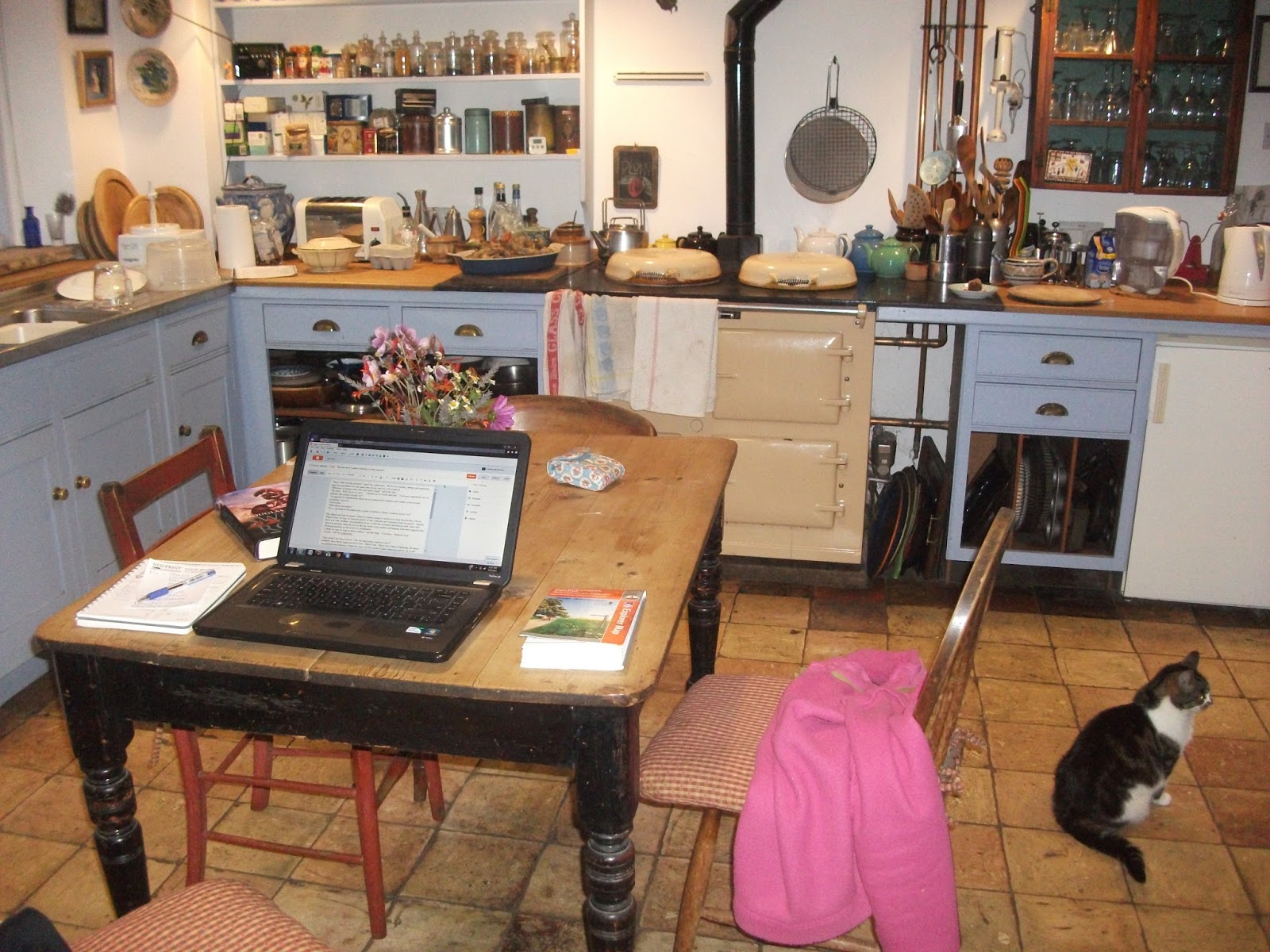
But Elmore Leonard seemed a world away from this kitchen, with its flagged floor, its Aga, its cheerful jumble of cats, cushions and courgettes from the garden.


Outside there was some weather too: rain plotching down, so that the sweetpeas and honeysuckle which had waved in greeting when she arrived the day before were sodden, hanging from their string supports like swooning maidens on the jacket of a bonkbuster.
"I think it's okay as long as there's similes," said the blog.  "You know - Marlowe style."
"Coolio," said the crimewriter.

"And action?' the blog went on.  "Do you find action sequences easy?"
Suddenly three things happened all at once.  Maybe four.  Lightning flashed, the house was plunged into darkness, behind her there was the sound of glass shattering and the cat on her lap dropped to the floor and streaked away through the catflap, crouched low with its ears flat back.
She leapt to her feet, knocking over her chair, and backed away from the door.  Even in the darkness, she could see a humped shape and an arm reaching through the broken pane to scrabble at the handle.
Through her panic, she had time to realise that a flash of lightning shorting the electrics, just when an intruder was about to burst in, was a massive coincidence, but the cat was a nice touch.

"Don't come any closer," she said, the relief of returning to dialogue lending a steady and commanding air to her voice, although her pulse thrummed.
"Who's going to stop me?" The snarl in the voice turned her legs to jelly.

Jelly!

All day she had been boiling pork bones and herbs to make stock.  She had been planning to use it as a jelly layer around the inside of a raised-crust pork pie.  None of that mattered now.  She tossed her head, trying to shake out the recipe nonsense.  With the movement, her hand brushed against the measuring jug sitting ready for when the stock had cooled.  She seized it, dipped it, and threw 500mls of scalding hot liquid, drained but unsalted (she shook her head again), right into his gleaming eyes.

Just then the lights came back on, for reasons which will have to be determined in the second draft and she looked down into the ugly and now blistering features of A Very Bad Man.
"How about characterisation?" the blog asked quietly. 
"Never mind that,' said the crimewriter.  "I still have enough stock left for my pie."


Thursday, August 29, 2013

And one sink (kitchen)


What a great question!  I've never, in all my list-making, floor-plan-drawing, map-copying, outfit-sketching obsessiveness ever actually thought about what Dandy Gilver carries in her bag.

I know she has little notebooks, because Alec Osborne - her Watson - ribs her about them and lately she's taken up a propelling pencil too.  She has a cigarette case and a box of matches, a lipstick and powder compact, a handkerchief - white lawn, some embroidery, a purse (= US wallet) with bank notes, coins and postage stamps, and a nail-file.

I know she doesn't have any keys because her house is never empty.  If she wants to get in, she rolls up the drive and waits for someone to open the door.  I can't see her with locks of baby's hair or photographs of her husband either, somehow.  Maybe she'd have a scrap of leather from Bunty the Dalmatian's first collar, but even that is a bit mawkish for Dandy.

I imagine it would be quite a small plain thing and easily decanted into an evening bag without a lot of triage.

I, on the other hand . . . here's a run down as of  28th August 2013 in order of excavation: 

promotional postcards for Dandy Gilver
promotional postcards for AS SHE LEFT IT
sunglasses
reading sunglasses
reading glasses
another pair of reading glasses
ibuprofen (I've had a cough)
Strepsils (ditto)
paracetamol (ditto)
phone
camera
another phone
baby wipes
Tigi Bedhead
glasses case
three blue Bic Cristals
skeleton bunch of only three keys and three keyrings because away from home
lipstick
mascara
rouge
sunscreen
large pink hanky (was white and my dad's until a laundry incident)
five earrings
toothpaste I bought yesterday and forgot was in there
1UKP off The Guardian coupons from the Edinburgh Book Festival (expired)
wallet containing skeleton staff of only nine cards because away from home
stamps
lucky 2 dollar bill
earplugs
receipts (various (for tax))
receipts (various (for no reason whatsoever))
four business cards from the Crimewriters' Association lunch last Friday
money
seaglass
two dead batteries
twenty nine Christmas cards

And the thing is that I only bought this bag a month ago so it's still building up its foundation layer.  There are whole pockets in there I haven't even assigned yet.  There are no wedding favours with happy memories that I can't throw out, no orders of service from funerals that I can't throw out, no 3D specs from films I've enjoyed and can't throw out, my bike lock and front light aren't in there, not a single packet of seeds, no CDs, no unrelated CD cases, no charger cable for either of the phones . . . why it's practically empty.  I could almost be fictional with a bag as empty as that.


Thursday, August 15, 2013

No Ballet for Catriona

Funnily enough, I'm answering this question in my childhood bedroom, in the house where I was born, where my three big sisters taught me to read, playing at schools every day (I can't remember not being able to read; certainly I was well away by the time I got into my first real classroom with a non-sister teacher).

And in the bedside cabinet is ... pause to look ... Five Go To Smuggler's Top by Enid Blyton (1945).


I must have read it a fair few times, along with the other stories in the Famous Five series.  In each one, a group of cousins (four of them) come home from boarding school for the summer, shake off the grown-ups (Uncle Quentin and Aunt Fanny) and disappear off with their dog (the fifth one) on a hike, in a caravan, after a circus, to a treasure island . . . there to be posh, solve crimes and eat picnics.  Hogwarts food was pretty much Famous Five food and Scooby-Doo will give you an idea of the plotting.

Much, much better than these though was Ballet for Drina by Jean Estoril (1957) and five of its ten sequels.  No, wait - hear me out.  Okay, Drina is an awkward little shrimp of a girl, orphaned, living with her grandparents, who blags her way - Billy Elliot style - into ballet classes and, predictably, becomes a ballerina.  But besides the clichés, there are friendships, passions, secrets, betrayals, concern for social justice, wrongs righted, triumphs, disappointments and some the best Mean Girls ever. 

As well as all that, once Drina knows her arabesques from her elbows, she starts to tour with the corps de ballet and, an intrepid Londoner, she takes Paris and New York in her plucky but dainty stride.  Then she goes to the Edinburgh Festival.  That story was my first experience of reading a book set in a place I knew - having resisted Walter Scott and being too young for Jekyll and Hyde - and the detail was enchanting.  I had been on those streets and looked at those views.  It made me want to see how accurately Estoril had depicted London, Paris and New York too. 

Luckily, it didn't make me want to be a ballerina.  I was five foot eight at the age of twelve and could trip over the pattern in the carpet.  But the reason I can't take a quick phone picture of Ballet For Drina is that it's not here; all six books are in my house in California in the glass-fronted bookcases where the treasures stay.  I've read them many times and I still reach for them when life gets the way life does.   If anyone else has read them - sssshhh! (There's a massive plot twist at the end of book 1) - but let me know if you too love them.

Thursday, August 1, 2013

The Five Identical Red Herrings

I can't quite believe I'm doing this - because I do love her; honest I do - but my bad classic is by Dorothy L Sayers.  Not only that, it's the one set in Scotland - land of the purple liver, land of my heart forever.  And not just Scotland - Galloway!  Where I lived for fifteen happy years, swimming in the icy pools under waterfalls and swatting midges with fern fronds on the bonny banks and braes.
I've done the literary walk around the real places used in the book. I've had a picnic at the bit of the Mennock Burn where the body tumbled into the water.  Heck, I've probably been on the fateful Girvan train.

But still.  The Five Red Herrings by DLS is (IMHO) a stinker.


Some of it is the dialect representation.  I know a bit about this one way and another and much as it hurts to write that someone says: "The moon's none the worse for a dog's bark" when what you hear in your head is: "The meen's nane the waur fur a dug's howf" you really can't, can you?  I mean it makes little enough sense in English as it is.

So the apostrophe-tastic depiction o' Sco'ish people talkin' is one thing.  But the main difficulty with the Five Red Herrings is the five red herrings (and the guilty party).  I think it would be possible to find six actual herrings, in a fishmonger's, that were easier to tell apart than Strachan, Fachan, Gachan, Wachan, Grachan and Fergachan. 

I'm kidding.  They're called Strachan, Farren, Gowan, Waters, Graham and Ferguson.  But they're all artists and they're all exactly the same.  In fact, for once I don't have any worries about spoilers slipping out because, although I've read FRH a couple of times and listened to a BBC radio dramatisation too, I still have no idea which one of them did it.

I know what you're thinking, by the way.  Yes, I read it again even though it's bad.  And then I listened to it in the form of a radio play too.  (In fact, when I was looking for jacket photos for this blog I saw that the telly version is on youtube and I might well watch it later.) What can I say?  I told you I love her.


Thursday, July 18, 2013

Logan MacRae, but on another topic . . . my book launch!

I'm reading Close to The Bone, Stuart MacBride's 90mph head-on multi-plot pile-up of a novel right now, since we're on a panel together at Harrogate and it's terrific stuff.  But poor (acting) DI MacRae could do with a break, so I nominate him to spend a couple of weeks in the California sunshine solving my murder.

Unless I'm knocked off in the next few months, in which case he'd only get down the road to Edinburgh.  I'm there for the summer and tonight I was in Waterstone's in George Street doing a launch event for DANDY GILVER AND A DEADLY MEASURE OF BRIMSTONE. 


And the strangest thing happened.  You know that bit in Harry Potter where they zap dormice into milkjugs but the jugs still have tails and fur?  Well, my book popped up again and again tonight.  Blue with touches of blood-red was everywhere.  In the lovely flowers from my oldest friend Catherine Lepreux:


In a hand-felted tea-cosy made by my dear friend Louise Kelly:


And of course in cake form, courtesy of my mum and dad:


Many, many thanks to Colin, the manager, who came in on his day off for the event:


And to Stuart Campbell, my beloved high-school English teacher, who took one look at my train-print dress and reminded me why he was such an inspiration all those years ago by saying "O. S. Nock" (he wrote the book that the illustrations appeared in, you know.) 


I'm feeling very lucky tonight: a wonderful family, fantastic teachers and friends I've known for decades.  Life is sweet and, on balance, I hope Logan MacRae doesn't get the chance to take that trip!


Wednesday, July 3, 2013

Trouble at the Front


How timely this question is!  I've just hit SEND on the edited draft of THE DAY SHE DIED, my second contemporary stand-alone for Midnight Ink.  It's notable for being the first book that's coming out under my title after a run of five that were changed. 

And you know what?  The editor was right and I was wrong every one of those five times.

The last modern one AS SHE LEFT IT started life as OPEN THE DOOR.  Well, actually it started life as FISHBO'S PUFFER.  Neither of my attempts were terrible but ASLI is best.

I thought I was going to have two keepers in a row, mind you, because DANDY GILVER AND A REGRETTABLE KETTLE OF HERRING (just submitted) struck me as pure genius, but Editrix Lestrange at my London publisher pointed out that nothing about that title says "crime".  Duh.

A BOTHERSOME NUMBER OF CORPSES began as TROUBLE WITH YOUNG LADIES

AN UNSUITABLE DAY FOR A MURDER was once TROUBLE IN STORE

And DANDY GILVER AND THE PROER TREATMENT OF BLOODSTAINS - a gem of a title - gave me endless gyp along the way.  I called it IN THE DARK.  It's about  a. a coalminer's strike b. buried secrets and c. servant life in the basement of a house.  In the dark x three!  But then Mark Billingham brought out his new book and it was called In The Dark (for no good reason that I could see or at least not for three of them).

So then we called it DEEPEST RED, as in blood and as in the people's flag of the left wingers who wanted the strike to succeed.  I liked it; others thought a quote from a Marxist anthem might not hit the right note.


So for a while, just among ourselves, we called it TROUBLE DOWN BELOW.  It started as a joke, but after a while it seemed quite, quite fine.  This is how people manage to be called things like Dr Sprinkle (he works at my local surgery) and Hampton Sublet (A colleague of my husband's) without giggling all day.

So, all in all, I'm very grateful to my editors for thinking up better titles than I do. 

My favourite title of recent years?  Hands-down, saw it in the bookshop and bought the book without even looking reading the back jacket copy . . . WITCHES ON THE ROAD TONIGHT.  That it was about depression-era Appalachia, a time and place that fascinate me, was a bonus.  It's still on the TBR pile but every time I see it (while dusting) it makes me happy.

Thursday, June 20, 2013

Butlers and wise guys need not apply.

There's three categories of books I can't read while I'm writing.  (Writing meaning first-drafting; chipping the virgin story out of the ground.)

1. Books similar to mine that I want to be able to say I didn't read and haven't stolen from even if we've both got retired burlesque dancers who fly the first air ambulances in Worcestershire and killed their twin brothers with a grapefruit spoon.

So that's Jacqueline Winspear and Rhys Bowen - the other two blonde Brits who live in northen California and write amateur detective stories set in the UK in the 1920s.  And Carola Dunn (as above except it's Oregon) and Kerry Greenwood too.  Which is a lot of great books to not read.  Moof.

2. Books in the wider genre so breathtakingly, heartbreakingly fantabulous that I'd get a case of the why-bothers only Ben, Jerry and Sheldon Cooper could cure.  This sees off Dennis Lehane, Ruth Rendell and Ann Cleeves.  There are more but I need to stop now because even listing them is dispiriting. 

3.  Books by writers whose style is insidiously contagious (and who are too famous to hyperlink).

Raymond Chandler is just about the worst of these.  I was reading him once while writing and decided that Dandy Gilver's tea frock could fit her like a mermaid's scales.  Why not?  (I caught it in the edit.)

Ernest Heningway isn't worth the risk either.  Nick and the fish and the big two-hearted river?  Hugh Gilver sometimes poddles off with his rods hoping to catch a salmon but it's not the same.

But pipping them both at the post (or poking them both smartly in the second waistcoat button, as he would say) is PG Wodehouse.  Some of Wodehouse's lines make me laugh out loud no matter how many times I've heard them.  When Bertie Wooster had a hangover and "a cat stamped into the room".  Or when Mr Beach is displeased but says nothing and PW describes it thus -  "ice formed on the butler's upper slopes".  Genius.  Or when  . . . I think it's Bingo Little . . .  sends a telegram that begins - "I say Bertie old boy stop yes Bertie stop I wonder old chap if I might have a word stop"  The narrative goes on - "The telegram is not Bingo's natural form."

So part of the joy of getting that first draft done is to be able to read absolutely anything again.  Mystic River or Right Ho, Jeeves.  The world's my TBR pile.


Thursday, June 6, 2013

Catriona McPherson: Private Eye

I'm the wrong person to ask about day jobs because I've so rarely had a day job I either a. liked or b. was any good at.  For sure, I've never had a day job that c. was going to make my fortune.

I tried banking.  Hah.  Fifty-pound-notes got bundled into hundreds.  Which was four notes, right?  After they searched my bag and and my pockets and recounted my stash and looked down the back of the couch, a very honest wages clerk came back to the bank and returned the extra.

I tried being a university lecturer.  Hah.  I was one of four lonely linguists in an English literature department, teaching phonetics and syntax to kids who wanted to learn Jack Kerouac.  When one of my colleagues asked me what I read for pleasure I said I only read the TV Guide to see what time Star Trek was on.  I forgot to wink; he believed me; I was the talk of the senior common room.

I worked in a pub serving food but my portion control was non-existent and just before the place went bankrupt I was demoted to cleaning.

I worked in the Fine Art and Local History departments of Edinburgh City Library.  That, I loved.  That, I could do.  That, was between university courses.

So giving up a full-time day job in 2000 to try this writing lark wasn't as difficult a decision as it might have been.  I did part-time tutoring to make some money and also had a number in my head: if I ever got an advance of *this* amount, I said to myself, I'd give up even the tutoring and write really full-time.  That took five years and it was scary when it came.

This is year thirteen of writing stories and I feel as if I'm just about to get a day-job again in a funny kind of way, because I'm about to start renting an office in town and going back to having a commute instead of working in my house.  It'll be a big change - no more jammies, no more leftovers for lunch, no more chats with Joe the UPS guy . . .

My one regret is that my office doesn't have a half-window of bumpy glass on which I can put my name in gold paint like Philip Marlowe.  That would have been something.  But learning to smoke those unfiltered cigarettes might have been tough and a raincoat and fedora in this climate would have killed me.

Oh and also:  AS SHE LEFT IT comes out on Saturday.  Yeay!


Thursday, May 9, 2013

A tale of three mothers

That's Dandy Gilver's, Opal Jones's and mine.

Dandy Gilver's mother started her off with a good smack in the chops by naming her Dandelion.  Mr and Mr Leston were great devotees of the Arts and Crafts movement, so popular in the late Victorian age, and it seemed like a good idea, I suppose, to call their daughter after one of England's most neglected wildflowers.  I think, in contrast, that if you want someone in your family to have a funny name you should change your own.

After the christening, Dandy's mother receded and Nanny Palmer came to the fore, as was usual in the upper classes at the turn of the 19th century.  It's Nanny Palmer whose voice is still in Dandy's head and whose spirit hovers.


Dandy got a better deal than Opal Jones, the heroine of my new stand-alone AS SHE LEFT IT (8th June).  When the book opens Opal is coming back to her childhood home after her mother's death.  Here's what she finds:
The curtains were shut, like always, and the bed, like always, was heaped up
with pillows and cushions, piled high with quilts and blankets, a nest. 
Magazines and a toilet roll, some clothes, some bottles of course, an ashtray
and a big soup tin without its label for emptying the ashtray into and, where
the blankets were pushed back and the pillows and cushions were flattened,
a round hole, tiny.  Big enough to hold her mother?  Must have been.
She hadn’t died there; she’d gone to the hospital; admissions, acute medical
– or that bit of acute medical that’s basically the drying-out ward – then HD
then ICU and there she had died.  But it had started here.  One night, or one
morning more likely, she had climbed in and never climbed out again.
My two heroines have very different lives and grew up into very different women.  Dandy is brisk and capable and it would take a lot to sink her. Opal is tough on the outside but wary of going to places that will open her wounds. One the other hand, Opal can feel things; Dandy believes that feelings are not quite respectable and avoids them.  Hm, maybe they're more similar than I realised, after all.

I got a whole lot lucker than either Dandy or Opal when it came to mums. My mother, Jean McPherson, brought up four girls, knitted all their jerseys, cooked two hot meals a day from scratch and taught them a love of books.  What more could you ask for?  Okay, themed launch-party cakes:


cut with the McPherson family musical cake-slice. UK Mother's Day has been and gone but every day is a good day to say "Thanks, Mum."