Thursday, March 10, 2022

Perfect Risotto alla milanese in Twenty Easy Steps from James W. Ziskin

Some – not all – mystery novels have recipes in them. But surely every life has at least one recipe in it. What’s your go-to / stand-by recipe? Is it passed down in your family or did you invent it? 

My stand-by recipe is risotto. I do variations on a theme, but they’re all risotto with Arborio or Carnaroli rice. Either way, the result is delicious. For this post, I’ll go with my risotto alla milanese.

What you’ll need:

1 large yellow onion

Extra virgin olive oil

Sea salt

Ground pepper

Pat of butter

Large pinch of saffron

Large water glass of Arborio or Carnaroli rice

Large water glass of white wine or champagne/prosecco

Large water glass of chicken/turkey/vegetable stock (more as needed)

Water as needed later during cooking

Small glass of peas

Lots of freshly grated Parmigiano cheese (no green cans!)

After many years of trial and error, I’ve settled on what I think is the perfect recipe for risotto. You want the rice to be al dente. Not soggy or soft. Restaurants typically take a shortcut and parboil the rice in advance because they can’t have a chef stirring it for twenty-two minutes non-stop. But this recipe has no shortcuts. It requires twenty-two minutes of uninterrupted stirring. You can’t leave a risotto to cook on its own. Be prepared to stand in front of the flame for twenty-two minutes. Twenty-two minutes.

INSTRUCTIONS
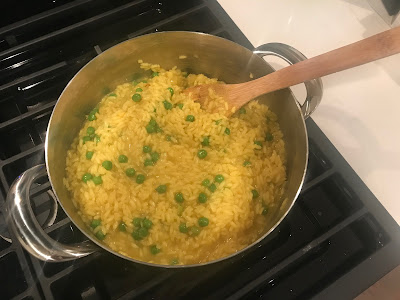
 1. Pour yourself a drink. One that will last twenty-two minutes. Place the drink near the stove. Measure the distance with your arm to be sure you can reach it without moving away from the burner.

2. Soak the saffron in an inch or two of hot water in a mug. Keep it at the ready.

3. Sip your drink and put on your game face, for God’s sake.

4. Chop the onion. In a large pot—e.g. what you boil pasta in, or, better, a risotto pot—simmer the onions in a puddle of olive oil (extra virgin only) and butter. Add a couple of pinches of sea salt and cook until the onions are soft and translucent.

5. Once the onions are perfect, set a timer for twenty-two minutes and add the rice. If the onions are not perfect, throw them out, curse yourself, and question your ability to follow simple directions. Start again. Then toast the rice for two minutes over a medium flame, stirring constantly with a wooden spoon. No fucking plastic spoons! What the hell’s wrong with you?

6. After two minutes, start adding the white wine gradually to the rice and onions. Don’t add it all at once. Take it easy, will you? Have a sip of the wine if you like. Go ahead. You know you want to. 

7. Keep adding the wine as the rice absorbs it, stirring as you go. That’s right. Like that.

8. Pour the saffron and water into the pot. Keep stirring.

9. Take a healthy gulp of your drink. And, why not? Have another nip for courage.

10. Begin adding the chicken stock to the rice.

11. Ignore the growing fatigue in your arm as you stir constantly. Switch hands and stir with the other if you can. If not, suck it up and stir anyway, you big baby.

12. Eye your drink and begin to worry if you’ve indeed poured yourself enough to see you through this recipe. Hey, don’t say I didn’t warn you.

13. Shrug in resignation and take another gulp.

14. Continue adding stock and stirring until the timer shows three minutes to go.

15. Add the peas. These are mostly for color, as they don’t really make or break the dish.

16. Keep stirring, slacker. And knock back whatever’s left of your drink into your mouth. Don't forget to swallow.

17. Add water to the pot as needed. You want the mixture to be a bit soupy when the timer goes off. The rice will continue to absorb the liquid in the coming minutes, and you don’t want dried-out risotto, do you? Well, do you? I didn’t think so.

18. Order everyone to the table to eat immediately, because your risotto will be Alpo in three minutes if it’s not consumed tout de suite.

19. Add generous heaps of Parmigiano to your rice. Pepper to taste.

20. Receive accolades from your guests with humility and good grace.

Wednesday, March 9, 2022

A guest post by John Lansing

This week, I’ve invited my good friend John Lansing to do a guest post. Before writing his best-selling Jack Bertolino series, he started out as an actor in New York City, performing the lead in the Broadway production of Grease at the Royale Theatre before putting together a rock ‘n’ roll band and playing the iconic club CBGB.

After heading to the West Coast, he landed a co-starring role in George Lucas’ More American Graffiti, and guest-starred on numerous television shows.


During his lengthy writing career, John wrote and produced Walker Texas Ranger, co-wrote two CBS Movies of the Week, and co-executive produced the ABC series Scoundrels. His first book was Good Cop Bad Money, a true crime tome he co-wrote with former NYPD Inspector Glen Morisano. He followed it with the Bertolini novels: The Devil’s Necktie,, Blond Cargo, Dead is Dead, and The Fourth Gunman. John now resides in Los Angeles, and we’re fortunate to have him here. — Dietrich

John: My father was first generation Italian American, my mother, first generation Polish American. They met and married post World War II, and because of the discrimination their parents suffered, they were all about assimilation. Dad didn’t speak Italian at home, and Mom never uttered a word in Polish. And after living on spaghetti every day of his childhood, my father vowed never to eat pasta again. We were American’s and ate American food.


Dad was one of seven brothers and sisters, and my culinary life changed the first time I went to a Sunday dinner at his sister’s house in Floral Park. I stepped past the door into Aunt Mary, and Uncle Chip’s home and was grabbed by the most wonderful scent I’d ever experienced and would never forget. 


Unlike my father, Aunt Mary kept the old recipes alive. There were two major pots of sauce simmering on the stove, one filled with meatballs, the other with sausage. The entire table was covered with homemade pasta noodles drying on flattened brown paper bags. Chip’s father was sitting at the table with a gallon jug of red wine under his chair that he’d tip into a jelly jar and partake throughout the day. 


Uncle Chip assembled the most wondrous antipasto I’d ever seen. The base of the salad was diced celery and onions, dressed with olive oil and red wine vinegar, covered in salami, prosciutto, provolone cheese, pickled peppers, artichoke hearts, pepperoni, anchovies and olives.


Are you kidding me? One bite of Mary’s meatballs and I was in heaven. How could my dad have ever given this up?


I learned how to cook Italian from Chip and Mary as the years went on. How not to over-mix the beef, veal, pork, egg, onion, garlic and Parmigiano Reggiano cheese for my meatballs to keep them light and flavorful. To use torn white bread soaked in milk instead of dense, dried bread crumbs. And I discovered, doing my own research, that by poaching the meatballs in the sauce, instead of pan frying them first, they became so light, they floated.


Years later, when I wrote my first novel, The Devil’s Necktie, the protagonist’s last name was Bertolino, and the foods he loved to eat came from my own experience.


Jack Bertolino was a decorated Inspector with the NYPD standing at the cross-roads. After taking a bullet wound to the back, and six months of painful rehab, he turned in his badge, not willing to become a decorated desk jockey. He suffered a contentious divorce, that left his relationship with his son in shambles. Jack accepted full responsibility and vowed to make things right. 

When his son won a baseball scholarship to Stanford, Jack packed his belongings and moved into a loft in Marina Del Rey, California. Close enough to try and mend their relationship, but not close enough to be annoying.


The loft had a balcony reminiscent of old New York City buildings and was in a mixed-usage neighborhood. One of the first things Jack purchased was a gas grill and two tomato plants that he set up on the balcony. Jack enjoyed his wine, but wasn’t a big drinker. When life got him down, he’d put on a red sauce. As soon as the tomatoes ripened they’d go into his pot. Until that time, he discovered the nearest Italian deli, and stocked up.


It was a simple sauce he loved. San Marzano whole canned tomatoes, garlic, onions, salt and pepper, fresh basil, dried oregano, extra virgin olive oil, red-pepper flakes and Pecorino Romano cheese. As soon as the garlic and onions hit the sizzling oil, and the scent filled the room, his heart rate ticked down a few notches. Jack let the garlic and onions cook until translucent, then he hand squeezed the tomatoes into the pot and gave them a stir. He added the red pepper, tore a few leaves of basil and dropped them into the pot before adding a pinch of dried oregano. He salted and peppered to taste. As soon as the sauce came to a rolling boil, he turned the heat to simmer, poured a glass of cabernet, and tossed a few picante Italian sausages onto the grill. The spaghetti would be DeCecco, because it held a good al dente. Firm, just the way he liked it.


While Jack waited for the salted water to boil, he watched a string of jets cross the sky, reflecting silver off the setting sun as they came in for their final approach to LAX. Jack had to smile. Things were starting to look up. A well-deserved feeling of peace washed over him. 


And then his cell phone chirped.


Dietrich: Thanks to John Lansing for dropping in. Fans of his work can find out more about him and his books at his website here.

Tuesday, March 8, 2022

Recipes for Food and Life


Terry here with our question of the week: Some – not all – mystery novels have recipes in them. But surely every life has at least one recipe in it. What’s your go-to / stand-by recipe? Is it passed down in your family or did you invent it? 

 I don’t know whether to take the question literally or figuratively. That is, are we discussing a recipe for food or a recipe for life? 

 As an enthusiastic cook, I have lots of food recipes that I fall back on when I’m busy or feeling uninspired. And they can’t possibly have been passed down from my family because my ancestors seemed to feel that if it wasn’t breaded and fried, floating in white gravy, or loaded with sugar, it wasn’t worth eating. I exaggerate, but only a little. The key ingredient was always carbs. Lots of them. As you might imagine, my relatives are a hefty bunch. 


 Several years ago one of my (many) cousins complied a book of family recipes. It’s great fun to go through it. Half of the recipes include a can of mushroom soup. A fourth of them are desserts—90% chocolate. Several call for Jello—lime, with celery, pecans, and pineapple; strawberry with fake whipped cream, chopped strawberries, and pecans. 


Whether these were family recipes or made up on the spot, I couldn’t say. I did recognize a few, though—my grandmother’s sweet potato rolls, which were beyond heavenly; my mother’s lemon fluff pie (lemon pie like a cloud); 


my grandfather’s sauerkraut salad recipe (think a cup of sugar for a cup of sauerkraut). Several people contributed barbecue sauce: start with one cup of brown sugar, one cup of ketchup, and as much hot sauce as you can stand and go from there. 

Although they always tasted good, most of these seemed like recipes for a heart attack—except that most of my aunts and uncles lived into their eighties and nineties, and their death had nothing to do with their heart. Go figure. 

 I eat low-carb (see hefty relatives, above), so my go-to recipes are usually some kind of fish/chicken/meat and vegetables. The easiest is my go-to: ground chicken/beef/turkey/pork with a bunch of cabbage and garlic, finished off with sour cream and mustard. You can also add bell peppers. Or mushrooms. Or…you name it. As a basic recipe it doesn’t get much easier. If I’m entertaining, I also have stand-by recipes, some that look fancy but are really easy. 

As for life recipes, I have a few that have stood me in good stead: 
 --Keep on keeping on (this old hippie phrase actually covers a lot of territory)

--Be loyal 


--Be honest, or at least be kind (as in, “honestly, you look great”) 
--Remember, people may be going through hard things you don’t know about. 

 If I relate this question to my Samuel Craddock books, there aren’t recipes in the books, but food does get referenced. Samuel likes enchiladas, barbecue, and beef stew. And his pal Loretta Singletary brings him mouth-watering pastries—coffee cake, cinnamon rolls (I suspect this is to satisfy my craving for food I can't have).


, muffins, and berry-filled buns. 

 And as for Samuel’s recipe for life, I think “be honest” fits him. Also, “be fair.” He has a finely-tuned sense of justice. 


He has more than once been faced with criminals he’d be inclined to let go free, but his fine-honed sense of justice demands that they pay for their actions.

Sunday, March 6, 2022

The Old Go-To Recipe

Some – not all – mystery novels have recipes in them. But surely every life has at least one recipe in it. What’s your go-to / stand-by recipe? Is it passed down in your family or did you invent it? 

Brenda Chapman here.

This is odd timing because I will be guest blogging in a few weeks on on Mystery Lovers Kitchen and have to include a recipe along with picture. I feel the pressure. 

I have some go-to recipes that aren't all that exciting, but I'll share my salmon recipe, passed along to me from my mother, that I use once every few weeks or so. It's simple to throw together and easily changed up. It also tastes mighty fine.

Mix in a bowl (this from memory) (I never measure)

Olive oil (start with quarter cup and add more if you feel like it)
Chopped up yellow onion (small)
Crushed garlic clove (or two if you like garlic)
Teaspoon of dried basil or dill (Use fresh if you have it, and throw in more)
Parsley - as much as you want
Half-teaspoon to a teaspoon salt
Pepper, freshly ground
Couple tablespoons lemon juice

Wash and put the deboned salmon fillets (or can be one big piece of salmon) in a baking dish and pour the mixture evenly over top. Bake uncovered in a pre-heated 300 degree oven for 35 minutes.

Note: The original recipe called for butter instead of oil, but I prefer oil for health's sake.

You can play with amounts to suit your taste. I've never had the dish turn out badly even without measuring. The cooking time at the low temperature hasn't failed yet. Any leftover salmon tastes great the next day when eaten cold. I also prefer fresh herbs when I have them.

Bon appetit!

Website: www.brendachapman.ca

Facebook & Instagram: BrendaChapmanAuthor

Twitter: brendaAchapman

Friday, March 4, 2022

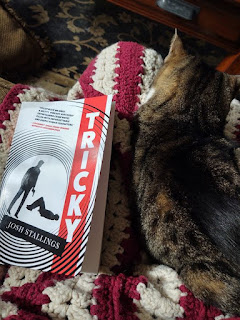
Pace, Voice, and other Mysteries, by Josh Stallings

 Q: Craft: Apart from studying books/courses about how to write, many writers hone their craft by reading the work of others. Can you share any insights you’ve gleaned this way? What about tricks or tips you’ve picked up from other forms of storytelling, like TV or movies? Any examples of how such insights have influenced your work?


A: I don’t analyze while reading fiction. After I’m done I may look back and think about things the writer did that impressed me. But I need to turn off the inner critic while reading or I’ll miss the emotional content. Earlier in my career I read Ken Bruen and tried to write with a poet’s brevity. I tried to find James Crumley’s bleak hard boiled flow. But once my voice established itself in my head I stopped looking for style pointers and started looking for broad structural approaches I wanted to steal, um, learn from.


The Cartel floored me. Don Winslow’s ability to tell this huge multi-character story, jumping from person to person and yet always landing back on a character just when I was thinking what’s happening with Mr. X? Winslow’s Power of the Dog trilogy led me on a journey to try and discover how sweeping sagas work. 


I frequently read outside of crime novels when I’m hunting a writing technique. Utopia Avenue by David Mitchell tracks four members of a band in the 1960’s London music scene. Mitchell drops the reader down into the middle of a scene —“With John gone we were left to…” Wait John’s gone? — leaving you to play catch up, then he cuts away before it’s fully resolved. It doesn’t feel like a cliffhanger gimmick, but it works like one. (Note to self “a gimmick is just a poorly executed technique.”) Utopia Avenue isn’t a thriller but in trying to figure out who did what it creates suspense like one.


With Station Eleven, Emily St. John Mandel handles multiple characters over a 20 plus year span with wild almost illogical non-linear time leaps, very like Writer/Director Alejandro G. Iñárritu’s early work Amores Perros, 21 Grams, and Babble. He shattered the timeline and I found after watching it I would put it back together in linear order in my head. I worked as a trailer editor on 21 Grams and Babble. I was able to study his work, the links between scenes are emotionally correct, that is, “they feel right,” but logically they are higgledy piggledy. I can understand what he’s done but haven’t yet been able to replicate it in words. 


Through out my creative career I have worked as an intuit. As a trailer editor I never could explain what I was going to do. I’d just tell my bosses, producers, studio marketing executives to leave me alone over night and I’d show them what I was thinking. My best work came together quickly by trusting my instincts and working my way from idea to idea. I write the same way. I read the same way. My analytical brain is taking notes, while my creative brain is just digging the story and taking a ride. 


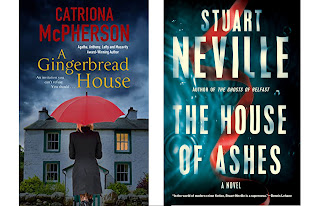
Many of my favorite writers I love because they do things entirely different from me. I spend enough time in my head with my books, I need to vacation in other writer’s worlds. Catriona McPherson is a master at setting, if she builds a village book store, you can smell the pages. She also delivers rich characters subtly. Her A Gingerbread House is darkly creepy. I read it back to back with Stuart Neville’s The House of Ashes. Two completely different writers tackling similar subjects. Each brilliant in their own way. Both masters of setting, and dialogue and character. However, if I randomly grabbed a page from either book I’d know if it was written by McPherson or Neville. They have distinctly unique voices. And that’s the part you can’t steal, so I just enjoy them.


If you don’t believe me about the voice thing, read anyone who has ever tried to knock off Chandler, or try it yourself. It’s not wrong to mimic or pay homage to your favorite writers, it’s how many of us started. Like painters copying masters to figure out how they did it. But it’s when you hear the sound of your own voice that writing gets really fun.


Ok Josh, stop rambling about voice and bring this home. 

What I know about brevity and pacing I learned from years of condensing films from two hours down to a two minute trailer and then condensing that into a thirty second tv spot. And all the time delivering the essential feeling of the film. Doing this I learned a lot about pace and how it functions. Pace is built by either speed of information flow or complexity of information being delivered. In film terms a wide shot classically composed can stay up longer without slowing the pace. Cut away too fast and it confuses viewers and that makes it feel slower. Confusion slows pace. In mystery/crime books there are two things going on at once, the reader is tracking the story being told, while they are also looking for puzzle pieces to solve the mystery. Too much backstory will slow down the pace, too little will also slow down the pace. Understanding neurodiversity has made it clear that pace is personal. I can only generalize about pace.


Another thing film taught me; the human brain is a connection seeking machine. It is built to find sense and order. The Kuleshov effect, in the early 1900s Kuleshov cut together a shot of an expressionless actor with a bowl of soup, a girl in a coffin, a woman on a divan… Audience members thought the actor was brilliant, he showed hunger, grief and lust. This told me how hard our brains work to find order and connections. 


In the RoboCop trailer we couldn’t show any direct violence (the trailer had to be G-Rated). I discovered if Robo’s fist was about hit a mans face and I cut to fist coming through a wall, or Robo fired his gun, and a building blew up, logically it made no sense but the brain didn’t care, it made a connection. In a book a character needs to speak to a suspect. Next chapter they are in conversation. The brain never wonders “how did they get there? Did they knock on the door?” It makes the connection. The reader’s brain allows us to remove all the boring stuff. 


Biggest lesson learned from reading books and editing trailers? Don’t lead or hand hold readers, they’re smart, they see nuance and make connections.


Thursday, March 3, 2022

And calling it working! by Catriona

Q: Craft: Apart from studying books/courses about how to write, many writers hone their craft by reading the work of others. Can you share any insights you’ve gleaned this way? What about tricks or tips you’ve picked up from other forms of storytelling, like TV or movies? Any examples of how such insights have influenced your work?

What a great question for the thoughftul, reflective, deliberate writer. For an extreme pantser like me, with a working method we could kindly call "organic" and more honestly call "chaotic" . . .?

I'll try.

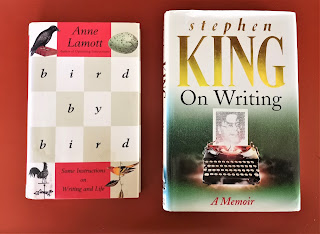
I'm halfway there, in that I don't have a ton of intrusive how-to manuals and courses to set aside before I get to the meat of the question. Guess why. The sum total of my book learnin' about writing is Stephen King's On Writing - read and re-read and recommended - plus Anne Lamott's Bird by Bird, bought but not yet opened. 

But I am reading my twentieth other book of the year right now. (They're here, if you're interested.) Four non-fiction, four general fiction, and that leaves twelve crime novels. So if my craft is being honed at all - and who's to say? - there's a good chance that it's other writers of mystery fiction honing it. 

I'm glad the question says "read", glean", and "pick up" rather than "study", "identify" and "collect" though because I absolutely, unashamedly, and as avidly as ever after twenty-two years of being a professional writer, approach every book for pleasure and nothing else.

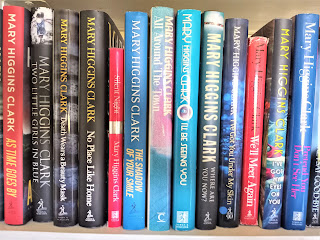
Still, I learned what could be done with multi-POV plots from Mary Higgin Clark. As did Harlan Coben and he's no slouch when it comes to plotting. Not that I can do what MHC did - God, that past tense still hurts - but it offers me inspiration to try. I think some of it is that she gives her characters strong distinctive names and, in early chapters, uses quite a simple sentence structure with the name in subject position to ground us in the voice. Aw hell - gave her characters, used a structure. Oof.

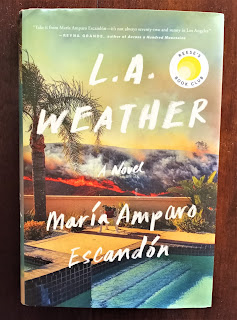
One of the other books I've devoured and adored this year so far is L.A. Weather by Maria Amparo Escandon. It's not crime fiction so much as melodrama, but it does have a puzzle at its heart and a heisty caper tossed in there too, so I'm claiming it. The reason I've picked it to talk about today - and am going to use it in a "masterclass" on settings tomorrow as part of Murderous March - is that Escandon embraces what it means to write about Los Angeles in a way I never want to let slip out of my mind. Would a writer necessarily mention roads, traffic, alternate routes and parking on almost every page in a perfect world? Probably not. Could there be a realistic novel about L.A. that didn't have characters bickering about whether to stay on the 10 or take the 110, then reveling in the gift of a parking space six inches longer than their SUV and only two blocks from where they needed to be? Definitely not.  In my case, I've pledged never to forget that if it's Scotland, it's raining. And it's Escandon's L.A. traffic I'll have to thank.

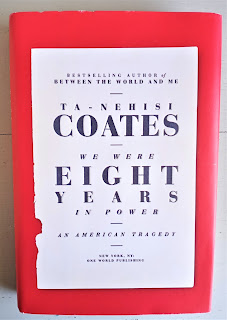
It's not always so on the nose as that, though. The book I'm reading right now is Ta-Nehisi Coates' We Were Eight Years in Power and what I'm being reminded of (while also being enchanted and educated) is the power of a really perfect line to make you pause in your reading, go back, read again, read aloud, read out to anyone in earshot . . . As mystery authors we think about plot, characters, setting (especially tomorrow), clues, pacing and all the other mechanisms involved in delivering a satisfying story. So, just as we're always told to look up into the distance now and then when we've been staring at a screen, one of the reasons I read poetry is to revel in language without narrative for a change, language dialled up to eleven and saturated with colour, langauge for the sheer joy of it. Language like:

Split the lark - and you'll find the music - bulb after bulb in silver rolled

or

See no past greatness in ourselves and thus no future glory

or

Sleep that knits up the raveled sleave of care / the death of each day's life.

Except that middle one wasn't Shakespeare or Emily Dickinson and it wasn't poetry. It was half a sentence from Coates' essay on the Civil War. Wow, right?

In conclusion - there's something about this topic that reminds me of writing essays (back in the day when I couldn't get away with "Wow, right?" as a literary response) - I reckon the reading I do for pleasure can't be harming my writing and even if I don't dissect it and pinpoint its effect, I'm going to carrying on lying in a hammock, eating grapes, reading a book and calling it working.

Cx 


Wednesday, March 2, 2022

Happy (belated) St. David's Day by Cathy Ace


Hello folks! St. David's Day was yesterday, March 1st, so as you're reading this I am flopping about somewhere in a Welshcake-induced coma. It also means I'm going to (respectfully) ignore this week's question, and take the chance to tell you ALL about the fabulous crime writing festival that will be held "in Wales" this end April/beginning of May, online, and free of charge. I hope you'll forgive me this bit of flag-waving! 
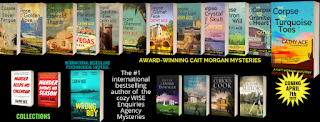
(And keep reading to the end of this post for news of a FABULOUS offer on my Welsh cozy mysteries!)

There are some international headliners, and great deal of Welsh-grown talent at the events - all of which are detailed below. I'll be appearing, as will fellow blogger here Abir Mukherjee, along with people like...no, I can't list them all, so check out the FABULOUS names below! 

Some you'll know, some will be new to you - so, come on, let's try to find you your next favorite crime writer...in WALES! 

Over 4,000 viewers watched the panels at last year’s digital Gwyl Crime Cymru Festival.

Another 3,000 have watched them on our YouTube panel since.

(FYI: Gwyl is the Welsh word for Festival)


Now it’s your turn…


We're incredibly excited to present the full programme for the
2022 digital Gwyl Crime Cymru Festival
.

Check out the panels for the 2022 digital Gwyl Crime Cymru Festival below and book your tickets now – you’ll find links by clicking on your chosen panel title.


And don’t forget…


All the panels are online. All the panels are free.


PROGRAMME & TICKETS


Wednesday 27 April
Event 1 - 18:30
The Second Story in Crime Fiction: We all have Issues!
Contemporary crime fiction has proven to be the perfect genre to explore many difficult issues that trouble society beyond law-breaking. Homelessness, dubious technology and deep-rooted traditions are just some of the subjects explored to great effect by the authors here.
Chair: Jacky Collins
Speakers: Trevor Wood, Awais Khan, Louise Mumford

Event 2 - 20:00
Who killed Daniel Morgan?
This panel discusses the infamous unsolved axe murder of Welsh private detective Daniel Morgan with journalist Peter Jukes and Alastair Morgan, Daniel’s brother.
Chair: Matt Johnson
Speakers: Alistair Morgan, Peter Jukes


Thursday 28 April
Event 3 - 18:30
Women in Crime Fiction: Pursuers and Perpetrators
Gone are the days of gender stereotypes in crime fiction. These authors demonstrate how the agency afforded women in crime fiction has diverged considerably to the extent that the characters these authors have created are found on both sides of the law and are always to be reckoned with.
Chair: Jacky Collins
Speakers: Mari Hannah, Elly Griffiths, Beverly Jones

Event 4 - 20:00
How Much Fact, How Much Fiction: Using Historical Events in Crime Fiction
Crime Writers’ Association Historical Dagger winner, Vaseem Khan (Midnight at Malabar House) and Historical Writers’ Association gold crown winner, Chris Lloyd (The Unwanted Dead) discuss how they balance writing compelling fiction and giving readers an authentic taste of the historical events their characters are dealing with.
Chair: Alis Hawkins
Speakers: Vaseem Khan, Chris Lloyd

Friday 29 April
Event 5 - 18:30
Gwaed ar y Dudalen
Mae’r Cymry yn hoff o drioedd felly yn y sesiwn yma bydd Jon Gower yn trafod tri o hanfodion sgrifennu trosedd gyda’r awduron profiadol a phoblogaidd Gwen Parrott ac Alun Davies – lleoliad, plot a chymeriadu.
Chair: Jon Gower
Speakers: Alun Davies, Gwen Parrott

Event 6 - 20:00
It’s all in your head: writing psychological crime fiction
Do authors need to get into their readers’ heads as well as those of their characters’ to write compelling, bestselling and prizewinning fiction? Clare Mackintosh and Belinda Bauer talk about playing with perception, plot and people in this fascinating discussion.
Chair: Katherine Stansfield
Speakers: Clare Mackintosh, Belinda Bauer


Monday 2 May
Event 7 - 18:30
Ex-forces cops – hard men or soft centres?
Craven’s Washington Poe and Johnson’s Robert Finlay both have pasts in the military, and the life-or-death situations they faced in uniform mean that they bring a particular ‘who gives a f***?’ attitude towards some aspects of policing. But does policing also require emotional intelligence? Barry Forshaw explores Craven and Johnson’s differing views.
Chair: Barry Forshaw
Speaker: MW Craven, Matt Johnson

Event 8 - 20:00
Island Crime
Do remote settings enhance the mystery and chill of the crime novel? Does location affect how the reader experiences the scene of the crime? These award-winning and critically acclaimed authors know how to transport us so that we feel the remoteness of bleak island landscapes and the bitter chill of northerly winds.
Chair: Jacky Collins
Speaker: Ann Cleaves, Lilja Sigurdardottir

Tuesday 3 May
Event 9 - 18:30
35 Diwrnod a Bang – y ddrama drosedd rhyngwladol
Yn y blynyddoedd diwethaf mae sioeau trosedd o Gymru wedi plesio cynulleidfaoedd yng Nghymru ac ar draws y byd. Bydd Jon Gower yn trafod y llwyddiant yma gyda dau sydd wedi disgleirio wrth lunio cyfresi treiddgar, cyflym a gwaedlyd, sef Fflur Dafydd a Roger Williams.
Chair: Jon Gower
Speakers: Fflur Dafydd, Roger Williams

Event 10 - 20:00
Where, When or Who? Which is the most important question in crime fiction?
Billingham, Jones and Ellis are all crime authors but they set their fiction in the past and the present, in Britain and Venice, featuring police officers and amateur sleuths. What unites their books under the crime banner? What common factors do they share? And why might their work appeal to different kinds of readers?
Chair: Barry Forshaw
Speakers: Mark Billingham, Mark Ellis, Philip Gwynne Jones


Wednesday 4 May
Event 11 - 18:30
The Truth, The Whole Truth and The Historical Truth
With dogged detectives who refuse to settle until the truth is revealed, the authors on this panel have successfully shown how constructing fiction around historical fact blends perfectly with crime and mystery and provides wonderful insight into times gone by and faraway places.
Chair: Jacky Collins
Speakers: Abir Mukherjee, Alis Hawkins

Event 12 - 20:00
Strong Women, Strong Setting
Cosy crime meets gritty as Cathy Ace pits her Cait Morgan and WISE Detective Agency series against GB Williams’ Branwen Jones (The Chair) and Ariadne Teddington (Locked series). How do the settings of these books influence their protagonists’ approach to the crimes they find themselves tangled up in?
Chair: Alis Hawkins
Speakers: Cathy Ace, GB Williams

To see all tickets, CLICK HERE


Book now and enjoy the buzz of a live panel with your favourite crime writers. That way, you can put questions to the authors, you interact with participants from all over the world, and you get to be part of an exciting online crime fiction festival as it happens. So put on your PJs, pour a cup of tea or a glass of wine and watch from the comfort of your own armchair… or bed, or mountain top… and buckle up for the

2022 digital Gwyl Crime Cymru Festival.

And, who knows, you might just find your next favourite crime writer in Wales sooner than you think…

And if you're in the mood to visit Wales NOW...look no further than this great deal: https://www.amazon.com/dp/B09SZLBH5T


With thanks to everyone who has purchased (and rated!) - it's been a real thrill to achieve #1 Bestseller status in multiple categories in Australia, Canada, the UK, and the USA! 


http://www.cathyace.com/


Tuesday, March 1, 2022

Fare Thee All Well (or Bye Bye Frankie Bye Bye)

(The One in Which Frank Zafiro Says Goodbye) 

When Jim Ziskin invited me to join this blog panel in April 2019, I gotta tell you -- I was thrilled. Like winning an award thrilled. I considered it an honor, and was happy to say yes.

Over the course of my stay, I've not only written twenty-odd posts a year but gotten a chance to know (and read) the other panelists on Criminal Minds. All of them (save newcomer Josh and hopefully we can change that at some point!) have been kind enough to come on my podcast, Wrong Place, Write Crime, so that we could have a deeper conversation about their work. What I have discovered in those discussions, a few face-to-face meetings, and our online exchanges is that these are some truly wonderful people. Talented writers (and of varying styles, too!), true, true... but most of all, cool people.

Seriously, I encourage you to follow the above link and scroll back through or search the interview archives and listen to the podcast episodes with each of them. You'll discover the tremendous personalities of each -- thoughtful introspection, humor, interesting journeys, great writing advice, it is all there.

And then, of course, read their books. If you've already done that, check to see if they've written another (some write in multiple subgenres) If there's a wait for their next one, listen to who they suggest you read instead. One thing I've learned in hosting the podcast is that one of the best places to get a good book recommendation is from another writer. We know what's good.

Given that, I unreservedly recommend all the books of the other nine Criminal Minds authors.

Read them.

Follow them.

Support them.

They deserve it, whether you want to measure that deservedness by talent, karma, or both. And here's the best part for you, dear reader -- you won't be disappointed.

Before I go, I should say why I'm leaving. I've been very happy here and proud to be a member of the group, so there's no dissatisfaction or disaffection of any kind. I've simply made some significant changes to my approach to my writing career. Increased productivity is the goal and one of the changes to allow for that has been to harness the most precious resource we have:  time. 

To this end, I have contracted considerably when it comes to outside obligations (outside being anything not directly tied to me putting words on paper or directly supporting those words). Some of the things I've carved away have intrinsic value -- this blog panel is a perfect example -- but my publishing goals have required hard decisions. For instance, I'm also scaling the podcast back to monthly episodes next season rather than weekly. And there are other time-investments as well that I've had to let go to focus on my primary mission, even though some of these things are quite enjoyable.

I equate it to the "kill your darlings" metaphor when editing. Killing your darlings is all about the goal of the story, and here it is all about very specific publishing goals I'm determined to meet as an independent author.

How ambitious? Well, my 2022 publication/release calendar includes 11 novels, 7 novellas, four short stories, an anthology of short crime fiction (editor/publisher), editing the novella anthology series A Grifter's Song, and putting together 5 box sets.

I said ambitious, didn't I? 

2023 is mapped out much the same. Thankfully, I am well ahead of the curve in the creative and editing process. And to be fair... 

  • One of the novels isn't new but a heavily revised re-issue of an existing novel, bringing it into my River City universe. And I finished it earlier this month, so it's already re-released. 
  • Three of the novels are either ready to drop already or are in revisions. 
  • Same with two of the novellas. 
  • Another one of the novellas is a re-issue of a 2021 story published by a different publisher, the first of a series that I'm continuing. 
  • All four of those short stories are already written, and the anthology is almost complete. 
  • A couple of the box sets are already out, and those projects only involve formatting and a brief introduction. 
  • And five of the seven novellas for A Grifter's Song are ready to go, with one in revisions and July's episode still outstanding. 

So I am well ahead of things. First draft-wise, I'm currently working on the second of two projects scheduled for a July release. If my pace keeps up, I'll stretch out my lead time even further by the end of the year.

Still, it is ambitious, even for an independent author who can set his own timeline. Accordingly, one of the changes I've made is a much more disciplined approach to writing new words in the morning hours and editing in the afternoon/evening. It's been extremely productive. It's also been a full-time job. Plus some. And so... I've had to make the hard decisions to be less committed elsewhere. 

Thus, among other changes, I am bidding a reluctant goodbye to Criminal Minds as a panelist. I'll still peruse the blog entries as I drink my morning coffee and wake up my brain, though. There's too much insight and humor and life lessons from these other authors not to.

And I'll see many of you at LCC or B'Con, as those are the two events I'm committed to attending each year.

So I'll be around. You can always find me at my website or on social media, or via email (all posted below). I want to thank Jim for inviting me to be on this panel and all of the other panelist for welcoming me with opens arms. I consider each of you a friend and look forward to continuing those friendships, ad infinitum.

See you all further on up the road.

a
FRANK Zafiro

    fscalise3@gmail.com  |      frankzafiro.com