Showing posts with label Paul Giamatti. Show all posts

Friday, June 10, 2016

They Ain’t Talkin’ ’Bout Wine

How do you make your characters’ dialogue sound realistic?

by Paul D. Marks

If you listen to two (or more) people talking you’ll hear that their conversation rambles all over the place. It bounces from one subject to another, there are pauses and ums and all kinds of distractions. This is conversation, not dialogue. Dialogue is not everyday conversation, but it needs to have the illusion that it is.

Your characters need to talk like real people, but at the same time their dialogue—your dialogue—needs to convey information, move the plot forward, possibly get out some exposition and either story or character background…….without being too obvious about it.


So how do you do this?

Listen to people around you. Their cadences. Intonation. Do they talk differently in a bar than a bookstore? On the East Coast than the West? And even if on the East Coast, don’t people from Maine talk differently from people in NYC or South Carolina? When we think of the East Coast, a lot of people think of New England, but the coast goes from Maine to the Florida Keys. How many different accents, ways of turning a phrase, slang, etc., do you think there are in just the states that border the Atlantic Ocean?

Even within a city there are different ways of talking. New York City has five boroughs. Is the accent and slang the same in each borough? Is it the same in Harlem and the East Side? Los Angeles is spread out over 503 square miles. Do you think the people from South Central talk the same as the people from the Valley—remember Valley Girls?

Make sure the way each character speaks is right for that character. Don’t have all your characters talk the same way. If all your characters speak with snappy lines and quick comebacks, how can you distinguish them from one another? I can understand having a couple characters that are smart and witty, but when every one of your characters is cracking one-liners, a reader might start to wonder if there’s something in the drinking water…  In other words, keep dialogue in line with character, don’t have a wallflower start talking like a sailor or a blowhard start speaking like Emily Post.

Don’t use too much jargon, maybe just enough to get the point across that the character works in a particular biz or is from a particular area or background. And don’t get carried away writing dialect. It’s hard to read. Focus on the way people phrase things. If the character’s from the South and has a drawl, don’t write everything out like it sounds, except sparingly to get an idea of the accent. Pop it in here or there, but mostly just say they talk with a drawl.

I once had a producer tell me to write dialogue in “ten word telegrams.” In screenplays most speeches should be short, not long soliloquys. Though ten words is a little too short much of the time (see the long speech from Sideways below). But you have more freedom in a novel, still you don’t want one speech running a page long.

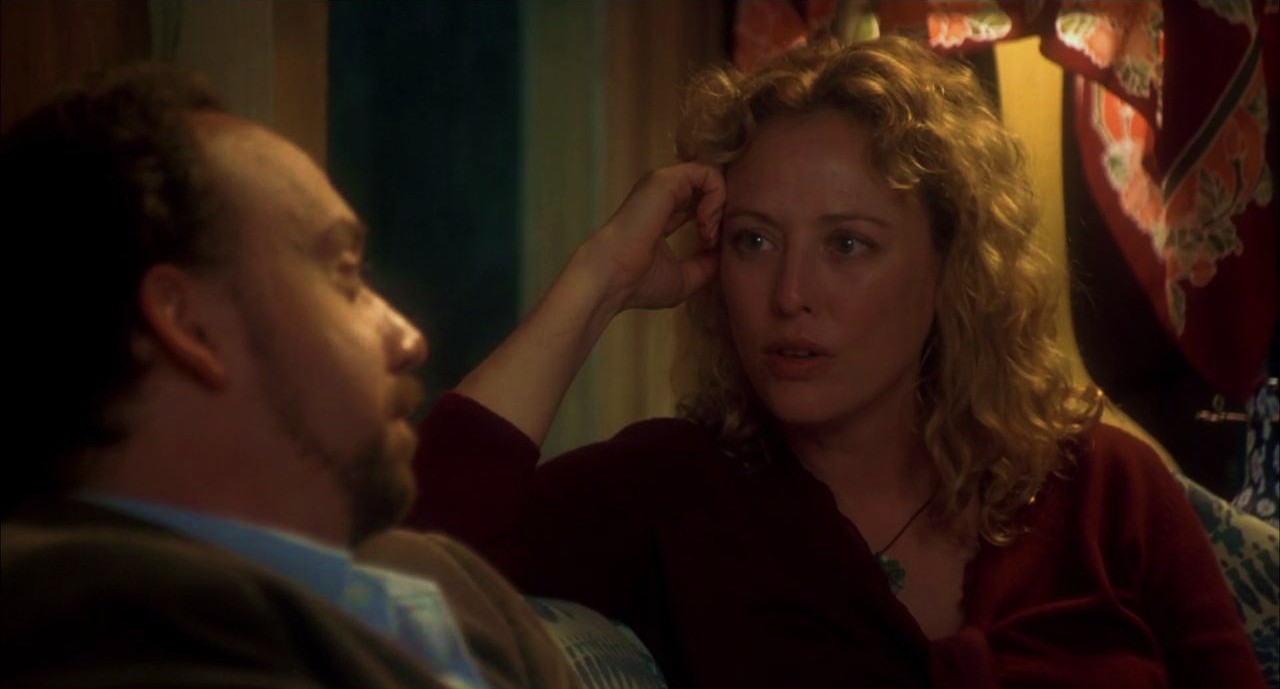
Another thing that will help your dialogue stand out is to enrich it with subtext. For example, if you have two characters that are in a romantic relationship and they’re unhappy and thinking of breaking up, maybe a conversation about what restaurant to eat in can reveal more than just eating preferences. I particularly like this subtext/dialogue from the novel/movie Sideways. In that movie (which I highly recommend), Miles is a wine aficionado and frustrated writer—and very sensitive and prickly, as opposed to his wild and crazy-guy pal, Jack. Miles and Jack take a trip up to Santa Barbara wine country and Miles has some private time with Maya, a waitress he’s friendly with up there. They have a conversation about wine, but is that what it’s really about?


Maya (Virginia Madsen): You know, can I ask you a personal question, Miles?

Miles (Paul Giamatti): Sure.

Maya: Why are you so into Pinot? I mean, it's like a thing with you.

Miles: Uh, I don't know, I don't know. Um, it's a hard grape to grow, as you know. Right? It's uh, it's thin-skinned, temperamental, ripens early. It's, you know, it's not a survivor like Cabernet, which can just grow anywhere and uh, thrive even when it's neglected. No, Pinot needs constant care and attention. You know? And in fact it can only grow in these really specific, little, tucked away corners of the world. And, and only the most patient and nurturing of growers can do it, really. Only somebody who really takes the time to understand Pinot's potential can then coax it into its fullest expression. Then, I mean, oh its flavors, they're just the most haunting and brilliant and thrilling and subtle and... ancient on the planet.*


And though this example is from a movie it applies to novels as well.

Then, when you’re done read it out loud, preferably in front of or with another person. You really do hear things that you don’t see when you read in your head.

Finally, be true to yourself, because everyone has an opinion and opinions are a dime a dozen:  I once optioned a screenplay to a producer. He read it and loved it, especially the dialogue. He gave it to a director to read it. She hated the dialogue. Magically and overnight, he hated the dialogue too. Go figure. So, unless you’re getting paid, write it your way.

***

I want to congratulate all the Shamus Nominees! Especially Bob Levinson, whose story Dead Detective was published in Coast to Coast: Murder from Sea to Shining Sea, edited by Andrew McAleer and…..me. We’re very happy for Bob and Down & Out Books and also that the first Coast to Coast volume has been recognized. Volume 2, Coast to Coast: Private Eyes from Sea to Shining Sea is in process.


###

*Directed by Alexander Payne. Screenplay by: Alexander Payne, Jim Taylor, based on a novel by Rex Pickett.

www.PaulDMarks.com


Click here to: Subscribe to my Newsletter

Friday, June 20, 2014

The Pinot Noir Grapes of Wrath

Does a great writer have to have a tortured soul? Why or why not?

by Paul D. Marks

Well of course the answer to this question is yes and no. How’s that for being unequivocal?

While many people think of writers, and artists in general, as having tortured souls, there’s no rule that says one must be tortured in order to be an artist.

So I wracked my brain trying to come up with some well-known writers whose names people would know who were happy and not tortured.

Zilch. Zero. Nada.

Couldn’t think of one.

We all know of the tortured writers of the present, past and near-past, Hemingway, Anne Rice, David Foster Wallace and possibly the queen of tortured writers, Sylvia Plath. The list is endless. And they created great art. But what about happy writers creating great art? Can it be done? The search for the happy writer continued.


I moved to the next step: checking the internet. And after a lot of searches, using different terms and ways of phrasing things, it seems I found one well-known writer who claims to be happy. Though when you see his name I think you’ll be surprised:

Philip Roth. Author of such happy-go-lucky stories as American Pastoral and Everyman.

According to Roth, and assuming the quote I found is correct ‘cause I never fully trust the net, he says, “I’m happy all the time, but a lot of people aren’t. I write about all those people. People in trouble make for interesting characters.”

So I guess even if the writer is happy the characters might not be and unhappy characters might make for more interesting characters.

I’m sure there’s other happy writers out there, but while the list of unhappy, tortured-soul writers is long and includes plenty of men and women, Roth is the only happy writer I could find.

This leads me to believe that many people who are tortured and scarred emotionally and/or psychologically one way or another perhaps go into writing as a way to exorcise those demons in the same way that it’s said that others with psychological problems go into psychology or psychiatry.

Artists of all kinds are said to be unhappy people: Comedians – most of them – are known to be unhappy in large measure. Lenny Bruce. John Belushi. Richard Pryor. Drug problems, early deaths in some cases. And musicians, from Beethoven and Kurt Cobain to Amy Winehouse and Syd Barrett of Pink Floyd. Fine artists like Edvard Munch, Georgia O’Keefe, Picasso, Gauguin, and, of course his pal, Van Gogh – all very depressed. The list in all of these categories is endless. And, of course, writers.

So maybe it is true that unhappy artists and writers – or characters – can reach into the depths of their souls, because they look inward – to touch some common threads that most of us wrestle with in our lives. And through their work we can see a mirror into ourselves and our society through which they can help us put things into perspective.

As for myself, I guess I would have to put myself on that long list of tortured souls. Without going into all the reasons why, I think if you asked people close to me, my wife and others, they would acknowledge that. And I would have to acknowledge it too.

That said, I don’t think a writer has to have a tortured soul. He or she just has to have a soul and enough introspection and empathy to be in touch with it so they give us a mirror to the world – give us something we as readers can relate to and connect with.

In the end, maybe writers – tortured souls or not – are like the pinot grapes that Paul Giamatti’s Miles character talks about in the movie Sideways. We are all, to one extent or another, pinot grapes in a cabernet world. He says:

Um, it’s a hard grape to grow, as you know. Right? It’s uh, it’s thin-skinned, temperamental, ripens early. It’s, you know, it’s not a survivor like Cabernet, which can just grow anywhere and uh, thrive even when it’s neglected. No, Pinot needs constant care and attention. You know? And in fact it can only grow in these really specific, little, tucked away corners of the world. And, and only the most patient and nurturing of growers can do it, really. Only somebody who really takes the time to understand Pinot’s potential can then coax it into its fullest expression. Then, I mean, oh its flavors, they’re just the most haunting and brilliant and thrilling and subtle and... ancient on the planet.