Showing posts with label #writetip. Show all posts

Friday, August 19, 2016

Writing Tics: The ‘Comfort Food’ of Writing

Do you have any writing tics (habits or problems which you repeat in your prose)? How do you deal with them?

by Paul D. Marks

“Go to hell,” I said with a Jack Nicholson grin. I jammed outta there, jumping in the car, slamming my foot down on the gas. The blood spread across my shirt like a Rorschach blot. I smiled. Shot out of there like a bat out of hell (hey, I made that one up, didn’t I?).

The above graph is from nothing I’ve written before today. But it could be a taken-to-extreme example of my writing tics. I do have certain words or expressions I fall back on, the “comfort food” of writing.


My characters tend to grin and smile. Not only guns shoot, but people shoot out of places, shoot here or there. They jam here and slam there and jump all over the place. So I definitely repeat certain words or phrases. Sometimes intentionally (hey, that’s my style, man), sometimes not so intentionally. And I do use Word’s Navigation feature (I think that’s what it’s called) to see how many times I might use a particular word or phrase. And I often cut them or rephrase them. And I also often start sentences with ‘and’ and ‘but’ but that is a stylistic choice. A voice choice, if you will, as I think it makes my narrators sound more natural and casual, which I like.

I also tend to use the word just maybe just a little too much. But it’s just because I just like the justness of it. Now, even I think that’s just too much of a good thing.


Even Gillian Flynn of Gone Girl fame, says “I'm trying to wean myself off my very Gen X abuse of the word 'literally. Gone Girl contains at least 33 uses of the word, which is 32 more times than any single novel needs.” This is where using Word’s Navigation feature can really come in handy and help you weed out those overused words.

And sometimes my characters use clichés—like ‘bat out of hell’—but that’s the way people talk. I also set things off in dashes a lot, so sometimes I try to cut down on that. If you read something of mine with a lot of that—well, you should see the earlier drafts. I use run on sentences, so I sometimes change them to two shorter sentences. And from the opposite side, I sometimes combine two short, choppy sentences into one sentence.

But I try to do better. I really do. I try to change things so they’re not so repetitive. I look things up in the thesaurus. Uh oh!

Stephen King says, “Any word you have to hunt for in a thesaurus is the wrong word. There are no exceptions to this rule.” I find that sophomoric—and yes I got sophomoric from the thesaurus when I really wanted to say absurd. But it’s not a word I would generally use. The thesaurus is a great help, despite what Mr. King says. And how many of us eschew them? Of course—I also tend to use ‘of course’ a lot—you don’t want to get those hundred dollar words when a two dollar word will do. But the thesaurus is extremely useful in helping you see things a little differently and pick just the right word for the job.

As I said, my characters smile or grin a lot. Sometimes it’s good to break that up with a different way of saying it. The thesaurus helps. And what’s wrong with that? Sometimes you just need something to help you get out of the rut of using the same words all the time. It’s not to use highfalutin words, but to the find the right word to express what you want to say. Sometimes your brain just needs a reminder of what other words are out there, begging to be a star for a moment.

One person’s tic is another person’s style. But you have to be conscious of what you’re doing and don’t overdo favorite things or lean on too many crutches. So, I do try to look for those weaknesses and repetition in my writing. And remember, it can all be fixed in the editing/rewriting.

###

www.PaulDMarks.com


I just heard that my story “Ghosts of Bunker Hill” will be coming out in the December issue of Ellery Queen's Mystery Magazine, last issue of Ellery Queen’s 75th anniversary year. Totally jazzed about that! – Bunker Hill (Los Angeles) was LA’s first wealthy residential neighborhood, right near downtown. Lots of film noirs were shot there (Criss Cross, Cry Danger, Kiss Me, Deadly and many others). It’s where John Fante lived when he wrote “Ask the Dust.” It got run down after WWI and became housing for poor people. And in the late 1960s it was all torn down and redeveloped. The fabulous Victorian houses were either destroyed or moved. They even flattened the hills. You can see the contrast of the old and new in the pic below. The insert is a Newell post that I copped from one of the Victorian homes on Bunker Hill before it was to be moved or torn down. It’s an artifact from Bunker Hill and the logo for my Bunker Hill stories and a prized possession.


Friday, June 10, 2016

They Ain’t Talkin’ ’Bout Wine

How do you make your characters’ dialogue sound realistic?

by Paul D. Marks

If you listen to two (or more) people talking you’ll hear that their conversation rambles all over the place. It bounces from one subject to another, there are pauses and ums and all kinds of distractions. This is conversation, not dialogue. Dialogue is not everyday conversation, but it needs to have the illusion that it is.

Your characters need to talk like real people, but at the same time their dialogue—your dialogue—needs to convey information, move the plot forward, possibly get out some exposition and either story or character background…….without being too obvious about it.


So how do you do this?

Listen to people around you. Their cadences. Intonation. Do they talk differently in a bar than a bookstore? On the East Coast than the West? And even if on the East Coast, don’t people from Maine talk differently from people in NYC or South Carolina? When we think of the East Coast, a lot of people think of New England, but the coast goes from Maine to the Florida Keys. How many different accents, ways of turning a phrase, slang, etc., do you think there are in just the states that border the Atlantic Ocean?

Even within a city there are different ways of talking. New York City has five boroughs. Is the accent and slang the same in each borough? Is it the same in Harlem and the East Side? Los Angeles is spread out over 503 square miles. Do you think the people from South Central talk the same as the people from the Valley—remember Valley Girls?

Make sure the way each character speaks is right for that character. Don’t have all your characters talk the same way. If all your characters speak with snappy lines and quick comebacks, how can you distinguish them from one another? I can understand having a couple characters that are smart and witty, but when every one of your characters is cracking one-liners, a reader might start to wonder if there’s something in the drinking water…  In other words, keep dialogue in line with character, don’t have a wallflower start talking like a sailor or a blowhard start speaking like Emily Post.

Don’t use too much jargon, maybe just enough to get the point across that the character works in a particular biz or is from a particular area or background. And don’t get carried away writing dialect. It’s hard to read. Focus on the way people phrase things. If the character’s from the South and has a drawl, don’t write everything out like it sounds, except sparingly to get an idea of the accent. Pop it in here or there, but mostly just say they talk with a drawl.

I once had a producer tell me to write dialogue in “ten word telegrams.” In screenplays most speeches should be short, not long soliloquys. Though ten words is a little too short much of the time (see the long speech from Sideways below). But you have more freedom in a novel, still you don’t want one speech running a page long.

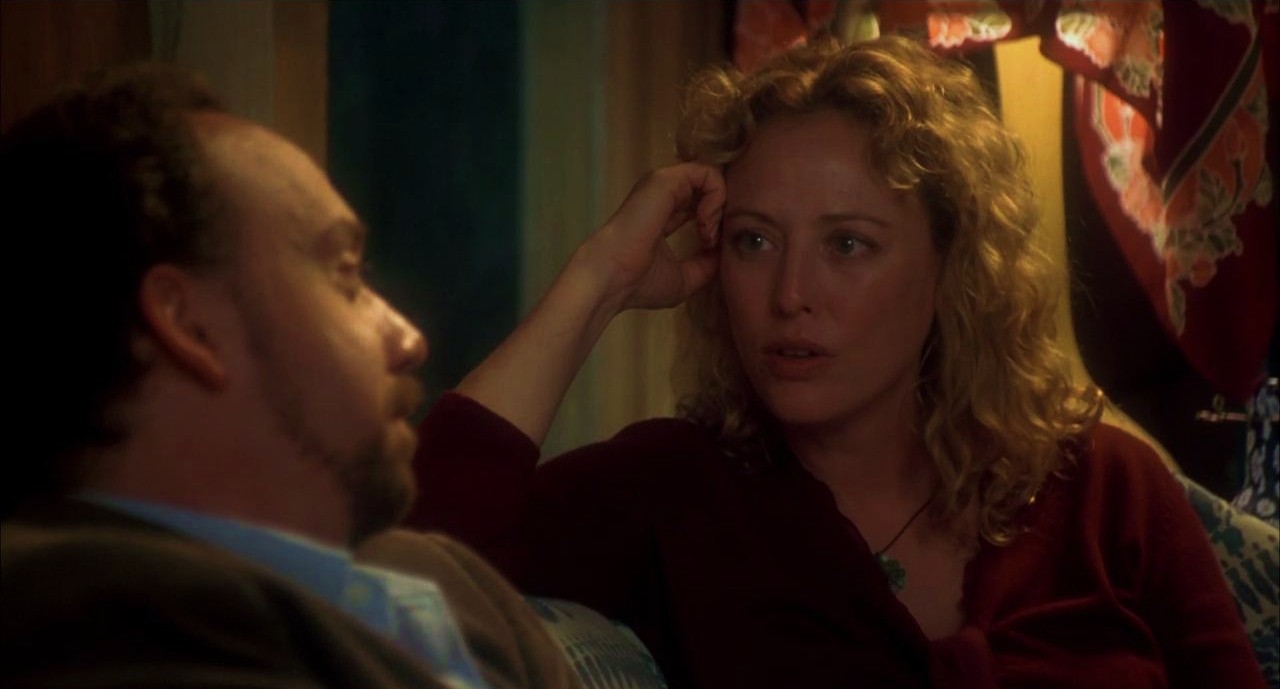
Another thing that will help your dialogue stand out is to enrich it with subtext. For example, if you have two characters that are in a romantic relationship and they’re unhappy and thinking of breaking up, maybe a conversation about what restaurant to eat in can reveal more than just eating preferences. I particularly like this subtext/dialogue from the novel/movie Sideways. In that movie (which I highly recommend), Miles is a wine aficionado and frustrated writer—and very sensitive and prickly, as opposed to his wild and crazy-guy pal, Jack. Miles and Jack take a trip up to Santa Barbara wine country and Miles has some private time with Maya, a waitress he’s friendly with up there. They have a conversation about wine, but is that what it’s really about?


Maya (Virginia Madsen): You know, can I ask you a personal question, Miles?

Miles (Paul Giamatti): Sure.

Maya: Why are you so into Pinot? I mean, it's like a thing with you.

Miles: Uh, I don't know, I don't know. Um, it's a hard grape to grow, as you know. Right? It's uh, it's thin-skinned, temperamental, ripens early. It's, you know, it's not a survivor like Cabernet, which can just grow anywhere and uh, thrive even when it's neglected. No, Pinot needs constant care and attention. You know? And in fact it can only grow in these really specific, little, tucked away corners of the world. And, and only the most patient and nurturing of growers can do it, really. Only somebody who really takes the time to understand Pinot's potential can then coax it into its fullest expression. Then, I mean, oh its flavors, they're just the most haunting and brilliant and thrilling and subtle and... ancient on the planet.*


And though this example is from a movie it applies to novels as well.

Then, when you’re done read it out loud, preferably in front of or with another person. You really do hear things that you don’t see when you read in your head.

Finally, be true to yourself, because everyone has an opinion and opinions are a dime a dozen:  I once optioned a screenplay to a producer. He read it and loved it, especially the dialogue. He gave it to a director to read it. She hated the dialogue. Magically and overnight, he hated the dialogue too. Go figure. So, unless you’re getting paid, write it your way.

***

I want to congratulate all the Shamus Nominees! Especially Bob Levinson, whose story Dead Detective was published in Coast to Coast: Murder from Sea to Shining Sea, edited by Andrew McAleer and…..me. We’re very happy for Bob and Down & Out Books and also that the first Coast to Coast volume has been recognized. Volume 2, Coast to Coast: Private Eyes from Sea to Shining Sea is in process.


###

*Directed by Alexander Payne. Screenplay by: Alexander Payne, Jim Taylor, based on a novel by Rex Pickett.

www.PaulDMarks.com


Click here to: Subscribe to my Newsletter