Friday, June 5, 2015

The Best of Both Worlds

Which is more important, to tell a story that compels readers to turn pages, regardless of writing craft technique OR to spend time on each sentence, on each word, to fine tune your writing so that your prose is admired by critics and scholars?

by Paul D. Marks

I think Susan and Robin really hit the nail on the head in response to this question on Monday and Tuesday. (And since I’m writing this on Tuesday I haven’t yet read the other two Crim Minds, but I’m sure they will too). But I’ll see what I might be able to add to what they said.
There are really two kinds of writers…story tellers and writers.

If you look at Dan Brown’s The Da Vinci Code – the go-to book for this kind of question – you’d have to assume that good writing doesn’t much matter. Great idea, not so great execution. Did it matter? No. He’s a great story teller, but not a great writer. And poor Mr. Brown, ’cause I know I’m not the only one who uses him as an example. And there’s plenty of others who we could mention here, too. But we all know the story.

Gravitys_rainbow_coverClearly we want readers turning pages. Without that we have nothing. Let’s face it, we’re writing genre fiction. We’re not writing Gravity’s Rainbow, Infinite Jest or other literary works. We want our stories to be entertaining and breezy, with intriguing characters and fast-paced, exciting plots. But what’s wrong with trying to give them a little extra polish in terms of the writing?

We all want our work to be recognized and there’s always that fine line between art and a pure entertainment. But why not go for the best of both worlds?

I find that a lot of the very popular best-selling authors have great stories, but I’m often disappointed because story isn’t everything. Sometimes the writing is flat or other elements like characterization, dialogue and plot are obvious and unoriginal. But they’ve hit on a sort of formula of storytelling that works, but is predictable and boring. And sometimes they might even have good characters and dialog and an exciting plot, but nothing that ‘stirs the soul,’ so to speak. When a book really knocks my socks off, it’s because it has all the elements, great writing, descriptions, dialog, characters and a compelling story and the soul stirring stuff.

James Ellroy seems to have hit that mark of compelling stories as well as being someone who critics like. He developed a distinctive, energetic style in the latter two books of the LA Quartet, LA Confidential and White Jazz. But then he went overboard with that staccato, short-sentence writing to the point where I couldn’t read him anymore. Though I have picked up his latest, Perfidia, and it seems that, while he’s still using that style, he’s toned it down a bit, so hopefully I can start enjoying him again. And if I’ve mentioned this before about Ellroy, sorry if I’m repeating myself.

For my Show and Tell visual example, think of the flat lighting of many TV shows and movies made for TV vs. the more sculptured lighting of theatrical movies. The lighting adds to the atmosphere and in some ways can be a character in itself – just look at any classic film noir from the 1940s.

Double Indemnity TV vs Feature collage

Well-crafted writing is like the lighting that makes big-screen movies stand out from made-for-TV-movies. Sometimes the same story can seem more magical and rich when produced for the movie theater. Take a look at the original theatrical version of Double Indemnity vs. the TV remake. The latter is flat in lighting and everything else. The lighting creates a mood, just as good writing does.9993856_orig

For myself, I hope my writing is a compelling read and well written. I start off writing a mess of a draft. And in the second draft I start the pruning and adding and fleshing out. That continues for the next couple of drafts. But the later drafts focus more on the fine tuning, where I do try to make sure that the sentences flow and come alive. And that I use the right word. Like Mark Twain said, and I’m paraphrasing, “The difference between the almost right word and the right word is the difference between lightning and the lightning bug.”

The bottom line is that a marriage of storytelling and craft is the best of both worlds.

* * * * *

And please join me on Facebook: www.facebook.com/paul.d.marks and check out my updated website www.PaulDMarks.com

Subscribe to my Newsletter: http://pauldmarks.com/subscribe-to-my-newsletter/

Hope to you see at the California Crime Writers Conference
CCWC snip - better
 
(http://ccwconference.org/ ). June 6th and 7th. I’ll be on the Thrills and Chills (Crafting the Thriller and Suspense Novel) panel, Saturday at 10:30am, along with Laurie Stevens (M), Doug Lyle, Diana Gould and Craig Buck.


Thursday, June 4, 2015

Break out the Windex - I'm editing!


There is a certain literary novelist I'm not going to name (because he's alive and he might - you never know - have one of those Google alerts) who said he reads his thesaurus looking for more obscure words to use instead of the ones that popped into his head. Or, as he might say, "detonated within his cranium".

If anyone wants to rush out and buy his latest, email me and I'll fill you in.

Don't get me wrong; I use a thesaurus when I'm writing too. I use it when I know there's a word that's perfect and it's on the tip of my tongue and argh it means "plague" sort of, or "torment", but it sounds grungier than that and . . . Oh God, I can almost hear it.*

But I'm with Steven King, on this as on so many other things, who says that the first word you thought of is probably the best one.  In fact, nothing dumps me out of a story so completely as when a writer uses what's unmistakably the wrong word, and you wonder why and then you see the right word in the next line and you know they didn't want to repeat it. And then all I can think about is the writer sitting there working on the second draft saying:

"I attempted to imagine how hard they'd tried I tried to imagine how hard they'd worked I worked to imagine how hard they'd attempted . . . "

And I want to shout "Give it up! You need to change the whole sentence!"

In short, it's not that I don't care about the writing in my writing. My most frequent "stet" at the copy-editing stage is the one that goes "stet, please, for rhythm".

But I want my words to be a clear pane of plate glass that lets anyone who looks see the characters and the setting and follow what's going on. I don't want them to be - buckle up for more of this metaphor - a stained-glass monster that shows a saint getting martyred and stops anyone inside the church from knowing whether it's raining.

My favourite kind of writer is one who tells a compelling story in beautiful prose so squeaky clean that, although you're drunk on the language, when you try to pick out an impressive bit, you can't catch them at it. Ian McEwan is one of those. So is Dorothy Whipple. So I've got no examples.

So here's PG Wodehouse instead. It doesn't matter what book it is, the story is that someone's engaged, someone's not, they've stolen a priceless antique and the policeman is locked in the coalhole. And that pane of glass? He's breathed on it and written this in the steam: “he had the appearance of one who has searched for the leak in life's gas-pipe with a lighted candle.” 

* scourge, by the way

Monday, June 1, 2015

A Question for Readers

"Which is more important, to tell a story that compels readers to turn pages, regardless of writing craft technique OR to spend time on each sentence, on each word, to fine tune your writing so that your prose is admired by critics and scholars?"


Hmmm, With all due respect, I think that’s a false dichotomy. My desire to tell a page-turning story in which each sentence is crafted may be part of the reason I’m not a prolific author. Many of my friends do much better at this, writing two or even three full novels a year. I can only hope I get better at it before I kick the bucket!

And, since when do scholars parse the words in genre fiction? I think the general feeling is we’re permitted into the waiting hall of the literary lounge because the best of us write in provocative, evocative language about things that really matter – crimes against the defenseless, the environment, civil societies, art, truth. If we’re admired by critics outside of the commercial fiction arena, so be it, but I haven’t met a crime fiction author yet who is waiting, hat in hand, to be dissected in an MFA program or in the New York Review of Books. Fifty years from now, a few contemporary crime writers will be elevated by the staying power of their books into the pantheon of the finest, transcending the genre because, in part, the genre itself will have changed, or the topics they wrote about will have become so critical to our understanding of the way the world works that the stories resonate widely. (Look at Robert Towne, who wrote the original screenplay for Chinatown, or Agatha Christie, who created two characters that simply will not die – in the literary sense.)

This is a question I’d love to hear readers respond to.

- from Susan


Friday, May 22, 2015

Truth, Justice, the American Way and a Crazy Me

Looking back over your life can you see the early clues that you were going to be a crime writer one day?

by Paul D. Marks

Oh boy! Well, aside from the seven banks I robbed and my days as a benevolent hitman, sure. But I was disappointed never to make it onto the FBI’s Top Ten.

And while the romance of being an outlaw is tempting, I think my temperament is better suited to that of “crime fighter” and crime writer. And not just because they rhyme.

I have a bit of a different take on how I came to be a crime writer. I was influenced by film noir and crime movies and later by the great writers from Hammett and Chandler on up. But because of certain things in my checkered past I think I’ve always had a strong sense of justice. And, while not getting involved in marches or crusades, I’ve tried in my own way to bring a little justice to this world on a micro level.

Someone who knew me well told me a long time ago that he thought I was like Don Quixote tilting at windmills. I don’t think he meant it as a compliment, but I’ll take it as one. As I tell my wife, who would rather avoid confrontation than fight, sometimes you win, sometimes you lose, but at least you have to stand up for yourself or others. And I don’t do this as much anymore. I guess I’ve mellowed with age and the sage advice of my wife. And also knowing that I can’t fight every battle.

At some point, I figured out one way that I could make justice prevail was to write about it. I think the below stories illustrate what I mean when I say I think I was born to be a crime fighter-writer.

Everything below has been abbreviated and abridged. Names changed to protect the innocent and guilty.

La Barbera’s/West LA:

clip_image002Many years ago (decades), my mother, grandmother and two brothers and I went to La Barbera’s (sadly no longer there) on Wilshire for dinner. Dad was out of town. We were seated in a booth. My youngest brother and me on one side of the booth. Mother, grandmother and middle brother on the other. The younger one was, well, young, squirming a little in the seat. The man in the next booth could feel him squirm through the seatbacks. He turned around and started yelling at my brother. Yelling and nasty! He finally turned around back to his companion. I didn’t like what he’d done so I started to mimic everything he said so he could hear it. I also started jamming my elbow into the back of the seat, so he could feel it on his side—yeah, I’m a little nuts, or used to be.

So he turned around, started yelling at my brother again. I said “I did it.” He didn’t respond, just turned away. But I couldn’t stop mimicking him. Well, to make a long story short, after some more back and forth, he ended up at our booth—pulling a knife on me. I had long hair and at that time it wasn’t cool with some people. And I thought everyone in the restaurant would de facto be on his side, especially the UCLA jocks sitting nearby on one side and a Marine in dress blues on another. But the jocks were on my side. One stood up and said, “I saw it, the guy pulled a knife on him [me].” And the Marine kept to himself. Eventually, we were moved to another side of the restaurant. Our original waitress came over to us, put her hand on my shoulder and thanked me for putting the guy in his place since he lived near the restaurant and came in every week with his sister causing trouble. But they couldn’t say anything since he was a customer. A couple other waitresses did the same. That made me feel good. But my mom and grandmother almost had heart attacks...

Dupar’s/Farmer’s Market:

clip_image004

Once again out to eat. With grandmother again and whole immediate family this time, dad included. Man in the next booth was yelling at his kid. Nasty. Deriding him for everything. Humiliating. Young kid, maybe around 5, 6, 7. As I say, because of my background things like this get my back up. “Why don’t you leave him alone?” I said. Uh oh! Paul’s at it again, the family thinks. Tell me to shut up. Nobody pulled a knife this time and the man’s wife finally got him to shut up. But I couldn’t help myself. And when it was over, nobody at my table said anything to me for some time. I guess they thought here goes crazy Paul again.

The Bus/Westwood:

A friend of mine and I were in Westwood which, at the time was a hub of activity. Crowded sidewalks. Lots of street traffic. A bus pulled up to a bus stop. An old man was running for it—“running” as best as he could. The bus driver saw him but didn’t wait. I was pissed. So I ran down to the next bus stop a block or two away, beating the bus by seconds—he was in traffic. When the driver opened the door I said “Why didn’t you wait for that old man?” The driver told me to “&#%*#@$ off” and drove off. I didn’t win that one, but maybe the next time the driver saw an old man running for his bus he would wait for him. Nah, not that guy. —And, of course, I’m abbreviating our conversation, but that’s what it amounted to.

The LAPD/West LA

I can honestly say that I pulled a gun on the LAPD and lived to tell about it. After all, here I am.
According to some people, if the LAPD is known for one thing it's for being trigger happy, ready to bust people up. Well, I'm happy to be able to say that I'm one of the few people to have pulled a gun on two cops and lived to tell about.

* * *
I was living in a four unit apartment building in West LA, a good neighborhood. Three downstairs units, one upstairs unit. I lived in the upstairs unit and had a view of the front door to the middle apartment downstairs from the top of the outdoor stairs. The woman who lived there had been attacked by a guy who tried to rape her. Her face was black and blue from the first attack.

The first time it happened, I was in my apartment (the only upstairs unit in a four unit building) and heard yelling and screaming. I went outside. Sally’s (name changed) boyfriend said something about her being attacked and the guy was in the alley. Her boyfriend and I chased him down the alley. The police came out in force, including choppers that lit up the alley like daylight. But they didn’t’ catch the guy.

Every night after the first I would search her apartment for her when she came home from work, if her boyfriend wasn’t there. I'd let her sleep on my couch. And then she started staying at her boyfriend’s place off and on, so I asked her to let me know if the cops were going to stake out her apartment. She said she would.
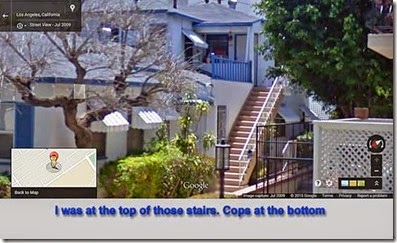
clip_image006Then, one night I’m watching “In a Lonely Place” on the tube (one of my favorite movies) when I heard helicopter noises. I grabbed my politically incorrect pistol, headed to my front door. I opened the door slowly and headed out to the landing at the top of my stairs. I watched a chopper circle above. Then, two scuzzballs came out of Sally's apartment at the bottom of the stairs. Greasy long hair. Big mustaches. Dirty clothes. The bad guy and a friend?

This was one of those situations where you don't have time to think. You have to act.

"Hold it," I said, aiming near-point blank at them only a few yards below. I could have dropped them both before they had a chance to turn around. "Turn around, slowly."

It was just like in the movies.

They did as ordered. Turned s-l-o-w-l-y.

"We're the police," the scuzzier of the two said. "Put the gun away and go inside."

I asked for ID and he badged me, cautiously. That was good enough for me. I went inside. So much for a trigger happy LAPD, though I wouldn’t try this today. It’s a whole different world.

Back in my apartment, “In a Lonely Place” was still on. And then the reality hit. Jesus, they were cops. And I had pulled a gun on them. The movie droned in the background. It could have been anything as far as I was concerned. I was freaking out. Visions of SWAT teams surrounding my apartment flashed through my mind.

The thoughts grew larger. What should I do? Sally hadn’t told me the police were staking out her place, as she’d promised. Now I’d pulled a gun on two cops. I called her apartment. One of the cops answered.

"Are you the guy from upstairs with the gun?" he said.

"Yes," I said.

"Man, you really made me nervous."

Not as nervous as I was when I found out you were the cops, I thought, but didn't say. He was cool. They weren't going to bust me. I had, indeed, pulled a gun on the LAPD and lived to tell about it.
Sally moved out not too long after that. And, shortly after that the Westside Rapist was caught a block away. Not sure if it was the same guy who attacked Sally, but I tend to think it was.

***
clip_image008

So there you have it. My crazy adventures seeking truth, justice and the American Way...and there’s more. But I guess that’s for another time. So when I started writing I naturally gravitated towards telling stories where the bad guys would get punished. What better genre to do that than crime writing. Of course, sometimes, especially in the noir genre, the bad guys don’t get caught, but then there is always the great hand of fate that I can bring down on them as I sit at my computer screen in my captain’s chair and steer my boat to exact revenge and justice in the world. …Okay, so I’m a little over the top but you get the idea.

I don’t do this much anymore – after all, someone might pull a gun on me. And I don’t think the bullets would bounce off my chest.

*** *** ***
clip_image011Hope to you see at the California Crime Writers Conference:

(http://ccwconference.org/ ). June 6th and 7th. I’ll be on the Thrills and Chills (Crafting the Thriller and Suspense Novel) panel, Saturday at 10:30am, along with Laurie Stevens (M), Doug Lyle, Diana Gould and Craig Buck.

Please join me on Facebook: www.facebook.com/paul.d.marks and check out my soon-to-be-updated website www.PaulDMarks.com

Subscribe to my Newsletter: http://www.pauldmarks.com/subscribe.htm


Thursday, May 21, 2015

One most likely . . .

Regrettably, I think the answer to this is a resounding yes.

Not only did I devour The Famous Five, The Five Find-outers, The Put 'em Rights, The Secret Seven and my absolute favourite - The Treasure Hunters (secret passageways! treasure maps! can't say more without spoilers!) - all from the Olivetti of Enid Blyton:

but I did my best to surround myself with drama and intrigue from the off. I was the fourth sister; maybe I reckoned the only way to get any attention was to raise the stakes and keep my big sisters and parents on the edge of their seats. A man followed me home! (He didn't.) There's a rattlesnake in my bed! (There wasn't. Blame Bonanza.) I've gone blind! (I hadn't.)

By the time I had graduated onto Agatha Christie, Dorothy L Sayers, Margery Allingham and Ngaio Marsh, I had learned to keep my melodramatic daydreams to myself. It took a surprisingly long time to learn the next step - write them down. But I'm glad it finally occurred to me.

The first full-length book I ever wrote was the equal of any blind bonanza rattlesnake mash-up as far as implausibility and peril went. But, coming out of almost fifteen years of academia, it had zero playfulness in the writing. I put it in a drawer and moved on to Dandy Gilver (with no great increase in gritty realism). But I never forgot it and never fell out of love with some of the core characters.

A couple of years ago I returned to the imaginary town, renamed it, dusted off some characters, dreamed up more, and wrote what became COME TO HARM. It came out two weeks ago.


It's a bit surreal suddenly having other people know this story that's lived in my head since 2001 and I'm blaming that experience for me sharing, here on Criminal Minds, the fact that I once pretended a strange man had followed me home. To me, it was a tall tale no different from the rattlesnake and the loss of vision. It's only now I get what my parents must have gone through. Sorry, Mum and Dad. Next strange man -  I promise, I'll write it down.


Monday, May 18, 2015

Who Would Have Guessed? Not Me.

Looking back over your life can you see the early clues that you were going to be a crime writer one day?

Nope. Writer yes, hints all over the place from about third grade. Never thought that I might write an entire book, much less three (numbers four and five in process).

I was a reporter for the high school newspaper, a great paper writer in college, a freelancer once my kids were old enough that I could reclaim adult forms of the English language. Served as a newspaper editor and writer, did a lot of high class PR and marketing prose for non-profits. Even learned how to make a case on paper for seven and eight-figure donations, write for the web, and do speechwriting for VIPs.

But emulate any of the crime writers I was in awe of? It took a lot of tiptoeing up to the idea before I got up the nerve to put one of those toes in the water. I’m still in awe of the classic crime writers and the remarkable crop of current ones, especially those I’m privileged to know.

Plug: If you’re reading this and are feeling like dipping your toe in the waters of crime fiction writing, check out Sisters in Crime. No matter how successful any of us are, we remember that beginning, knee-knocking sensation, and we’ll make sure you know you’re among supportive fellow writers who will cheer you, cheer you up, and be the first to celebrate your successes!

-from Susan


Friday, May 8, 2015

Cornered

What's the worst corner you've ever written yourself into and how did you get out again?

by Paul D. Marks

Before I get to my response to the question, I want to congratulate Art and Catriona on their Anthony nominations in the Short Story and Best Paperback Original categories, respectively. And, uh, there’s another Criminal Mind nominated in the Short Story category as well: Me! So I guess Art and I will have to duke it out :)

***
I never really think that I’m writing myself into a corner. I just write and if something doesn’t work I make a right turn, a left turn or a u turn and keep moving on. And, as a pantster, there’s always dead ends that you come up against.

I try to let my characters lead me and follow where they go. And mostly they go in directions that I like, but every once in a while you want to grab them by the neck and say “What the hell are you doing?”
On occasion I’ve run into a wall that was too hard to go through, so you have to do an about face and try something different.

clip_image002
My story Continental Tilt started out as one thing and ended up pretty much something else altogether. So when I hit the wall in the early drafts, how did I get out: I revamped the story completely. Continental Tilt partially takes place at the Hollywood Forever Cemetery, just over the wall from Paramount Studios. The title was inspired by Frank Lloyd Wright’s quote “If you took the country and stood it on edge, all the loose nuts would roll to California.” So add to that the fact that you have this cemetery in Hollywood where lots of movie and rock stars are buried, everyone from Tyrone Power to Iron Eyes Cody, Harry Cohn, Bugsy Siegel (fyi: I grew up across the street from his brother and his family), Rudolph Valentino, Ann Savage of classic B noir Detour fame, Darla and Alfalfa, from Our Gang/Little Rascals, Marion Davies, and Mel Blanc, and that in the summer they show movies on the mausoleum wall, while the audience sit on graves, sipping wine and eating brie or whatever the chic food du jour is, and you have a great genesis for a story idea. (How’s that for one long, run-on sentence?) A humorous/satirical mystery that, when I’d read from it at various events, would have people rolling on the floor. But it started out as something else:

Here’s how it started out – okay, get ready.

The original title was The Mystery of the Bi-Lateral Chinese Church of Dee Dee Ramone. A mouthful, I know. It started as a story sort of inspired by the Ramones’ song Chinese Rock (https://www.youtube.com/watch?v=sJh0I9j5UKA). But I can’t really do the bizarre idea justice here. If I had to give the elevator log line I doubt I could. But it was a mystery story and part of it was set...in the Hollywood Forever cemetery, where Dee Dee is buried and where there’s a bronze memorial statue or cenotaph to his bandmate Johnny.
clip_image004
And, while I Iiked the idea I began getting worried that the whole concept was too esoteric, unless one was a hardcore Ramones fan. So I guess you could consider that I’d written myself into a corner. And now it was time to get out. Time for a new idea. So, keeping the Hollywood Forever concept, since that is one bizarro cemetery and too good to pass up, and after some tweaking, it morphed into Continental Tilt. But I did give a hat tip to Dee Dee and Johnny in that story as a way of giving a nod to the original concept that started it all.

And, of course, things like this happen all the time. A story starts off as one thing and heads in a different direction. Or you think X is the main character and then decide Y is and the story goes off on a whole new path. Another thing that happens, and this one quite often, is that I might start off a story in first person and end up in third or vice versa. Sometimes it just doesn’t work one way or another but you change the POV and it’s magic.

Another time I hit a wall was when working on a script. I don’t know if you’d call it writers block, since I don’t much get writer’s block, but I had a good concept going and a draft that just didn’t work. I tried all of my usual tricks to get past it: taking some time off, driving up the coast listening to Creedence Clearwater Revival and other bands at full blast. Having a drink or two. Nothing helped. Finally, I packed up the car, drove down to Palm Desert (near Palm Springs) by myself. I spent my days hanging out by the pool, reading, or going out to eat. At night I worked on the script. And then I did the old standby trick with index cards, something I’m normally too lazy to do and this was pre-computer days, so I had to do the cards manually. But I put every scene on color-coded index cards and shuffled them around and around. And eventually it all came together. And that script ended up getting optioned several times, though never produced (my perpetual plight).

I think there’s lots of ways to get out of a corner you’ve backed yourself into. But next time I think I’ll just blow it up with some C4 or Bangalore torpedoes and plow over the rubble to the next corner.

***

And congratulations to Art on his Agatha win! This guy’s on a streak. Very happy for you, Art.

clip_image006

***
clip_image008

Hope to you see at the California Crime Writers Conference
(http://ccwconference.org/ ). June 6th and 7th. I’ll be on the Thrills and Chills (Crafting the Thriller and Suspense Novel) panel, Saturday at 10:30am, along with Laurie Stevens (M), Doug Lyle, Diana Gould and Craig Buck.

And please join me on Facebook:www.facebook.com/paul.d.marks and check out my soon-to-be-updated website www.PaulDMarks.com
Subscribe to my Newsletter: http://www.pauldmarks.com/subscribe.htm


Thursday, May 7, 2015

This is not my beautiful book.

As The Talking Heads almost said.

I wrote myself into a horrible corner earlier this year and am not sure yet whether I got out of it or not.

Briefly, I left off work on a Monday in February and instead of picking up on the Tuesday, I went to hospital for abdominal surgery, anaesthetic, pain, pain medicine and recovery.

Two weeks later - I know; I'm a big baby - I opened the file again and . . . I literally had no idea who the two people were who were mid-conversation on the page. One was called Cinty and one was called Gibb and they were both strangers to me.

My first attempt at a solution was to close the file and leave the draft for another week. It didn't help.

Then I thought I'd go back to the start - 60K words - and read what I'd written. Refresh my memory. I'd never done this before and, the truth is I couldn't do it this time either. I tried; I read two chapters but it was like running towards a cliff edge. I kept thinking "I'm reading a story that doesn't exist!" and it freaked me out.

So I decided to fake it. Gibb seemed like a policeman and I reckoned Cinty was one of three sisters who lived in the village near the main setting of the story. So I finished the scene on that assumption and then started a new chapter.

I'm pretty sure most of the stuff I wrote in the last 40K is connected to stuff in the first 60, but I won't know for sure until I read it. Probably in about a month. If I'm lucky, I won't even see the join. If not, this first draft will be a total hippogriff and the edit will start with a shovel.


Monday, May 4, 2015

It's a Bird, It's a Plane, It's That Stuck Writer Again!

Q: What's the worst corner you've ever written yourself into and how did you get out again?

A: Whatever corner I’m backed into at the moment is the worst.  Example: She left the apartment hours before she arrived at the apartment because I need her to see something that she could only see across town at that moment …but I also needed her to get the phone call at home that her partner couldn’t possibly make until that moment because he had been locked up in the villain’s basement and she had to rush out to rescue him before she realized the man she saw.... Time sucks. 

It all sounds so easy when I begin. I brush past the warning signs and write, write, write, relishing the rush until that moment I come to a screaming halt, betrayed by my decision not to have my protagonist be a time traveler of a close, personal friend of Dr. Who.

It isn’t just time issues that corner me. I sometimes find the murderer I anointed secretly in chapter one isn’t such a bad person by chapter fourteen and I get a little sad to think how much my readers are going to hate him in chapter twenty-three. So I start hedging, creating little scenes in which he shows a softer side. Such a mistake. I’m just making it harder to carry off the climax of the story without severe and unwelcome revisions.

Getting out of these corners is harder than avoiding them in the first place. So, while I don’t outline, I do try hard to construct and stay with a timeline, aided by stickie notes, that forces me to face up to plot complications and straighten them out as I go.  Either she didn’t need to see that clue, or she saw it from her window, or she saw it last week and only has to remember it while she waits for her partner’s call.

For characters who start to shape shirt, firmness is called for most the other time. The villain is the villain. If I don’t believe he’s dastardly enough for the job, I need to go back to the backstory and either get rid of him or add enough that I lose my misplaced sympathy. There’s something else that might be going on – maybe he isn’t the villain. Maybe my subconscious is telling me he’s the decoy and, if that’s the case, who is it I think is the real skunk? There’s always someone. I may merely have ignored my inner voice.


Corners are part of the business of being a writer – any kind of writing presents issues like these. The great fun of writing mysteries is the times I’m sitting at the keyboard grinning as I burst my way out like Superwoman, and rush into the next hot mess.

 -Susan