Showing posts with label Double Indemnity. Show all posts

Friday, October 23, 2020

Sometimes Less is More

How do you handle sex in your books? Or, if you don’t, why not?

by Paul D. Marks

Well, there’s sex and there’s sex. No, I don’t write really steamy sex scenes. If people want that they can go to Fifty Shades of Arousal, romance novels or porn, I suppose. But that doesn’t mean there isn’t sex in my stories.

I’d say I approach it more obliquely. We know the characters have or have had sex, but we don’t get the play by play like from the Howard Cosell scene at the end of Woody Allen’s Bananas (see link). It’s funny as hell and sort of makes fun of the overly purple sex scenes. 

Click here to see YouTube clip

Just as with violence, I don’t want the sex to be gratuitous. And, believe me, when working in Hollywood plenty of sex and violence were added to scripts strictly to have sex and violence where it wasn’t really needed. Also added were other elements that seemed extraneous. But that’s for another post, I suppose.

I like the sexual relationships in my fiction to reflect on the larger relationship between the characters, as well as being a reflection of their character. In the third Duke Rogers novel I’m currently working on (after White Heat and Broken Windows), a character sleeps with Duke essentially as a way to deal with her own issues of insecurity and doubt. The relationship between her and Duke is tentative and very confusing for Duke, and shows his own ambivalence about relationships. So what they do sexually is less important than conveying the idea that both Duke and his love interest are flawed people with fears and insecurities. And sex is intimated at in other stories and novels of mine. It’s just not explicitly described like in a high school sex ed class.

Fred MacMurray and Barbara Stanwyck in Double Indemnity

Sex scenes can also often stop the forward momentum of a story, especially if they’re not integral to the plot in general. But in particular, it drives me crazy when the characters are on the run, in grave danger, but they have the time and inclination to stop everything and have sex. I think of movies in this regard. We’ve gone beyond the time when filmmakers and screenwriters added sex because there was an opening up of social mores and the end of the Hollywood Production Code. When all that loosened up filmmakers went bonkers adding sex and violence, much of it gratuitous, just because they could.  They were spreading their wings. I like to think we’ve gotten that out of our systems so that when we do have a sex scene it’s more integral to the plot. But seeing some of today’s movies, I’m not so sure about that…

Lana Turner in The Postman Always Rings Twice

I like this exchange from In a Lonely Place, one of my favorite movies, between Gloria Grahame and Humphrey Bogart, as they stand in the kitchen. She’s in a robe, all bleary-eyed from having just gotten up. He’s doing his best attempt at making breakfast. They’re not in a bedroom. They’re not having sex. Not even kissing. But as Bogart says, in other words, their little vignette is a good love scene:

Humphrey Bogart and Gloria Grahame


Laurel Gray (Grahame): [referring to a scene in Dix's script] I love the love scene – it's very good.

Dixon Steele (Bogart): Well that's because they're not always telling each other how much in love they are. A good love scene should be about something else besides love. For instance, this one. Me fixing grapefruit. You sitting over there, dopey, half-asleep. Anyone looking at us could tell we're in love.


In the old days, movies had a code, so things were left to the viewer’s imagination. When Rhett carried Scarlett up those stairs, we didn’t have to see the culmination, our imaginations filled in the blanks.

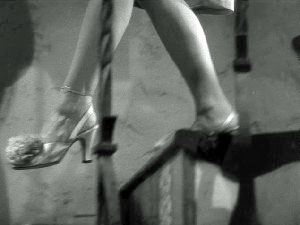
The famous anklet in Double Indemnity

During the code days, you couldn’t show graphic sex, but somehow the filmmakers got the point across. Maybe these bits seem quaint today, but they worked. In both Cain adaptations, Double Indemnity and Postman, sex isn’t even imminent in the scenes where Fred MacMurray and John Garfield first spot Barbara Stanwyck and Lana Turner, but you know it’s there and you know it’s coming sooner or later.  There’s nothing graphic in these scenes, but they’re still steamy as hell. And I would say the beach scene in From Here to Eternity is one of the great sex scenes of all time, yet there’s no actual sex in it. And the one from Ghost World, in particular, I think is played for laughs, making fun of those earlier tropes.

Double Indemnity: We first meet femme fatale, Barbara Stanwyck, wrapped in a towel. A few minutes later she descends the stairs and we see her sexy little anklet. It’s clear she’s seducing Fred McMurray and we don’t need to be hit over the head with it.  


The Postman Always Rings Twice: Here John Garfield sets eyes on Lana Turner for the first time. Again, we really don’t need everything spelled out here. It’s clear what’s going on without having to get all the details.


From Here to Eternity: Possibly the sexiest scene ever filmed and all they do is kiss.


Ghost World: When they cut to the toy “rocking” horse, the implication is pretty obvious and funny at the same time.


So, I don’t think sex has to be particularly graphic to get the point across or to be, well, sexy. In fact, I would argue that too much detail kills a sex scene and is boring. Sometimes less is more.

But if you just need a sex fix, here’s some songs about sex that might do the trick. (I do like these songs, I admit.) Be warned, some graphic content, but these are not obscure songs. My wife says some people don’t get my sense of humor sometimes and I thought these would just add a light, but sexy note, to this piece 😉. And, while I do like these songs, as I say, I’m also adding them here strictly for prurient interest, he said in jest.


So, if people want to read particularly graphic sex scenes, I guess my stuff isn’t for them, at least up till now. If a story calls for it in the future, maybe. But if you want some good mystery-thriller-suspense, then I hope you’ll check out my works.

~.~.~

And now for the usual BSP:

A great review of Coast to Coast: Noir at Just Reviews:

Each story is filled with sadness, tragedy and each character experiences death in a different way. The titles alone are eerie and will give you the chills. A fabulous collection of well written noir short stories told in different settings with  characters that work in meat packing plants, feed companies, markets and not very lucrative jobs causing their downfalls and falling for the need to complete jobs that most would turn down. A superb collection for readers that want something odd, different and dangerous.

-- Fran Lewis, Just Reviews
And a very nice review of The Blues Don't Care at The Irresponsible Reader:


Marks hits the right notes with his prose and characters, creating a mystery that appeals on many levels. I recommend this for mystery readers looking for the kind of thing they haven’t read before.

--H.C. Newton, The Irresponsible Reader


Please join me on Facebook: www.facebook.com/paul.d.marks and check out my website  www.PaulDMarks.com

Friday, January 11, 2019

Can You Judge a Book by its Cover?

What makes a great book cover? Is it the title or the graphics? Do you have favorites that you think work?

by Paul D. Marks

You can’t judge a book by its cover, but its cover might just be what draws you into it in the first place. The thing that makes you pluck it off the shelf and crack that cover to see if it’s something you might want to read. So, covers are definitely important.

As to what makes a good book cover, the title or graphics, I think it’s both. An intriguing title makes me want to read something as do mysterious or evocative pictures and graphics. It’s a symbiotic thing, each element works in conjunction with the others to create a whole that, if it’s done well, will grab my attention.

I think the best way to explain is to show this is by comparing different covers of the same book. As many of you know, I like classic crime fiction from the 20th century (that sounds really weird) so let’s take some of those covers and look at them. I’m using some of the books I mentioned in my December 14, 2018 post of year-end book recommendations:
( https://7criminalminds.blogspot.com/2018/12/classic-year-end-reads.html ) .

And I will tell you up front that the pictures pretty much go in the order that they attract me. So on single rows the ones towards the right end are the ones I like better. On double rows the bottom (and more to the right side) are the ones I like better. What attracts me to them? It’s hard to say. It’s an image that evokes some kind of reaction in me. Sometimes it could simply be that the cover that I first read the book under is if not the one I like best at least towards that end. But, I’m not a purist. I don’t necessarily have to go for the original cover or the first cover I saw on a book and often don’t as you’ll see.

So, after you’ve checked out my choices, let us know what you think.

DOUBLE INDEMNITY – JAMES M. CAIN

I don’t really like any of the covers on the top row. The woman in the second from right pic reminds me of Kim Novak in Vertigo, which isn’t a bad thing if it’s a Vertigo cover. On the bottom row I like them better as they go from left to right. Though the last two on the right are pretty much tied for my faves.


THE CHILL – ROSS MACDONALD

My favorite Ross Macdonald book is The Chill. Here’s a selection of covers from it. Which one/s do you like? Which one/s suck you in and make you want to at least check the book out without knowing anything else about it.


TAPPING THE SOURCE – KEM NUNN

Another book I like a lot is Tapping the Source by Kem Nunn. Here’s a sampling of covers for that. Again, which ones do you like?


THE RAZOR’S EDGE – SOMERSET MAUGHAM

The Razor’s Edge by Somerset Maugham is my favorite book of all time. I like the last cover because of its ethereal feel.


L.A. CONFIDENTIAL – JAMES ELLROY

L.A. Confidential might be James Ellroy’s best known book, probably because of the movie based on it. I like the original cover and I also like the last shot, which is from the movie.


DOWN THERE / SHOOT THE PIANO PLAYER – DAVID GOODIS

Down There, a.k.a. Shoot the Piano Player, is my favorite David Goodis book. Goodis has been called the “poet of the losers” by Geoffrey O’Brien. And, while I like the original cover (2nd to last), I really like the Black Lizard cover (last). I do, however, like the original title, Down There, better than Shoot the Piano Player, which came about because that’s the name of the Truffaut movie based on the book. And I have to say I absolutely hate the cover on the left and I don’t much like the movie either.


MONTE WALSH – JACK SCHAEFER

I don’t read a lot of westerns. But I really like Monte Walsh, the story of a man who’s basically outlived his time. And I really like the last cover here. It’s so evocative of a man alone in the West. A man riding into the sunset.


THE GRIFTERS – JIM THOMPSON

Except for the last cover, the Black Lizard cover, I don’t like any of these other covers. They’re just so cheesy, but not good cheesy.


DEVIL IN A BLUE DRESS – WALTER MOSLEY

The book that introduced Easy Rawlins and I’ve been hooked from day one. I really don’t like any of the covers on the top row, though I can tolerate the last two. But the first two just don’t do it for me. All four on the bottom row are fine, but I like them from left to right, the last being my fave, which also happens to be the original cover.


WORLD’S FAIR – E.L. DOCTOROW

I really like this book for a lot of different reasons, but that’s for another post as this is about covers. I like all these covers, except the first one. But my two faves would be the last two on the bottom row.


ASK THE DUST – JOHN FANTE

Another favorite book. If you’re into L.A. at all you have to read this – and maybe its sequels. I like all these covers in descending order except for the first, which I don’t like at all. And though the building in the last one is hardly what Bandini would have lived in in Bunker Hill in the 1930s, the whole ambience of it works for me. And I think the palm tree seals the deal.


WHITE HEAT – UNKNOWN AUTHOR 😉

Okay, I couldn’t resist. And I gotta be honest, I like both of these covers. But ultimately it’s what’s in between them that counts for all of these books.


So, what do you think? What are the ones that speak to you from above? And in general. And why?

~.~.~

And now for the usual BSP:

Dave Congalton of KVEC Radio interviewed me. Check out the podcast here. My part comes in at 20 minutes, 30 seconds into the recording.

***

And Broken Windows has been getting some great reviews. Here's a small sampling:

Kristin Centorcelli, Criminal Element: 

"Although it’s set in 1994, it’s eerie how timely this story is. There’s an undeniable feeling of unease that threads through the narrative, which virtually oozes with the grit, glitz, and attitude of L.A. in the ‘90s. I’m an ecstatic new fan of Duke’s."

"Duke and company practically beg for their own TV show."

John Dwaine McKenna, Mysterious Book Report:

"This electrifying novel will jolt your sensibilities, stir your conscience and give every reader plenty of ammunition for the next mixed group where the I [immigration] -word is spoken!"

Betty Webb, Mystery Scene Magazine:

"Broken Windows is extraordinary."


Please join me on Facebook: www.facebook.com/paul.d.marks and check out my website www.PaulDMarks.com


Friday, January 13, 2017

The Wonder of Me ; )

It’s a New Year – and we Criminal Minds are taking the chance to (re)introduce ourselves. First up – how we’ve arrived where we are in our writing career.

by Paul D. Marks

My name is Paul and I’m a wordaholic. I write ’em. I read ’em. I horde ’em. I find secret hiding places for them. How the hell did I get in this fix?

I started young. At first I didn’t mainline. I just read a few words here and there, cat, dog, see Spot run. Then I began to string more and more words together, until I could read a whole book. Sure, it might have been a little Golden Book, but a book. These were my ‘gateway’ books to other, longer and harder books.

As Bob Dylan said, “I started out on burgundy, But soon hit the harder stuff.”

And since I already did my Adventures in La La Land post both here and at SleuthSayers (http://7criminalminds.blogspot.com/2015/11/adventures-in-la-la-land-redux.html ), which introduced a lot of my influences this will focus more on my writing history. So here’s the wonder of me (not totally in chronological order):

I’m a multi-generation L.A. native. Being from L.A. definitely influenced my writing and probably my career choices as well. It was a good city to grow up in........the city of Raymond Chandler’s “mean streets,” Ross MacDonald’s Lew Archer and Cain’s Double Indemnity. In fact, I grew up in a Spanish-style house very much like the one that Barbara Stanwyck lives in in the movie version of Double Indemnity. A film noir town for a film noir kid.

I was born in the heart of Hollywood, literally. And, even though no one in my family was in the film biz, it must have been destiny, providence, fate, kismet that I ended up a script doctor (Hey, mom, I’m a doctor…), even though my initial “goal” was to be a rock star. But as someone who did make it as a rock star said, ““Life is what happens to you while you’re busy making other plans.”

As a kid I loved reading and watching movies. My first venture into “writing” was when I would pretend my army men were on a film set instead of a battlefield and use TinkerToys as Klieg Lights. So I was creating scenarios, making my little men talk, move and go through plots of one sort or another. Eventually I lost the men and started doing pretty much the same thing on a typewriter and now a computer, making characters talk, move and go through the paces of plots of one sort or another.

My long and winding road to becoming a professional writer started with writing songs for that rock superstardom that was sure to come. Yeah, they were classics. (Well, some weren’t so bad.)

My first paid writing gig was for a piece on John Lennon for one of the L.A. papers. What a thrill to see my name in lights, or at least on newsprint and, of course, to get a check. Wow!

While still doing that, I was also trying to break into Hollywood, so I could see just how far Sammy really could run. I would try almost anything to get noticed and have people read my scripts. I’d send letters to everyone. The bigger they were, generally speaking, the nicer they were. Gene Kelly invited me to his house to drop off a script. And when I got there he invited me in for a chat. Cary Grant called me—twice. (And you ought to hear where I was the second time he called, that story can be found on my website.) Burt Reynolds asked to take a look at a script. I got invited to pitch to the biggest producers of the day. And more. And eventually I started getting work as a script doctor, no credit, no glory, but fun, at least for a time. So a fun time was had by all, except for the screaming matches or the producer threatening to send his friends in the Mossad after me after an argument. Y’know, fun, like Day of the Locusts. Fun.

At one point, I shot a film on the last surviving MGM backlot, giving me the distinction, dubious though it might be, of being the last person to have shot a film on any of the fabled MGM backlots before they bit the dust to make way for condos. According to Steven Bingen, one of the authors of the well-received book MGM: Hollywood’s Greatest Backlot: “That 40 page chronological list I mentioned of films shot at the studio ends with his [Paul D. Marks’] name on it.”

And after several years, I went back to grad school at USC, where, even though I was a cinema major I took an advanced short story class from T. Coraghessan Boyle. Today, after donations from George Lucas and Steven Spielberg, and others, the cinema department at SC just about rivals any major studio with top of the line equipment and modern buildings. When I went there the soundstage was an old army cavalry barn and the editing rooms were the former horse stalls. I think we could still hear the ghosts of the horses. Things being what they were, I never did finish my degree. Sometimes I actually think about going back and doing that.

So after years of optioning scripts that paid well but didn’t get produced, doing rewrites, with my dad never being able to figure out what I did for a living, I guess I became one of the disenchanted, plus I wanted more autonomy. Didn’t want everyone and their chef and gardener sticking their two cents in, saying how something should be done, so I started writing short stories and novels (ah, those glorious rejection slips, but they did make nice targets).

The transition from screenwriting to prose was a difficult one. Screenplays are great for structure, not so hot for description. And people said my first stories and novels read like screenplays. It took a while for me to be able to do description and interior character thoughts. (See the piece I did for Ellery Queen Magazine’s Something is Going to Happen site for more on the differences between novels, stories and screenplays: https://somethingisgoingtohappen.net/2014/10/22/words-and-pictures-short-stories-novels-and-screenplays-by-paul-d-marks/ )
So I honed my craft and one of those early novels, maybe my first, hard to remember now, was even accepted for publication at a major publisher. Of all things, it was about a screenwriter trying to make it in Hollywood and as absurd as much of it was, little of it was made up. But then the sky fell in. The whole editorial department at that publisher was swept out and new brooms sweeping clean and all of that, the new editors dumped me and my novel. So the experience was like something out of a Hollywood movie…minus the happy ending. And by the time all this happened the humor in the novel was dated as it had a lot of topical satire, so it couldn’t go to another publisher right away and, in fact, went on my shelf. But you know what they say about satire anyway, it closes Saturday night. Still, some day I’ll resurrect this tale.

Eventually, I started placing short stories here and there and slowly started reaching some of my prose writing goals and winning writing awards along the way, which is a great honor and thrill.
One of my goals was finally reached when my story Howling at the Moon was published in Ellery Queen and it was short-listed for both the 2015 Anthony and Macavity Awards, as well as coming in # 7 in the Ellery Queen Reader’s Award Poll, I also reached another writing milestone when my story Deserted Cities of the Heart was published in Akashic’s St. Louis Noir last year.

And sappy as it sounds, I hope this is just the beginning of the journey. So there you have it, the wonder of me.

###


And now for the usual BSP:

Coming on January 30th from Down & Out Books:
Coast to Coast: Private Eyes from Sea to Shining Sea 
A collection of 15 Private Eye stories from some of the best mystery and noir writers from across the country. Available for pre-order now on Amazon:


And I have a couple of appearances in January.

Santa Clarita: The Old Town Newhall Library
Saturday, January 14, 2017, from 10:00 AM-3:00 PM.
24500 Main St, Santa Clarita, CA  91321

Cerritos Library, where I’ll be moderating a panel:
Saturday, January 28 from 11 a.m. to 4 p.m.
18025 Bloomfield Avenue, Cerritos, CA  90703

😎😎😎

Friday, August 5, 2016

ReDouble Double Indemnity

What do you think of fan fiction? Have you ever written any?

by Paul D. Marks

Since this is a fairly long post, let me mention my BSP at the head: My story Deserted Cities of the Heart appears in Akashic’s St. Louis Noir, which just came out on Tuesday of this week. Please see the end of this post for more details.


Now to the question at hand:

Like others here this week, I didn’t really know what to make of this question or how to respond. My initial thought to the questions were just to say “I really don’t think about fan fiction one way or another” and “No, I haven’t written any,” and leave it at that. But that would have made for a very short piece. Then I wrote a serious response based on the little I do know of fan fiction. Didn’t like that either. So I decided to try my hand at it. It’s my understanding that in one version of fan fiction, or fanfic, the writer creates a new ending for a well-known work. And what we have here is my fanfic alternate ending for the movie version of Double Indemnity, complete with Product Placement. And I know what I’m doing here is sacrilege (to me too) but hopefully also at least a little bit entertaining.

So, if you haven’t seen the movie there might be SPOILERS (sort of). If you have I hope I don’t ruin it for you. And since I came on this brainstorm late and close to the deadline, it’s probably not as polished as I would have hoped, nor as concise – so sorry if it’s a little on the long side, but hopefully worth a look. 

It also helps if you know the Double Indemnity story. If not, this probably won’t make sense to you. Oh hell, it might not make sense even if you know the story.


We pick up our intrepid hero, uh, anti-hero, Walter Neff in the offices of the Pacific All-Risk Insurance Company in the dead of night. The wounded Neff has been talking into a Dictaphone. His co-worker, Barton Keyes, has been listening to the last part of Neff’s confession of duplicity and………murder. Here we go:


Somewhere in the night, Walter Neff held a handkerchief over the bleeding chest wound. He’d looked around the office for a dressing, but all he found was Newman’s Own. It wouldn’t work so the handkerchief would have to do. He stumbled out of the office into the hall of the Pacific All-Risk Insurance Company. He slumped down. Barton Keyes watched from the open door behind him, unlit stogie in hand. He approached Neff.

“You’re really through now, Walter. All washed up.”

“We can’t all be the King of the World, huh, Keyes. Besides, I wish I had something to wash up with now.” Neff inched down the hall.


“Where do you think you’re going, Walter?”

“Mexico.”

“You’ll never make it.”

“You gonna stop me, Keyes?”

“Me and that gaping wound.”


Neff fumbled in his pocket again. Pulled out a sleek Mother of Pearl-handled revolver (sleek revolver on loan from Zales) with a stainless steel finish. Aimed at Keyes.

“What’s that, Walter?”

“My ace in the hole.”

“And what are you going to do with it?”

“Nothing, if you don’t stop me. Nice gun, don’t you think. I borrowed it from Mrs. Dietrichson.” 

“I’m sure she won’t miss it.”

“I’m sure she won’t.”

“You’ll never make the border.”

“Watch me.”

“No, you watch me, Walter.” Keyes stepped in front of Neff, blocking his path to freedom. Neff’s eyes locked on his, even though Keyes was about a foot shorter. “We should have brought some apple boxes, huh, Keyes.”


“You think of everything, Walter. I’ll make a note to contact the grip department about that.”

“I love you, Keyes, but me and my gat gotta do what we gotta do.”

“I love you, too, Walter.”

Bam!

Keyes hit the ground. Neff took Keyes’ keys from his pocket, including his 20 Year Anniversary Gold Key.

“Sorry, Keyes.”

Neff jammed the handkerchief against his wound to slow the bleeding and a paper towel roll in his pants for his ego (Brawny, of course!). He staggered down the upper hall, limping past Raymond Chandler, still sitting there in that chair unnoticed all these decades. Chandler jerked his foot out, trying to trip Neff. 


“Damn, I hate when my characters get away from me,” Chandler mumbled.

Neff, coughing blood, danced around Chandler. And being Fred MacMurray, he pulled out his Selmer Gold Medal saxophone, seemingly from nowhere, and played a few bars of Coleman Hawkins’ “I’m Through with Love,” and he wished he were. But he knew he wasn’t. He threw the sax over the railing down to the ground floor, slid down the banister. Danced toward Max, the 800 year old night watchman.

“Here, Max.” he said, handing him the keys.

“Why, ain’t those Mr. Keyes’ keys, his gold key too?”

“Keyes won’t be needing his keys anymore.”

“Are they the keys to the kingdom?” Max laughed at his own insipid joke.

“Only if the kingdom is Pacific All-Risk Insurance.”

“What about that special key of Keyes’?”

“What key is that?”

“The glass key.”

“Don’t have it.”

“Well, then can I borrow your rod?”

“No can do.” Neff headed for the front door of the building.

“Don’t catch cold. This weather’ll be the death of you,” Max said.

“Yeah, Max. Sure.” Neff tipped his fedora.

He dashed out of the fog into the rain-slicked street. His car was waiting for him in the red zone in front of the building. Luckily no ticket, especially since three motorcycle cops were standing chewing the fat just across the street. He put the key in the ignition. Rrrrrrrr. Rrrrrrrr. It wouldn’t turn over. Movie cars never start the first time, he thought, sweating blood.

After a few tries it turned over. He zigged and zagged through downtown LA, veering straight towards a watermelon cart – ’cause according to Siskel and Ebert there’s always a watermelon cart or similar to be slammed into.

Pedal to metal, racing at a reckless 73, as much as the car could do and fast for the day, he zipped over to Phyllis’ very cool Los Feliz house. Amazing how he could drive through the streets willy nilly and no one called the cops on him. And no cops saw him. 

He screeched to a stop in front of Phyllis’ house. Limped up the walk – first on one leg, then on the other, ’cause the script supervisor messed up – to the still-open door. Phyllis lay on the Spanish-tiled living room floor, coughing up blood. 


“That’s still a honey of an anklet,” Neff said, admiring the anklet on her leg.


“Walter, is that you?” Her eyes opened slowly. They stared at each other, both bleeding buckets – so much that for any mortal people they would have been dead hours ago. Love in their eyes. (Okay, I ain’t no romance novelist.)

“Oh, bay-bee, I’m so sorry.” Neff helped Phyllis to her feet. Stuffed some Kleenex Soft and Soothing tissues into her wound.

He pulled two cigarettes from the pack of Lucky Strikes. Held the box up to the camera (what camera, hey this is my story). Put them both in his mouth and lit them.

“Isn’t that from another movie?” Phyllis said.

“You know what they say, good artists borrow, great artists steal.”

“Did Nietzsche say that?”

“Joe Nietzsche down at the Five and Dime. I don’t think so.”

They smoked cigarettes holding hands, blowing smoke at each other. 

“That’s a nice outfit, what do you call that?”

“It’s a crimson kimono.”


“I like it.” He admired her anklet from Jared Galleria of Jewelry (213-555-1944). “How much did that honey of an anklet cost, if you don’t mind my asking?”

“Not enough, my husband was a cheap SOB.”

“Well, now he’s a dead SOB. But I love you, baby.”

“Me too, Walter,” she cooed. “You think we can make another go of it?”

“Sure, just get some Mercurochrome so we can get fixed up.”

They moved to the bathroom. She pulled the Mercurochrome, BandAid brand bandages and Bactine from the shelf. “Damn,” she said, turning the three items to face the camera. She slathered Mercurochrome on him and he on her. It was very sensual. They closed with the Bactine and BandAids. 

“Good as new.”

“Good as new, Walter. Straight down the line.”

“Straight down the line, baby.”

“I love you, Walter.”

“The last guy that said that to me didn’t fare so well.”

“You look hot, baby.”

“I am hot, Walter, white hot, with the white heat of a thousand suns.” She returned to the living room, Neff trailing.

“Do you really think we can make it? Do you really think we have a chance?”

“Why not? We’re not any different than any other pair of cold blooded killers.”

“But look, there’s a shadow on the wall. Isn’t that bad luck?”

“Don’t let it spook you.”

The door opened. Channing Tatum walked in.

“I feel dizzy,” he said.

“Who are you?”

“Mike, Magic Mike. But I think I stepped into the wrong–”

“Take a hike Magic Mike.” Neff pushed Tatum out the door. He was just about to close it when Nino Zachetti walked in. He had that surly look they hired him for.

“What gives?,” he barked, giving Phyllis the once over. “I thought we were going to hook up tonight.”

“Run off, little man,” Neff said.

“What’s the gag?” Zachetti said.

“Do like the man says, Nino.” Phyllis nudged him toward the door.

“The name is Zachetti. And I ain’t goin’ anywhere.”

Phyllis stuck her hand into Neff’s pocket, slid the gun out. She shot Zachetti, philosophically.

“We better lam, bay-bee,” Walter said.


“Yes, Walter. We better lam.”

She packed for every occasion, her travel suit, dinner dress, evening dress, evening gown, after-dinner dress, before-dinner dress, cocktail dress, lounging by the pool dress and matching shoes, handbags and anklets for each outfit. They strolled down the walk to Neff’s car, Neff limping on one leg and then the other. The honeysuckle smells like murder, Neff thought. Why can’t I hear my own footsteps – that’s a bad omen. Wait, it’s cause I’m wearing New Balance sneakers, quieter than quiet. He breathed a sigh of honeysuckle-filled relief. They got into his car, which wouldn’t start, but finally did. They drive by night down to Sunset Boulevard.

“This LA late at night is some place, isn’t it?”

“Yeah, it’s a fantastic sight.”

“I feel like I’m being sucked into some kind of exciting vortex with you, Walter,” she murmered, seductively. “What street is this?”

“Scarlet Street, but some people call it the street of chance.”

“I should have known. This is some dark passage we’re on. A truly dark journey.”

“Nothing but a journey into fear.”

“Watch it, Walter. You better take that detour down that sidestreet. Less cops in the dead of night.

“No problem. It’s just a pitfall.”

They drove and drove, down to the border, all the way to the big heat of Acapulco.

“I need a drink, baby.”

“Something cold, Walter. There’s a café. La Mar Azul, sounds pretty.”

They parked where the sidewalk ends, walked across the road. Loud voices spilled out of the café as they entered.

“What’s that yelling?” Phyllis said.

 “You don’t own me,” the woman said.

“If it weren’t’ for you we would never have gone to jail,” her husband shouted.

“Me, don’t you mean you?”

“What goes on?” Neff said to the waiter.

“Oh, that is Señor Joe Guidice and his wife Teresa. They are very noisy.”

“This is my nightmare,” Phyllis said.

“It’s nothing but a little fear in the night.”

“Well, I’m in a lonely place, Walter, a very lonely place.”

“How can you be lonely with all that shouting?”

“What’re you looking at,” Teresa Guidice said, aiming a daggers glare at Neff and Phyllis. Phyllis shot back with her own patented stare. The Guidices slunk away.

“Here is your table.” The waiter sat Phyllis and Walter in the dark corner, knowing they’d want their backs to the wall. He left so they could peruse the menu.
Phyllis rang a bell for the waiter to come back.

“Did you ring, madame?”

“Twice.” She said. “I’d like a slushy margarita made with Gran Patron Platinum Tequila and just a touch of evil.”

“I didn’t know you could get slushy margaritas. I didn’t think they existed yet.” Neff ordered a Captain Morgan rum and Coke. “Heavy on the rum.”


Just then a stunning woman in stunning white stepped into the doorway, framed and silhouetted in the door, the stunning sun beaming around her. A tall man joined her. The man zeroed in on Phyllis. 

“Don’t I know you somewhere from out of the past?” he said to Phyllis.

“How could you? We’ve never met.”

“Sure. Sure. Up at Lake Arrowhead. Phyllis, right? You married that rich guy from Los Feliz.”

“What goes on?” the stunning woman in stunning white said.

“I’m Jeff Baily. You must remember this,” Baily said directly to Phyllis. He was sloe-eyed and slow moving. “This is my, uh, friend, Kathie Moffat. Isn’t she stunning?”

The jealousy grew exponentially in Phyllis’ eyes.

“Seems like I’m the odd man out here,” Neff said.

“Me too,” the stunning woman said.

“You’re no man, bay-bee,” Neff said to the stunning woman in stunning white.

At the same moment, Phyllis and the stunning woman in stunning white both pulled guns. They quickly eyed each other’s pieces to see whose was bigger. Bam! Phyllis shot Baily. He landed on the floor, headed for the big sleep. He fought to open his eyes, a struggle for this actor even when he hasn’t been shot, “Build my gallows high, baby. But make sure you use sustainable wood.” His eyes closed for the last time…maybe.

The stunning woman in stunning white squeezed the trigger. Phyllis squeezed faster. Bam! The stunning woman in stunning white fell to the floor creating a stunning crimson tide. Phyllis turned to 
Neff.


“Give me a kiss, Walter, a kiss before dying.”

“I died a thousand times since meeting you.”

She leaned up, kissed him on the lips.

“The kiss of death?” he whispered.

“Yes, Walter, the kiss of death.”

“You’re crazy, Phyllis,” Neff said with his dying breath.

“Not crazy, Walter, just gun crazy.”

Phyllis looked triumphant. She turned to the camera (yeah, that one), “I’m the Queen of Noir!”

***
There are around 30+ film noir titles (and a couple not noir maybe) in this piece. How many can you pick out? There’s a list at the very end of this post.

Also, I absolutely love both Double Indemnity and Out of the Past and the actors in them, so I hope I haven’t offended anyone’s noir sensibilities by taking some liberties with them. They are two of my three favorite noirs, the other being the Garfield-Turner version of The Postman Always Rings Twice.

Now I guess I will be able to say “yes” to the second question, I’ve written fanfic.

***

And now for the usual delightful BSP:

My story Deserted Cities of the Heart appears in Akashic Books’ St. Louis Noir, hot off the press on 8/2/16. Hope you’ll check it out. I’m honored to be among such a great group of writers. Edited by Scott Phillips.

Publishers Weekly says, “…[I]t’s no surprise that the most notable tales are the work of three genre veterans…” including “…‘Deserted Cities of the Heart,’ by Paul D. Marks (‘White Heat’), [which] charts the fall of loner Daniel Hayden after he meets femme fatale Amber Loy at the Gateway Arch.”

http://www.amazon.com/St-Louis-Noir-Akashic/dp/1617752983/

www.PaulDMarks.com

Join my newsletter or Fade Out:


Here’s the list of titles (and a handful of extras) in ReDouble Double Indemnity. I hope I didn’t miss any:

Somewhere in the Night
Ace in the Hole
The Glass Key
Out of the Fog 
Crimson Kimono
White Heat 
Shadow on the Wall
They Drive by Night
Sunset Boulevard
LA Late at Night 
Vortex
Scarlet Street
Street of Chance
Dark Passage 
Journey into Fear
Detour
Sidestreet
Dead of Night
Pitfall
The Big Heat 
Where the Sidewalk Ends
Nightmare
Fear in the Night
In a Lonely Place
The Dark Corner
Touch of Evil
Out of the Past
Odd Man Out
The Big Sleep
Build My Gallows High
A Kiss Before Dying
I Died a Thousand Times 
Kiss of Death
Gun Crazy


Friday, January 22, 2016

To Suffer the Slings and Arrows of Outrageous Fortune...or Misfortune...of Having Gotten This Question

Is there a well-regarded classic mystery that you’ve read and didn’t see what all the fuss was about? Why not?

by Paul D. Marks

I want to thank Cathy Ace for citing Agatha Christie’s The Murder of Roger Ackroyd as a classic mystery she had issues with. As every graph of this post except this one was written prior to her piece you’ll see why I owe her a debt of gratitude to be the first to publicly take the Christie heat. Though I guess my not seeing the fuss in Christie goes way deeper than hers. So I’m ready to start shaking in my hobnail boots.

As Susan said on Monday “This week’s question is perfectly designed to get us all on the wrong foot with readers, writers, and obsessive fans.” Well, I like a good fight as much as the next person. And I like a classic mystery as much as the next person. And I’m going to assume that when we say “classic” here we’re talking dead writers. ’Cause we sure don’t want to piss off anyone who’s still living, do we?

And instead of focusing on one book, how about one author, so get your slings and arrows ready: I don’t like reading Agatha Christie. Now, it’s been a long time since I have but I clearly don’t feel the need to go back to her. It’s not that I don’t like her stories, I do. But the style of writing is not one that I enjoy reading.

I hate to be like the person who won’t watch black and white movies because they’re old and look dated or funny to them. I love black and white movies as a whole. But there’s something about Christie’s style of writing that I just don’t spark to though, as I say, I do love her stories. And I like the movie versions of many of her stories, especially And Then There Were None (1945 and despite some changes from the novel), based on Ten Little Indians and its earlier title, which I won’t repeat here.

But, instead of dwelling on the negative and turning an army of Christie fans into haters who will then have to feel horribly guilty, go to a shrink, spend tons of money, and still feel guilty, how about I mention some classic books that I do like and end the week on a more positive note. The style I prefer is more hardboiled, gritty and urban. There are exceptions, of course, but that’s where I’d go first.

Here are some choices, all of which have been turned into movies for good or ill. And even though you might have seen the movies, maybe check out the books too or vice versa. My purpose here isn’t to analyze each novel, just to give a shout out to some I like, so if you haven’t read them you might want to give them a shot, since I know you have nothing but time on your hands and no TBR pile next to your bed:

Down There (a.k.a. Shoot the Piano Player) (1956), David Goodis’ magnum opus. I’m a huge Goodis fan. Came to him through the movies, the Bogart-Bacall film, Dark Passage, based on Goodis’ book of the same name. Geoffrey O’Brien said of him, “David Goodis is the mystery man of hardboiled fiction. ... He wrote of winos and barroom piano players and small‑time thieves in a vein of tortured lyricism all his own. ... He was a poet of the losers. ... If Jack Kerouac had written crime novels, they might have sounded a bit like this.” And I would agree. So if you’re just feeling too bubbly and happy one day, read a Goodis book. That’ll bring you down a notch. On the other hand, it might also make you appreciate all the good things in your life more. And by-the-by, I think the novel of Down There/Shoot the Piano Player is much better than the Truffaut movie based on it.


Black Money (1966). Ross MacDonald is one of my favorite mystery writers. And Black Money is one of my favorite books of his. Right now it appears that the Coen Brothers (of Blood Simple and Fargo fame) are set to write and direct an adaptation of the book. I’m not sure if I love or hate this idea, but it’ll be interesting to see the final result. You betcha. 

The Grifters (1963) by Jim Thompson. Thompson wrote a series of hard-assed noir novels and even a handful of screenplays, including The Killing and Paths of Glory for Stanley Kubrick—there’s a match made in someone’s idea of heaven. And he led one hell of an interesting life. This one’s a nice mother and son story, just the kind of family story that warms the heart and the barrel of a gun.

Double Indemnity (1936). James M. Cain practically invents noir with this book and the film that followed. Unfaithful femme fatale, shady insurance guy, trains, crutches, murder and anklets. What more could you ask for?

Build My Gallows High (1946) by Geoffrey Homes (a.k.a. Daniel Mainwaring) is the basis for one of the all-time great film noirs, Out of the Past, with Robert Mitchum, Kirk Douglas and Jane Greer as the most alluring of all femme fatales. The screenplay had an uncredited assist from one James M. Cain, among others—something I know oh so much about...

And just about everything by Raymond Chandler and Hammett.


Friday, November 27, 2015

Adventures in La La Land Redux

Settings play a key role in mysteries. Where do your mysteries tend to be set and why?

by Paul D. Marks

Since it’s Thanksgiving weekend, I hope you don’t mind if I repost a piece I did for another blog I write for (Sleuthsayers.org). This was the first post I did for them and I think it pretty much responds to our question this week.

And though I have stories set in other places, I consider myself an LA writer and Los Angeles does play a major role in many of my stories. Many people have said it’s another character and I agree. S.W. Lauden said, “I just read your novel Vortex. I loved how the action bounced around Southern California, almost as if the region was one of the main characters.”

So here are (some of) my Adventures in La La Land (with a couple of minor revisions from the original as posted on Sleuthsayers):

I thought I’d write about two things I know pretty well, Los Angeles and me. Sort of an introduction to my writing and me, my influences, especially my inspiration for setting. And since it is an intro it might be a little longer than a normal post...

I’m old enough to have grown up in Los Angeles when both Raymond Chandler’s L.A. and Chandler himself were still around. When I was a kid L.A. still resembled the city of Chandler's "mean streets," Ross MacDonald's Lew Archer and Cain's Double Indemnity. In fact, I grew up in a Spanish-style house very much like the one that Barbara Stanwyck lives in in the movie version of Double Indemnity.

L.A. was a film noir town for a film noir kid. And that certainly had an influence on me and my writing. And a lot of my writing involves L.A., not just as a location but almost as a character in its own right. Of course, we’re all influenced by our childhoods, where we grew up and the people we knew. And those things, whether conscious or unconscious, tend to bubble to the surface in our writing like the black pitch bubbling up from the La Brea tar pits.

* * *

Two things that Los Angeles means to me are movies and noir, oh, and palm trees, of course. Movie studios and backlots were everywhere in this city. You couldn’t help but see the studios, feel their presence and be influenced by “the movies” one way or another. Many of the studios and backlots are gone now, but almost everywhere you go in this city is a movie memory and often a noir memory. L.A. is Hollywood’s backlot and many films, including many noirs, were filmed throughout the city.

As a kid, a teenager and even a young adult, I experienced many of the places I read about in books and saw in the movies, once the movies got out of the backlot and onto those mean L.A. streets. Not as a tourist, but as part of my “backyard.”

So Los Angeles has insinuated itself into my writing. Here’s some examples of how it might have gotten there and how it reflects my view of the ironically named City of Angels.

Angels Flight
photo credit: Angels Flight via photopin (license)
Angels Flight is a funicular railway in downtown Los Angeles. Star of many films and many noirs, including Kiss Me, Deadly, Criss Cross and others. Chandler visits it in The High Window and The King in Yellow. As a young boy, my dad took me to the original Angels Flight (now moved down the road and since closed). And though I may not have known about noir films and hardboiled novels then, it was an experience I’ve always remembered. Such a cool little pair of trains going up and down that hill, the tracks splitting in the middle just as each car approaches the other and you think they’re going to smash into each other head on. Angels Flight slams back to me in memory every now and then and makes its way into my writing, most notably in the eponymous story Angels Flight, which I must say came out before Michael Connelly’s novel of the same name.

That story, about a cop whose time has come and gone, is still pretty relevant today. The world is changing and he’s having one hell of a time catching up, if he even wants to. He’s a dinosaur. And he knows that Angels Flight is an anachronism, just like he is. He says to the other main character:
 October_2,_1960_LOWER_STATION_-_NORTHEAST_ELEVATION_-_-Angels_Flight-,_Third_and_Hill_Streets,_Los_Angeles,_Los_Angeles_County,_CA_HABS_CAL,19-LOSAN,13-1
“Will Angels Flight bring back the glamour of the old days? Hollywood’s lost its tinsel. Venice’s lost its pier. And there are no angels in the City of Angels. What can Angels Flight do to bring that back?”

“Sometimes you need something for the soul,” the other person says.

I think that sums up a lot of my attitude not only toward Angels Flight but to the City of Angels as well. 

In Nathanael West’s Day of the Locust, Tod Hackett comes to L.A. thinking he’s an artist. And like so many others he gets trampled by that dream. Not much has changed all these decades later in my story Endless Vacation, when a young woman comes to Hollywood with big dreams and a bigger heroin habit. The narrator tries to help but he also knows:

Who the hell am I to talk? I came to L.A. looking for a Hollywood that died before I was born. A glamorous town of movie stars and studios and backlots. A studio system that nurtured talent, whatever you say about how it also might have stifled it with the other hand. A town that made movies in black and white but whose streets were, indeed, paved with gold. Yeah, I bought it – hook, line and clapboard.

Luis Valdez examines the Zoot Suit Riots that took place in L.A. during World War II in his play Zoot Suit. I remember my grandfather, who lived through that time, talking about “pachucos” when I was a kid. In my story Sleepy Lagoon Nocturne, set during the war, I take a stab at dealing with the racial tension of that era.

Hot jazz—swing music—boogied, bopped and jived. And Bobby Saxon was one of those who made it happen. Bobby banged the eighty-eights with the Booker “Boom-Boom” Taylor Orchestra in the Club Alabam down on Central Avenue. It was the heppest place for whites to come slumming and mix with the coloreds. That’s just the way it was in those days, Los Angeles in the 1940s during the war.

Venice Beach and boardwalk is the number one tourist destination in Los Angeles.Venice-CA-Canal-1921 People think it’s cool and flock to see the “freaks,” and maybe the nearby Venice Canals. Developer Abbott Kinney wanted to recreate Italy’s Venice in L.A., and he did, to some extent. But it didn’t quite work out. Many of the canals were drained and filled in, though some remain. They can be seen in several movies, too numerous to name. And, because they were another place I’d done time at, they pop up in my short story Santa Claus Blues, which opens with a bunch of kids playing along the canals and coming across a dead Santa floating in one of them.

Staring at the canal, Bobby thought about Abbott Kinney's dream for a high culture theme park, with concerts, theatre and lectures on various subjects. Kinney even imported Italian gondoliers to sing to visitors as they were propelled along the canals. When no one seemed to care about the highbrow culture he offered he switched gears and turned Venice into a popular amusement area. And finally the people came.

My grandparents always referred to MacArthur Park, on Wilshire Boulevard on the way to downtown, as Westlake Park, its original name. It was renamed for General Douglas MacArthur after World War II. But for my grandparents it was always Westlake. When I was a kid it was the place they took me to have a picnic and rent a boat and paddle around the lake. A nice outing. In the movies it’s the scene of a murder in one of my favorite obscure noirs, Too Late for Tears. By the time of my novel White Heat, set during the 1992 “Rodney King” riots, the nature of the park had changed from when I was a kid:

MacArthur Park is midway between Hancock Park, not a park, but an upper class neighborhood, and downtown L.A., a neighborhood in search of an identity. When I was a boy, my grandparents used to take me to the park. We’d rent rowboats and paddle through the lake, tossing bread crumbs to the birds. The park is a different place today. You can still rent paddle boats – if you want to paddle across the lake while talking to your dealer. Sometimes on Saturdays or Sundays immigrant families still try to use it as a park. Most of the time, it’s a haven for pushers, crack addicts, hookers and worse. Even the police don’t like treading there. If they were scared, who was I to play Rambo?

Even if someone’s never been to Los Angeles, most people know Sunset Boulevard and the Sunset Strip. Sunset begins or ends, depending on how you look at it, at Pacific Coast Highway on the west and continues to Union Station in downtown L.A., though recently the last part of the jog has been renamed. It goes from wealthy homes in Santa Monica and the West Side, into Beverly Hills, through the Strip in West Hollywood, where hippies back in the day and hipsters today hang out. Into Hollywood and on to downtown. It’s a microcosm of Los Angeles. Of course, both Union Station and Sunset have made multiple appearances in movies and novels and have made several appearances in my writing. Sunset was a major artery in my life as well as in the city. One time I walked almost the entire length of Sunset on a weekend day with my dad, ending up at Union Station. Later, I hung on the Strip. I drove it to the beach. I slammed through the road’s Dead Man’s Curve, made famous in the Jan and Dean song. Sunset appears in my stories Born Under a Bad Sign, Dead Man’s Curve, L.A. Late @ Night and more. In the latter, Sunset is as much of a character in the story as any of the human characters.

She'd only noticed the mansion. Not long after that, her parents had taken her to the beach. They had driven Sunset all the way from Chavez Ravine to the ocean. She had seen houses like the one in the movie. Houses she vowed she'd live in some day. 

What she hadn't realized at the time was that there was a price to pay to be able to live in such a house. Sometimes that price was hanging from a tag that everyone can see. Sometimes it was hidden inside.

And who doesn’t know the famous—or infamous—Hollywood Sign? Something I sawHollywood_Sign almost every day as a kid, and which a friend of mine and I hiked up to many, many years ago, before it was all fenced in and touristy. In Free Fall, originally published in Gary Lovisi’s Hardboiled magazine, a man recently separated from the service, heads west, as far west as he can go until he comes to the terminus of Route 66 in Santa Monica, near the Santa Monica Pier. This is the end of the road for him in more ways than one.

I kept looking at the Hollywood Sign, wondering about all the people down below, pretending to be in its glow. Where do they go after L.A.? There is nowhere, the land ends and they just tumble into the arroyos and ravines, never to be heard from again.

So this is a sampling of my writing and my relationship to L.A., La La Land, the City of the Angels, the Big Orange. Could I have written about these places without experiencing them? Sure. We can’t experience everything we write about. But hopefully it has made my writing more authentic.

Maybe there are other cities less well traveled that would be ripe for exploration in movies and books. Maybe L.A. is overworked and overdone. But Los Angeles is part of me. Part of who I am. So it’s not only a recurring locale in my writing, it’s a recurring theme. And I’ve only just touched the surface here of Los Angeles, the city, its various landmarks and neighborhoods and my relationship to it.

So that’s part of what shaped me and makes me who I am. And some of my L.A. story. You can take the boy out of L.A., but you can’t take L.A. out of the boy. Oh, and here’s an L.A. story for you (a true one): I’m one of the few people to pull a gun on the LAPD and live to tell about. But that’s for another time. Or you can see the story on my website at: http://pauldmarks.com/he-pulled-a-gun-on-the-lapd-and-lived-to-tell-about-it/

*** *** ***

So, thank you all. Hope you had a great Thanksgiving and will have a good rest of the weekend!

*** *** ***

Down and Out Books is putting a whole bunch of great books on sale for 99¢ for the next two weeks, including Coast to Coast: Murder from Sea to Shining Sea, with mystery stories from such luminaries as 4 Time Edgar Winner and Co-Creator of “Columbo,” William Link • Mystery Writers of America Grand Master Bill Pronzini • Scribner Crime Novel Winner William G. Tapply • Shamus Winner Paul D. Marks • EQMM Readers Award Winner Bob Levinson • Al Blanchard Award Winner James Shannon • Derringer Award Winner Stephen D. Rogers • Sherlock Holmes Bowl Winner Andrew McAleer and other poisoned-pen professionals like Judy Travis Copek • Sheila Lowe • Gayle Bartos-Pool • Thomas Donahue
 
Click here to go to the Down & Out Amazon sale: http://amzn.to/1HiabZG

And my new noir-thriller Vortex is also on sale in e-form for 99¢.

“…a nonstop staccato action noir… Vortex lives up to its name, quickly creating a maelstrom of action and purpose to draw readers into a whirlpool of intrigue and mystery… but be forewarned: once picked up, it's nearly impossible to put down before the end.”
—D. Donovan, Senior Reviewer, Midwest Book Review


And now for the usual BSP stuff:

Click here to subscribe to my Newsletter: Subscribe to my Newsletter
Please join me on Facebook: www.facebook.com/paul.d.marks and Twitter: @PaulDMarks
And check out my updated website www.PaulDMarks.com