Q: (Besides getting rich) how has the writing life changed you as a person?
-from Susan
A: Sorry to be late posting today. I could blame it on the eclipse but that would be a lie...I want to get serious for a minute with my answer. In 2008, my wonderful life partner died. I had just begun to query agents about my first novel - maybe sent 3 letters - before his illness went into its critical phase. Of course, everything else stopped while I had the privilege of caring for him.
He died at the end of March. I had already signed up for a mystery writers conference in July and since he said to me 10 days before he died, "You have to get an agent before I die," I knew how ardently he wanted my new career to go forward. I signed up for an agent review at the conference and had the extraordinary good fortune to have her offer to represent me on the spot. In the bad economic climate of august 2008, she sold the book.
Before that, I had begun to find new friends among my fellow writers, published and unpublished. But with the degree of credibility and acceptance that my book contract brought, I was embraced more widely into the crime fiction community. Four books later, this mutually supportive, far-ranging, and lively cohort has become so important to my well-being, my sense of self, my optimism, and my deep satisfaction. The writing community kept my spirits up, offered me comfort and encouragement, and cheered my books as they came out.
What would 2008 and beyond been like without the momentum of a writing career, the validation of publishers, and the people? I don't know, but I know my life is much richer as a result.
So, thank you one and all, readers, editors, agents, writers!

Monday, August 21, 2017

Thursday, August 17, 2017
"One of these days, I'm gonna get organiz-ized!"
James W. Ziskin
"Writers gather a huge miscellany of info - drafts, notes, contracts, plot ideas, pix, reviews, etc; do you have any tricks for keeping it all organized?”
I quote the poster from Taxi Driver every now and then to remind myself how disorganizized I really am. As a writer, I pride myself on being a plotter, not a pantser, so I'd naturally like to believe that I'm organized. The truth, however, is that I am not. I plot out my stories in advance precisely because I’m disorganized and forgetful. Without an outline, I’d be lost.
But I have managed somehow to forge some work habits that keep things (mostly) on a steady course while writing my Ellie Stone novels. Instead of folders and to-do lists, I make use of the efficiency tools built into the computer programs we all use. Why re-invent order? For instance, I mark e-mails as unread if I haven't yet dealt with them. That makes for a constant reminder that I have something outstanding to do. It dovetails well with one of my more compulsive behaviors: a manic desire to keep my unread e-mails down to one or two at most. Another pense-bête I use is the calendar on my iPad. I travel everywhere with my iPad and write all my books and stories on it, so the calendar is always handy. To keep track of my reservations for writers conferences, for example, I enter flight and hotel and panel information in the calendar as soon as I finalize the bookings, never before. That way, later on when my mind has completely erased all memory of the preparations, I know I’ve paid for the conference, the flight, and the hotel.
So that’s how I stay up to date on appointments, dates, and commitments. Keeping my writing ideas straight is another matter. First, I save my work regularly (on the Cloud) with a sequential number, e.g. Heart of Stone18.DOCX. That way I can always go back and recover something if I change my mind.
I work from an outline, but as I proceed, I tend to get new ideas, especially for subplots and twists and turns. I add notes to the end of my file, ideas of what to put into the story, and I delete them only once I’ve written them into the book. Not the most elegant system, perhaps, but I will never forget to incorporate those ideas into my book if they’re tacked onto the end of my file. If nothing else, my editor will discover them and ask what the hell is this gibberish after THE END?
I used to bookmark websites that I consulted for research for my books. Then, once I’d finished with that part of the book, I’d delete the bookmark. Another manifestation of my mania for keeping e-mails and bookmarks to a minimum. And then one day my editor challenged me on a word usage in historical context. I was sure I was right, but couldn’t find the proof I’d once had. Reluctantly, I changed the word. But that taught me a lesson. I now save my research as I go in the Word document of my novels. Any detail that I think might need justification—like sunrise or sunset times in August—I copy a URL link and paste it into a note attached to the word in question in my book. Then I can delete the bookmark I so desperately want to be rid of. This works extremely well for references, including photographic ones. I’ve pasted photos of newspapers from 1962 into my work in progress, A STONE’S THROW. Look, there’s the weather report for August 11, 1962, in the upper left-hand (Photo removed)

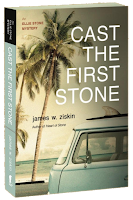
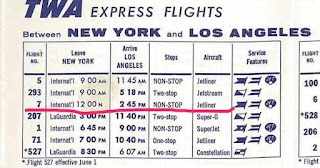
Or maybe I anticipate that my meticulous line editor will want confirmation that “Jetliner” was the name of the aircraft Ellie took to Los Angeles and needs to be capitalized. There's the flight number and timetable as well, both of which I used in Cast the First Stone.

Or I need a note to myself to remind me that Ellie’s 1955 Dodge Royal Lancer’s gearshift was on the dashboard, not the steering column. And note the handbrake on the left. Ellie needs to pull, not step on, the emergency brake. (Photo removed)
These are just a few examples of what I paste into notes in my manuscript. I’ve made peace with my creative, disorganized side, and try to keep as many of my ideas and as much of my research close at hand while writing. What tricks do you use?
"Writers gather a huge miscellany of info - drafts, notes, contracts, plot ideas, pix, reviews, etc; do you have any tricks for keeping it all organized?”
I quote the poster from Taxi Driver every now and then to remind myself how disorganizized I really am. As a writer, I pride myself on being a plotter, not a pantser, so I'd naturally like to believe that I'm organized. The truth, however, is that I am not. I plot out my stories in advance precisely because I’m disorganized and forgetful. Without an outline, I’d be lost.
But I have managed somehow to forge some work habits that keep things (mostly) on a steady course while writing my Ellie Stone novels. Instead of folders and to-do lists, I make use of the efficiency tools built into the computer programs we all use. Why re-invent order? For instance, I mark e-mails as unread if I haven't yet dealt with them. That makes for a constant reminder that I have something outstanding to do. It dovetails well with one of my more compulsive behaviors: a manic desire to keep my unread e-mails down to one or two at most. Another pense-bête I use is the calendar on my iPad. I travel everywhere with my iPad and write all my books and stories on it, so the calendar is always handy. To keep track of my reservations for writers conferences, for example, I enter flight and hotel and panel information in the calendar as soon as I finalize the bookings, never before. That way, later on when my mind has completely erased all memory of the preparations, I know I’ve paid for the conference, the flight, and the hotel.
So that’s how I stay up to date on appointments, dates, and commitments. Keeping my writing ideas straight is another matter. First, I save my work regularly (on the Cloud) with a sequential number, e.g. Heart of Stone18.DOCX. That way I can always go back and recover something if I change my mind.
 |
| Heart of Stone, 2017 Edgar, Anthony, Lefty, and Macavity Award finalist |
I work from an outline, but as I proceed, I tend to get new ideas, especially for subplots and twists and turns. I add notes to the end of my file, ideas of what to put into the story, and I delete them only once I’ve written them into the book. Not the most elegant system, perhaps, but I will never forget to incorporate those ideas into my book if they’re tacked onto the end of my file. If nothing else, my editor will discover them and ask what the hell is this gibberish after THE END?
I used to bookmark websites that I consulted for research for my books. Then, once I’d finished with that part of the book, I’d delete the bookmark. Another manifestation of my mania for keeping e-mails and bookmarks to a minimum. And then one day my editor challenged me on a word usage in historical context. I was sure I was right, but couldn’t find the proof I’d once had. Reluctantly, I changed the word. But that taught me a lesson. I now save my research as I go in the Word document of my novels. Any detail that I think might need justification—like sunrise or sunset times in August—I copy a URL link and paste it into a note attached to the word in question in my book. Then I can delete the bookmark I so desperately want to be rid of. This works extremely well for references, including photographic ones. I’ve pasted photos of newspapers from 1962 into my work in progress, A STONE’S THROW. Look, there’s the weather report for August 11, 1962, in the upper left-hand (Photo removed)

Or maybe I anticipate that my meticulous line editor will want confirmation that “Jetliner” was the name of the aircraft Ellie took to Los Angeles and needs to be capitalized. There's the flight number and timetable as well, both of which I used in Cast the First Stone.


Or I need a note to myself to remind me that Ellie’s 1955 Dodge Royal Lancer’s gearshift was on the dashboard, not the steering column. And note the handbrake on the left. Ellie needs to pull, not step on, the emergency brake. (Photo removed)
These are just a few examples of what I paste into notes in my manuscript. I’ve made peace with my creative, disorganized side, and try to keep as many of my ideas and as much of my research close at hand while writing. What tricks do you use?
Wednesday, August 16, 2017
The bits and pieces
Writers gather a huge miscellany of info - drafts, notes, contracts, plot ideas, pix, reviews, etc; do you have any tricks for keeping it all organized?
by Dietrich Kalteis
I don’t plot or outline my stories, it’s all seat-of-the-pants stuff, but under the surface I’m fairly organized. Electronic files and folders, that’s the key. I keep a general file on my computer for each category of what I write: novels, short stories, screenplays, etc. Then there are sub-folders for the drafts, edits, final files, cuts, reference files, character files, character names used, references, timelines, graphics, photos, marketing files, and so on.
When I finish a novel, I cull through the files and folders and toss out anything that I don’t need anymore. Clearing the clutter. And I start new ones for whatever I’m working on next. The trick is to keep it simple and organized, and in the end I just hold onto what I really need.
 Right now, I’m sifting through the final files for Zero Avenue, and except for copy edits, I’m pretty well finished the one after that, Poughkeepsie Shuffle. Meanwhile, I’m close to sending my publisher a final draft of a new story I’ve been working on, and I’ve got a longhand draft ready to key into the computer for the one after that. Then there are a couple of short stories I’ve been working on. So, with all that going on, I have to stay very organized.
I back up all electronic files on two separate drives. Everything. Every day. Hitting ‘command save’ has become a reflex — as my character Zeke Chamas from Zero Avenue might say, “It’s automatic, like scratching.” And it’s something I learned back when I was in the graphics field (saving, not scratching) — and yes, I learned it the hard way, by losing something I had been working on.
I write first drafts in longhand, keeping the pages in old-school folders. There’s something organic about working with pen in hand. Then the second draft gets keyed into my computer. I wish I could write the whole thing in longhand, but I edit and add too much, and my studio would just end up being a sea of crumpled paper by day’s end. Before the computer came along, I did type out a novel on my old Selectric. Working drafts were a mess of lines scratched out and scribbled notes, and the final draft was painted in Wite-Out and had cut strips of paper taped across the pages, not individual letters like a ransom note, but pretty close. There was never a clean final copy. It was all smoke, mirrors, correction fluid and tape by the time I had a submission ready to photocopy and send out. I guess I sometimes have this love/hate relationship with my computer, but it sure saves me a lot of time.
I still write myself little notes for whatever story I’m working on, and these litter my desk. They’re the little ideas that pop into my head and need to find their way onto the page.
 When I wrote House of Blazes I did more research than for the novels set in present-day. The setting was the 1906 San Francisco earthquake, and in addition to the usual files, I had to keep some on ships, autos, dress, which buildings were destroyed, street maps, statistics, newspapers, files on army involvement, ships involved in rescue, a time sequence of actual events that ran concurrent with the story’s events, personal accounts, and so on. When I started out, I thought all that research and organization would drive me nuts, but I actually liked it and learned so many interesting facts along the way. After which I’ve gone on to write more novels steeped in history.
Back when I was writing mainly short stories, I kept lists of where each story had been submitted, often making simultaneous submissions to three publishers for each story, keeping track of rejections and what was still out there. Once a rejection came in, I’d send the story right back out to another publication, keeping track of all that.
In the end, coming up with a system that keeps me organized and avoids disaster sure gives me a lot more time for writing.
Monday, August 14, 2017
Organization Tricks
Terry
Shames, here, giving some hints about how I deal with:
BUSINESS:
Tricks for staying organized.
Hahahahahahaha.
Excuse me while I try to gain control of my hysterical
laughter.
Tricks? No. Hard-won methods? Sort of.
I used to be organized. I used to write lists, do tasks at
once so they wouldn’t back up, and generally have control of my life. That was
before I became a published writer. Who knew being published took up so much time
and energy. Here’s how I thought it worked: write a book, get an agent, find a
publisher, turn over everything regarding the book to the publisher. Do the
book tour the publisher organized. Collect the money. Repeat.
Now a pause for me to wipe my eyes from weeping.
What follows is a list of what I have done to stay at least
somewhat organized:
1)
Start a new file folder for each book. Seems
easy, right? The problem is what to call the folder: Book Three? Possible
Africa mystery? France? I was halfway through writing a book before I realized
I had another whole folder of notes for the book that I had forgotten about.
2)
Flag emails that are important. Seems easy,
right? A few hints: different flag colors for different categories (I wrote the
colors down and promptly lost the cheat sheet). There need to be flags for
things that need to be done soon and those that will occur eight months from
now. Another hint: remember to flag
things. If you have forgotten to flag one email that is relevant, your
whole system is useless. Guess how I know this.
3)
Write things on your calendar. There are
actually calendars that have ways of color coding what you are writing down
(i.e, personal, business, family, urgent) I actually have one of those
calendars. If I bothered to use it, I bet I’d love it.
4)
Drop emails into separate folders with useful names. Sorry, but “To Do” is
not useful unless, unlike me, you have the discipline to look at it every day,
not once every six months.
5)
Keep a file cabinet for paper documents.
Especially helpful if you file things in it, instead of “filing” papers in a
big pile on one corner of your desk.
6)
Send remainder emails to myself. Only useful if
I actually read them, instead of thinking, “Oh, I know what that is. I’ll get
to it.”
7)
Keep a list with the names and email addresses
of: book store contacts to set up readings; publicity department contacts for
newspapers and magazines that publish notices when I have a new book; all the
miscellaneous people I meet who might be willing to give me a plug, an interview,
etc. I have such a list. If I kept it up-to-date, it would be really useful.
8)
Keep a running list of blogs that I enjoy
reading and that might be willing to host me when I have a new book coming out.
See last line of #7.
And here is a list of things I wish I had done or hope to
do:
1)
Keep a book bible—a list of names of people,
places and things that crop up in each book with a short description. Great
idea. Instead, I seem to enjoy spending tedious time looking back through books,
trying to find out what I called “that barbecue place on the road to Bryan,” or
the name of Samuel Craddock’s banker, or… In my search, first I have to figure
out which book it was in, and then where it was in the book. I seem to enjoy
this because if I didn’t, I would have kept a book bible, right? I actually
start one with each book. Start one. Not finish one.
2)
Hire an assistant. What keeps me from this? I
don’t actually insist that the person has to “think like me.” No, what I think
is, he or she has to BE me. Also, if I hired an assistant, I’d have to give her
instructions. Enough said.
3)
Learn how to use the following effectively: my computer, my word
processing program, my printer (ha!), Facebook, Twitter, Instagram, and all
other social media. Gosh, it’s so much easier to stumble around making stabs at
being effective, finding something that works sort of okay, breathing a sigh of
relief, and failing to write down the discovery.
4)
Go through all those folders, deleting or
pitching out everything that has become irrelevant. Of course that requires
deciding what is and is not relevant.
Don’t even get me started on photos. I have some wonderful
photos from readings, meetings, and conferences. However, would it really be
interesting to anyone if I were to publish a photo from a reading I did three
years ago and never got around to sharing? How about that zany photo of a
favorite author whom I posed with back in 2013? If I posted it now on Facebook,
would he think I was stalking him? I must have 200 photos of conference panels
with tiny little faces on the panels because the photo was taken from the back
of the room. Do I really need to keep these? I will delete them. Eventually. Just
give me time to get organized.
And speaking of photos, here is one from my fabulous
vacation in British Columbia:

Friday, August 11, 2017
The Times They Are A-Changin’
The world is changing faster than you can write - technologically, politically, environmentally etc. How do roll with the changes in your fiction?
by Paul D. Marks
I don’t really think about it. We’re just immersed in those things so they make their way into what we write by osmosis. As long as we’re not living in a cave these changes just become part of our daily lives and thus our writing.
However, It’s true that the world is changing faster than we can write. Between the time we write something and the time it comes out that snazzy (anachronistic word choice) new cell phone we mention is already an outdated brick. But there’s not a lot we can do about it. Ditto for the rest of technology and politics. So you just have to go with what’s current at the time and hope for the best. Or you can try to be generic in your writing as to technology or politics, but I think if you do that you miss something that gives it a sense of verisimilitude.

As far as environmentally goes, unless the place you’re writing about ends up falling into the ocean or getting covered in volcanic rock, most places don’t change all that quickly. Now, if you’re talking a cityscape, those can change via development, and somewhat quickly. But usually you can see what’s coming in that arena. However, you can also choose to just go with it as it is at the time of writing. For example, I’m working on a story now and a couple scenes are set on a specific corner in L.A. That corner is being leveled to make way for new development that, by the time the story sees the light of day, may exist in the form of new buildings. My scenes take place at a construction site on this corner. As I say, that site maybe no longer be under construction but might be a building or partial building when the story comes out. But I’ve chosen to go with the site as it is now. Besides, how many people will know what this particular corner looks like at any particular moment while they’re reading my story?
The harder thing, in my opinion, is not what’s changing today, but writing something set in the past, especially the recent past. We’ve all been there in our lives so it’s easy to spot that smart phone in the 1980s before smart phones existed, except for Dick Tracy, who had one in the 1940s in the form his wrist radio.
My novel Broken Windows, the soon-to-be sequel to White Heat, is set in 1994 and in writing it I had to make sure that I had the right version of Windows for the characters’ computers (3.1 – remember how cool that was?), the correct songs, and other things common to that era. But also to make sure that I didn’t transpose things that we’ve become accustomed to since that time into that era. Believe it or not, that actually takes some thinking and sometimes some research – trying to remember what was appropriate to that fairly recent time and get it right.

Long before White Heat, I did a satirical novel about a screenwriter trying to make it in Hollywood. While almost everything he goes through is real (happened to one extent or another), the story was very much part of the time in which it was written, the 1980s. The humor was very topical to that time – remember Jessica Hahn? See what I mean. That gave it a very short shelf life. And that novel actually got picked up by a major publisher. Then that publisher’s editorial staff was swept out and replaced by a new editorial staff. As a new broom sweeps clean, my novel was swept out with them. But because the humor in it was so topical and timely it was never picked up by another publisher. I still like the story and one of these days I plan to rework it but sans any topical humor.

So I think the key is just to roll with it, go with the flow. Write what you want, try not to be anachronistic but also try not to create sci-fi with things that don’t exist unless that’s something you’re doing on purpose. Just write a good story and send it out in the world to stand on its own two fonts.
And now for the usual BSP.
My short story “Ghosts of Bunker Hill,” from the December 2016 Ellery Queen is nominated for a Macavity Award. If you’d like to read it, and the stories of all the nominated authors, please check them out at the links below. If you like my story I hope you’ll want to vote for it. And thank you to everyone who voted for it and got it this far:
Lawrence Block, “Autumn at the Automat”: http://amzn.to/2vsnyBP
Craig Faustus Buck, “Blank Shot”: http://tinyurl.com/BlankShot-Buck
Greg Herren, “Survivor’s Guilt”: https://gregwritesblog.com/2017/07/21/cant-stop-the-world/
Paul D. Marks, “Ghosts of Bunker Hill” http://pauldmarks.com/Ghosts-of-Bunker-Hill
Joyce Carol Oates, “The Crawl Space”: https://www.amazon.com/gp/product/B01N6INC6I
Art Taylor, “Parallel Play”: http://www.arttaylorwriter.com/books/6715-2/
If you want to read a great article on the Macavity nominees, check out Greg Herren's blog: https://gregwritesblog.com/2017/07/24/beatnik-beach/
by Paul D. Marks
I don’t really think about it. We’re just immersed in those things so they make their way into what we write by osmosis. As long as we’re not living in a cave these changes just become part of our daily lives and thus our writing.
However, It’s true that the world is changing faster than we can write. Between the time we write something and the time it comes out that snazzy (anachronistic word choice) new cell phone we mention is already an outdated brick. But there’s not a lot we can do about it. Ditto for the rest of technology and politics. So you just have to go with what’s current at the time and hope for the best. Or you can try to be generic in your writing as to technology or politics, but I think if you do that you miss something that gives it a sense of verisimilitude.

As far as environmentally goes, unless the place you’re writing about ends up falling into the ocean or getting covered in volcanic rock, most places don’t change all that quickly. Now, if you’re talking a cityscape, those can change via development, and somewhat quickly. But usually you can see what’s coming in that arena. However, you can also choose to just go with it as it is at the time of writing. For example, I’m working on a story now and a couple scenes are set on a specific corner in L.A. That corner is being leveled to make way for new development that, by the time the story sees the light of day, may exist in the form of new buildings. My scenes take place at a construction site on this corner. As I say, that site maybe no longer be under construction but might be a building or partial building when the story comes out. But I’ve chosen to go with the site as it is now. Besides, how many people will know what this particular corner looks like at any particular moment while they’re reading my story?
The harder thing, in my opinion, is not what’s changing today, but writing something set in the past, especially the recent past. We’ve all been there in our lives so it’s easy to spot that smart phone in the 1980s before smart phones existed, except for Dick Tracy, who had one in the 1940s in the form his wrist radio.
My novel Broken Windows, the soon-to-be sequel to White Heat, is set in 1994 and in writing it I had to make sure that I had the right version of Windows for the characters’ computers (3.1 – remember how cool that was?), the correct songs, and other things common to that era. But also to make sure that I didn’t transpose things that we’ve become accustomed to since that time into that era. Believe it or not, that actually takes some thinking and sometimes some research – trying to remember what was appropriate to that fairly recent time and get it right.

Long before White Heat, I did a satirical novel about a screenwriter trying to make it in Hollywood. While almost everything he goes through is real (happened to one extent or another), the story was very much part of the time in which it was written, the 1980s. The humor was very topical to that time – remember Jessica Hahn? See what I mean. That gave it a very short shelf life. And that novel actually got picked up by a major publisher. Then that publisher’s editorial staff was swept out and replaced by a new editorial staff. As a new broom sweeps clean, my novel was swept out with them. But because the humor in it was so topical and timely it was never picked up by another publisher. I still like the story and one of these days I plan to rework it but sans any topical humor.

So I think the key is just to roll with it, go with the flow. Write what you want, try not to be anachronistic but also try not to create sci-fi with things that don’t exist unless that’s something you’re doing on purpose. Just write a good story and send it out in the world to stand on its own two fonts.
***
My short story “Ghosts of Bunker Hill,” from the December 2016 Ellery Queen is nominated for a Macavity Award. If you’d like to read it, and the stories of all the nominated authors, please check them out at the links below. If you like my story I hope you’ll want to vote for it. And thank you to everyone who voted for it and got it this far:
Lawrence Block, “Autumn at the Automat”: http://amzn.to/2vsnyBP
Craig Faustus Buck, “Blank Shot”: http://tinyurl.com/BlankShot-Buck
Greg Herren, “Survivor’s Guilt”: https://gregwritesblog.com/2017/07/21/cant-stop-the-world/
Paul D. Marks, “Ghosts of Bunker Hill” http://pauldmarks.com/Ghosts-of-Bunker-Hill
Joyce Carol Oates, “The Crawl Space”: https://www.amazon.com/gp/product/B01N6INC6I
Art Taylor, “Parallel Play”: http://www.arttaylorwriter.com/books/6715-2/
If you want to read a great article on the Macavity nominees, check out Greg Herren's blog: https://gregwritesblog.com/2017/07/24/beatnik-beach/
My story “Blood Moon” appears in “Day of the Dark, Stories of the Eclipse” from Wildside Press, edited by Kaye George. Stories about the eclipse – just in time for the real eclipse on August 21st. Twenty-four stories in all. Available on Amazon.


Thursday, August 10, 2017
The Drumbeat of War
The
world is changing faster than you can write - technologically, politically,
environmentally etc. How do you roll with the changes in your fiction?
by Catriona
I thought I was being so jammy - setting a book in 1922 - no forensics, no mobile phones, no computers to worry about getting right. Hemlines, menus and current events were a doddle in comparison.

There are three things you get wrong at your peril when writing about any period though: trains, birds and guns. There will be letters. I don't have many guns in the Dandy Gilver novels. I make sure any bird that sings would actually sing at that time of day, at that time of year, in that place.
But I have made a mistake with a train. I had a train stopping at the right station at the right time on the right route, but then Dandy walked along the corridor and opened a carriage door. I got a few letters telling me that the train on that route that year had carriages opening right onto the platform. Oy.
I'm up to 1935 now and there have been technological changes. Dandy and Alec have tungsten torches now (electric!) and she's got a telephone extension in her sitting room. The environmental changes are minimal: there's a bit of talk about commercial softwood plantations, and there are some new houses dotted around - modest ones for roadworkers and villas for the middle class - but it's the politics of the 1930s that's most beginning to threaten my make-believe world of dilettante detectives.
To an extent I always did let the politics - and economics - into these stories, unrealistic as they are. The 1926 book took place during the General Strike and the striking miners played a part. And in The Reek of Red Herrings I tried to show the grinding harshness of the fisherfolk's lives in a shrinking industry. Even the circus book was about how a 1920s circus gets through the winter when there's no income (a lot of rabbit stew is involved).

But it's getting very real now, in Europe, in 1935. My detective, Dandy, has two sons in their very early twenties and a husband too old to be enlisted, who will nevertheless want to serve in some capacity. And here it comes.
I keep it out of the stories, largely. Dandy herself doesn't believe there will be another war. Some of that is maternal denial and some of it is that fact that if her husband takes one point of view she tends to take the other. And Hugh know. Here it comes.
In the last book - i.e. the next book, just handed over to the editor - I found myself writing:
"... Except that nightclubs made me think of Berlin
and I wondered if a trip to Vienna was a sensible idea. I wondered if any part
of Europe was a sensible idea. ‘Luftwaffe’ still struck me as a comical word,
but in the last month alone Germany had rejected disarmament
and then there had been the business in Sudetenland. ‘They’ve won an election, Dandy,’
Hugh had said, reading the headlines. ‘Those Nazis have actually won at the
ballot box now.’ .."
Here it comes.
Wednesday, August 9, 2017
Keeping up with the... by Cathy Ace
The world is changing faster than you can write -
technologically, politically, environmentally etc. How do you roll with the
changes in your fiction?
 |
| Budapest's tumultuous history permeates this book |
Oh my, yes, this is the sort of thing that can present an
author with constant challenges. For each of my two series – both of which are
set in contemporary times – I have tackled such potential pitfalls in two
different ways.
 |
| The quirks of the local inhabitants? Normal here! |
As such, I do a huge
amount of research, and I also use settings with which I am familiar – having
either lived or worked there, or at least having spent months there, off and
on. Sometimes I’ll use the setting in a specific way, for example, in the case
of THE CORPSE WITH THE EMERALD THUMB, set on the Pacific coast of Mexico,
environmental factors such as the shortage of water, the need for both tourism and
agriculture, but the imbalance caused by the massive amount of water used by tourists is one of the
elements that sours the locals to the incomers in the tale. So I think it’s
fair to say that in the Cait Morgan Mysteries I allow my fiction to grow from the
roots of reality. In all aspects, and with all the changes we see in the
twenty-teens. But the Cait books are not political diatribes – neither with an
upper or lower case p; that’s not what I’m writing about, though my characters
do not live in a vacuum, and are the product of their upbringing in every case.
In the case of my WISE Enquiries Agency Mysteries, whilst
they are set in Wales (which, contrary to some opinions, is a real place!) they
are specifically set largely (allowing for some spectacular excursions) within
the fictional environs of stately Chellingworth Hall, and the nearby village of
Anwen-by-Wye. Now these are not real places, but they do operate in the real
world. Indeed, one factor of all the WISE Enquiries books is that modern
technology plays a significant part in the major cases that these private
investigators are tackling.
 |
| Use the Internet here? But of course! |
In THE CASE OF THE CURIOUS COOK, 3D printing plays
a key role, for example, and I’ve brought state-of-the-art surveillance
equipment, google mapping, online dating, social networks and the general use
of online sources of research data to bear in the books. It’s interesting to allow for the interplay
between the sort of lives lived by people with a title that goes back to the
fifteenth century and modern life.
One thing to my advantage, you might think,
is that Wales is full of mountains, lakes, empty spaces and few people, and it really
does have massive areas where you cannot get any cellphone reception…but I have
to be careful how I use that, because readers might think I’m using such a
device unfairly, however realistic it is.
 |
| Yes, lots of Wales is "empty"! |
Cathy Ace is the Bony Blithe Award-winning author of The
Cait Morgan Mysteries and The WISE Enquiries Agency Mysteries (#4, The
Case of the Unsuitable Suitor will be released in hardcover in the UK in
September 2017 and in the
USA & Canada on January 1st 2018). You can
find out more about Cathy, her work and her characters at her website, where
you can also sign up for her newsletter with news, updates and special offers: http://cathyace.com/

Subscribe to:
Posts (Atom)