I’m going to deviate from this week’s question as I’m turning over my post today to the
Macavity Short Story Nominees Blog Tour.
The five Macavity nominees are Craig Faustus Buck, Barb Goffman, Travis Richardson, our own Art Taylor...and me. I’m honored to be among these people and their terrific stories.
I want to thank everyone who voted for us in the first round. And the second and final round of voting is taking place right now. So if you’re a member of Mystery Readers International I hope you’ll take the time to read all of the stories and vote.
The deadline is September 1st and you should have received your ballots by now.

But even if you’re not eligible to vote, I hope you’ll take the time to read the stories. I think you’ll enjoy them and maybe get turned onto some new writers, whose
bios are at the end of this post.
All five of the stories are available free here—just click the link and scroll down.
http://mysteryreadersinc.blogspot.com/2015/06/read-all-macavity-short-story.html
So without further ado, here’s our question and responses:
Do you return to certain themes or ideas in your writing? How does this story fit in or differ from your other stories?
*~*~*~*~*~*~*~*~*~*~*~*~*~*~*~*~*~*
Craig Faustus Buck: “Honeymoon Sweet” (Murder at the Beach: The Bouchercon Anthology 2014, edited by Dana Cameron; Down & Out)

The common thread in my stories has more to do with character than theme. The people I create are all gasping for breath, struggling against the current in the sea of life.
In “Dead End,” for example, my protagonist Johno Beltran was an LAPD detective whose tiny misjudgment, while handling evidence, allowed a vicious killer to walk free. We meet Johno four years later. He has lost his wife, home, and career, and now lives in his car and works as a restaurant parking attendant. One night the freed murderer drives up to Johno’s valet stand in a $100K BMW and we’re off and running.
“Honeymoon Sweet” (current Anthony and Macavity nominee) stars a couple of low-rent con artists, newly married, who break into a mansion on the beach for their honeymoon. The woman is smarter than the man, and they both know it, creating an uneasy tension in their relationship. This issue rears its head when their plans go south.
One of my favorite stories, “Pongo’s Lucky Day” (to be reprinted in Kings River Life in September), stars a bumbling competitive snowboarder who can’t land the triple-flip he needs to be a serious contender or even to get laid. He stumbles on an ATM-gone-wild that spits out money. Of course, his apparent lucky day turns into a nightmare.
So in terms of recurrent themes, I’d have to say that I’m attracted to likeable low-lifes and underdogs, and the foolish decisions that doom them. Doom is, after all, the touchstone of noir.
***
Barb Goffman: “The Shadow Knows” (Chesapeake Crimes: Homicidal Holidays, edited by  Donna Andrews, Barb Goffman, and Marcia Talley; Wildside Press)
I don’t write with a theme in mind. My only goal is to tell a good story. That said, there are some ideas I’ve returned to repeatedly:
Child molestation. I’ve had four stories published involving child molestation. I don’t, thankfully, have any personal knowledge of this subject. So why did I revisit this topic? A crime writer is often looking for a good reason to justify murder. Child molestation more than fits that bill.
Sibling rivalry, particularly between sisters. I’ve also had four stories published in which one sister tries to kill another sister or get her sent to prison. This topic also makes sense: No one can get in your craw like your family, making murder believable. (Moreover, these stories bother my own sister, who doesn’t believe that they’re not about her. So they’re a win win. Kidding!)
Humor. I like writing funny crime stories. When I write something humorous, I don’t worry that the reader will think, “Who cares?” Everyone likes to laugh. I had this idea in mind when I began writing my Macavity- and Anthony-nominated “The Shadow Knows.” I knew I wanted to write about a man who believes his town groundhog controls the weather and has caused his area’s excruciatingly long winters, so he decides to get rid of the groundhog. That’s an odd idea, but adding humor can turn a weird story into a fun one and make a reader smile. And that’s a great thing to do.
***
Paul D. Marks: “Howling at the Moon” (Ellery Queen’s Mystery Magazine, Nov. 2014)

One recurring theme in my writing is that most of my characters are damaged, often dealing with or “recovering” from some physical or psychic wound. Another is the theme of memory and the past and how those things affect the characters in the present.
Ray Hood in “Dead Man’s Curve” is a man who’s lost his focus, his dreams and his purpose, and is desperately trying to get them back. The question is, how far will he go to get all of that back? Duke Rogers in
White Heat is battered from growing up with an abusive father and that affects the actions he takes. Winger, the Weegee-like photog in “Poison Heart” is so desperate for recognition that he finds pleasure in doing photo recreations of grisly murder scenes...until it all gets out of hand and becomes too real. Darrell Wood in “Howling at the Moon” is jaded by war and life in general. He’s lost touch with his roots, causing him to question his priorities. He also shares a collective memory with his native American ancestors and that shapes his actions in the story. And in my upcoming novella
Vortex, available on September 1, 2015, Zach Tanner is physically wounded by war and mentally changed by it. This sends him on a collision course with the past and decisions he made that he deeply regrets now.
All of these characters have to overcome their issues to survive and come out on the other side...if they can.
***
Travis Richardson: “The Proxy” (Thuglit #13, Sept./Oct. 2014)

“The Proxy” fits into my rural noir stories which constitute about half my writing. Most of the other stories take place in Los Angeles or other urban areas. Of my rural crime fiction, a few have been set in the fictional town of Lynchwood. I don’t exactly know where Lynchwood is located, only that it’s east of Oklahoma and in the American South. In a lot of my writing, I try to focus on the morality of crime. I often write about criminals who are very much human, not stone cold psychopaths. They may be in way over their heads or burdened with knowledge that their actions have devastating consequences, yet they cannot leave the life or ever undo what has happened. There is sadness combined with a sense of duty. Life continues for my characters as their wounds harden into ragged scar tissue. They must trudge on… unless they are killed in the end. I don’t think I’ve ever overtly preached that crime is bad, but I don’t make it sexy or positive either.
***
Art Taylor: “The Odds Are Against Us” (Ellery Queen’s Mystery Magazine, Nov. 2014)

Many of my stories seem to hinge on the idea of relationships taking a bad turn. I like to explore the kinds of responsibilities people have in relationships, the duties to others, and then look at the factors that might cause that sense of responsibility to fracture, that might threaten to cripple or even shatter those relationships (or in some cases maybe make them stronger—there’s that too). Betrayal is a common theme, the tests and temptations that we’re all subject to, and there’s a moral weight to all of this, I hope—at least that’s the thing I respond to in the short stories that have had the strongest impact on me, so I can only hope that my own stories might have a similar effect on my readers. “The Odds Are Against Us” falls pretty squarely in the middle of those themes. Two old friends seem to be having a simple conversation, remembering old times, but there’s trouble beneath the surface of that talk—and heavy stakes for everyone in the decision that one of them has to make at the end of it all. Part of my focus in the story was on how and why that decision got made—how and why the odds might ultimately be against both these characters—but beyond that what interested me was their friendship and the legacy of that friendship, the way the memory of those old times will cast a long shadow on the narrator, well beyond the close of the story.
***
Author Bios:
Craig Faustus Buck’s debut noir novel
Go Down Hard was published May 5, 2015 (Brash Books). His short story “Honeymoon Suite” is currently nominated for both Anthony and Macavity Awards (free at
tinyurl.com/CFBPlanB). He lives in LA, where noir was born, and is president of MWA SoCal.
http://CraigFaustusBuck.com
Barb Goffman is the author of
Don’t Get Mad, Get Even (Wildside Press 2013). This book won the Silver Falchion Award for best single-author short-story collection of 2013. Barb also won the 2013 Macavity Award for best short story of 2012, and she’s been nominated fifteen times for national crime-writing awards, including the Agatha, Anthony, and Macavity awards. Barb runs a freelance editing and proofreading service focusing on crime and general fiction. Learn more about her writing at
www.BarbGoffman.com.
Paul D. Marks is the author of the Shamus Award-Winning mystery-thriller
White Heat. Publishers Weekly calls
White Heat a “taut crime yarn.” His story “Howling at the Moon” (EQMM 11/14) is short-listed for both the 2015 Anthony and Macavity Awards for Best Short Story.
Vortex, a noir-thriller novella, is Paul’s latest release. Midwest Review calls
Vortex: “…a nonstop staccato action noir.” He also co-edited the anthology
Coast to Coast: Murder from Sea to Shining Sea (Down & Out Books).
www.PaulDMarks.com
Travis Richardson has published stories in crime fiction publications such as
Thuglit,
Shotgun Honey,
Flash Fiction Offensive,
Spinetingler Magazine and
All Due Respect. He edits the Sisters-In-Crime Los Angeles newsletter
Ransom Notes, reviews Anton Chekhov short stories at
www.ChekhovShorts.com, and sometimes shoots a short movie. He has two novellas
Lost in Clover (rural coming of age crime) and
Keeping the Record (violent baseball roadtrip comedy).
www.TSRichardson.com
Art Taylor is the author of
On the Road with Del & Louise: A Novel in Stories. His short fiction has won two Agatha Awards, a Macavity, and three consecutive Derringer Awards, among other honors. He writes frequently on crime fiction for both
The Washington Post and
Mystery Scene.
www.ArtTaylorWriter.com
*~*~*~*~*~*~*~*~*~*~*~*~*~*~*~*~*~*
In other news, but having consulted with a “higher authority...,” I have a couple of announcements:
Vortex: My new Mystery-Thriller novella coming September 1
st.
![Pageflex Persona [document: PRS0000037_00019]](https://blogger.googleusercontent.com/img/b/R29vZ2xl/AVvXsEh2Z184vij6fFCdnjPPRG5K26bDISiqOTC7DeMrvE8RE1zbrNQa3VaW9HClQMo-WLmcBkI1XalL3f_hWyljl6WsgOMV65aKw7i5jd036OKQ8o0WRWHXD4KSsC5ho_h-lS-LHrr1nw_Sx7VZ/?imgmax=800 "Pageflex Persona [document: PRS0000037_00019]")
“...a nonstop staccato action noir... Vortex lives up to its name, quickly creating a maelstrom of action and purpose to draw readers into a whirlpool of intrigue and mystery... but be forewarned: once picked up, it’s nearly impossible to put down before the end.”
—D. Donovan, Senior Reviewer, Midwest Book Review
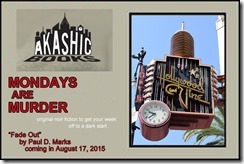 Fade Out
: flash fiction story – set at the famous corner of Hollywood and Vine – coming on Akashic’s Mondays Are Murder, Monday (big surprise, huh?), August 17
th. Here’s the link, but my story won’t be live till 8/17:
http://www.akashicbooks.com/tag/mondays-are-murder/
Please join me on Facebook:
www.facebook.com/paul.d.marks and Twitter:
@PaulDMarks
And check out my updated website
www.PaulDMarks.com
Click here to subscribe to my Newsletter:
Subscribe to my Newsletter


![Pageflex Persona [document: PRS0000037_00019]](https://blogger.googleusercontent.com/img/b/R29vZ2xl/AVvXsEj4hZrtULFffmFh4HWakU3juJNHnfKffThpVWWDv1V8i6QJwC-YcnqOR-eVxVFN-3AhxehsFzZv3-7b2Vkti7-plemrXkP86fIeBtGR-wi5Jxxa_A4jLjK_cwOo9rvGaYlKNewRfNXuQ6bA/s1600-h/Vortex-Kindle-Cover-FD3%252520%2525282%252529%25255B3%25255D.jpg "Pageflex Persona [document: PRS0000037_00019]")
