Monday, June 20, 2016

Why Would I Ever Put Down a Book?

"Once you start a book, do you feel compelled to finish it? If not, what causes you to put it down?"

 - from Susan

If you had asked me this question three or four years ago, I would have said, “Almost nothing.” I felt I owed it to the writer, to my wallet from which the funds came to buy it rather than some other book, to the principle of “waste not, want not” to finish what I started, to eat everything on my plate.

But having written four books and being in the thick of the fifth, I’ve lost a bit of the sense of loyalty – duty? – and have learned more about what goes into a good story, and how to spot something that’s just not taking off. I’m also a few years older and have enough unread books to last me more than my allotted years. So, if I get annoyed, confused, bored in the first 70-80 pages, I’m out.

I can hear you: 80 pages? Way too long. Yes, but maybe the writer starts slowly and is about to crack the story open on the next page. Maybe he redeems himself with the next scene. Mostly, no, that doesn’t happen. What does happen is:

Four female characters are introduced and they are all essentially the same – same physical tics, same attitudes, same voices, same ages. By page 50 I can’t keep Mary, Pat, Nancy, and Barbara (generic names too) apart and the author hasn’t given me a solid reason to try.

The first chapter takes place in Cleveland 2006, the second in Atlanta in 1873, the third in Cleveland again but in 2000 and the time and place shifts are giving me vertigo. It’s fair to time-shift and to place-shift but you’d better make each place more distinctive than Southern accents and hoop skirts.

The plot is way too complicated and the more convoluted it gets, the harder it is to maintain any momentum or focus. If I accepted the main plot and the three sub plots, I promise I’ll close the book when, on page 80, the author drops in an entirely new problem that means new characters and relationships and doesn’t seem to fit with what’s gone before.

The dialogue is not real and it doesn’t take me anywhere within the story. Assume the writer speaks English as a first language. Assume he or she lives in the real world and speaks to checkout clerks, dentists, and other writers hanging out at bars during conventions. Why don’t his characters talk like that? Why do her characters spend whole pages discussing how slow the elevators are in speech patterns right out of 1940s propaganda films?


The harder I work to get these things right in my own books, the more I have come to lose patience with books that can’t seem to pull it all together. Even now, though, I feel as though I’m being harsh and snobby, and that means I’ll probably assuage my guilt by sticking with the next not-quite-ready-for-prime-time novel that comes my way. It’s hard to write a good book, and I’m in awe of my colleagues who do it book after book after book. Those are the ones I read – carefully – to see how to make my own next book better.

Friday, June 10, 2016

They Ain’t Talkin’ ’Bout Wine

How do you make your characters’ dialogue sound realistic?

by Paul D. Marks

If you listen to two (or more) people talking you’ll hear that their conversation rambles all over the place. It bounces from one subject to another, there are pauses and ums and all kinds of distractions. This is conversation, not dialogue. Dialogue is not everyday conversation, but it needs to have the illusion that it is.

Your characters need to talk like real people, but at the same time their dialogue—your dialogue—needs to convey information, move the plot forward, possibly get out some exposition and either story or character background…….without being too obvious about it.


So how do you do this?

Listen to people around you. Their cadences. Intonation. Do they talk differently in a bar than a bookstore? On the East Coast than the West? And even if on the East Coast, don’t people from Maine talk differently from people in NYC or South Carolina? When we think of the East Coast, a lot of people think of New England, but the coast goes from Maine to the Florida Keys. How many different accents, ways of turning a phrase, slang, etc., do you think there are in just the states that border the Atlantic Ocean?

Even within a city there are different ways of talking. New York City has five boroughs. Is the accent and slang the same in each borough? Is it the same in Harlem and the East Side? Los Angeles is spread out over 503 square miles. Do you think the people from South Central talk the same as the people from the Valley—remember Valley Girls?

Make sure the way each character speaks is right for that character. Don’t have all your characters talk the same way. If all your characters speak with snappy lines and quick comebacks, how can you distinguish them from one another? I can understand having a couple characters that are smart and witty, but when every one of your characters is cracking one-liners, a reader might start to wonder if there’s something in the drinking water…  In other words, keep dialogue in line with character, don’t have a wallflower start talking like a sailor or a blowhard start speaking like Emily Post.

Don’t use too much jargon, maybe just enough to get the point across that the character works in a particular biz or is from a particular area or background. And don’t get carried away writing dialect. It’s hard to read. Focus on the way people phrase things. If the character’s from the South and has a drawl, don’t write everything out like it sounds, except sparingly to get an idea of the accent. Pop it in here or there, but mostly just say they talk with a drawl.

I once had a producer tell me to write dialogue in “ten word telegrams.” In screenplays most speeches should be short, not long soliloquys. Though ten words is a little too short much of the time (see the long speech from Sideways below). But you have more freedom in a novel, still you don’t want one speech running a page long.

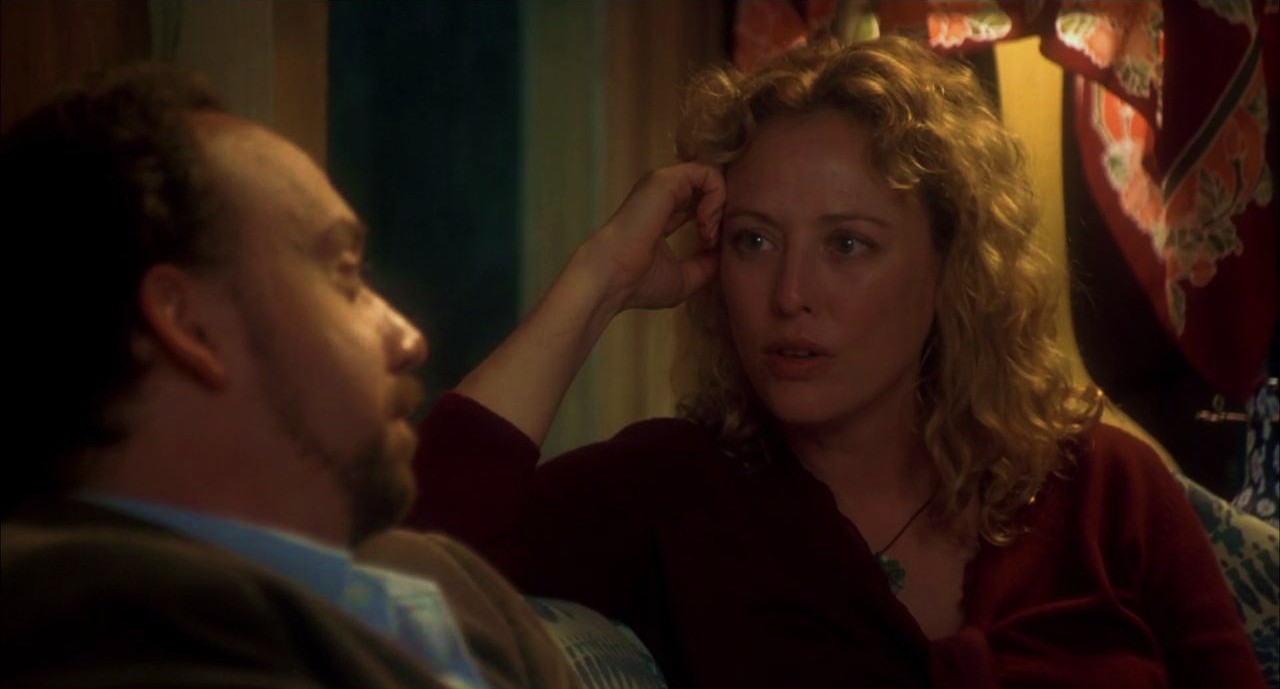
Another thing that will help your dialogue stand out is to enrich it with subtext. For example, if you have two characters that are in a romantic relationship and they’re unhappy and thinking of breaking up, maybe a conversation about what restaurant to eat in can reveal more than just eating preferences. I particularly like this subtext/dialogue from the novel/movie Sideways. In that movie (which I highly recommend), Miles is a wine aficionado and frustrated writer—and very sensitive and prickly, as opposed to his wild and crazy-guy pal, Jack. Miles and Jack take a trip up to Santa Barbara wine country and Miles has some private time with Maya, a waitress he’s friendly with up there. They have a conversation about wine, but is that what it’s really about?


Maya (Virginia Madsen): You know, can I ask you a personal question, Miles?

Miles (Paul Giamatti): Sure.

Maya: Why are you so into Pinot? I mean, it's like a thing with you.

Miles: Uh, I don't know, I don't know. Um, it's a hard grape to grow, as you know. Right? It's uh, it's thin-skinned, temperamental, ripens early. It's, you know, it's not a survivor like Cabernet, which can just grow anywhere and uh, thrive even when it's neglected. No, Pinot needs constant care and attention. You know? And in fact it can only grow in these really specific, little, tucked away corners of the world. And, and only the most patient and nurturing of growers can do it, really. Only somebody who really takes the time to understand Pinot's potential can then coax it into its fullest expression. Then, I mean, oh its flavors, they're just the most haunting and brilliant and thrilling and subtle and... ancient on the planet.*


And though this example is from a movie it applies to novels as well.

Then, when you’re done read it out loud, preferably in front of or with another person. You really do hear things that you don’t see when you read in your head.

Finally, be true to yourself, because everyone has an opinion and opinions are a dime a dozen:  I once optioned a screenplay to a producer. He read it and loved it, especially the dialogue. He gave it to a director to read it. She hated the dialogue. Magically and overnight, he hated the dialogue too. Go figure. So, unless you’re getting paid, write it your way.

***

I want to congratulate all the Shamus Nominees! Especially Bob Levinson, whose story Dead Detective was published in Coast to Coast: Murder from Sea to Shining Sea, edited by Andrew McAleer and…..me. We’re very happy for Bob and Down & Out Books and also that the first Coast to Coast volume has been recognized. Volume 2, Coast to Coast: Private Eyes from Sea to Shining Sea is in process.


###

*Directed by Alexander Payne. Screenplay by: Alexander Payne, Jim Taylor, based on a novel by Rex Pickett.

www.PaulDMarks.com


Click here to: Subscribe to my Newsletter

Thursday, June 9, 2016

Telling it likes of how it is.

I love dialogue. It's the writing I find easiest to do.

Action is much trickier for me. If I use enough words to paint the scene it ends up too slow and if I try to keep up with the scene it's too telegraphic and gets boring. I think that's why good sports writing is so very good.

Description is easier. But since description is much to be resisted if you're hoping to get those pages whipping past, I always know when I'm writing it that I'll probably cut it later anyway. (I'd  love to see a modern editor faced with the opening chapter of Thomas Hardy, where he starts with the geology of the county. Talk about easing into the scene.)

Oh, but dialogue! I enjoy it a bit too much sometimes. Get carried away with what my agent calls the Dinnerladies scenes (after the brilliant ensemble British sitcom, where a clutch of factory canteen workers talk about ab-so-lute-ly nothing until the tears pour down your face from laughing so much.)

To the extent that I can write realistic dialogue, I do it lots of different ways. Three of the most useful are:

Staggering. Instead of each question being answered and each remark acknowledged in order, the conversational balls are tossed and caught in whatever pattern suit the characters' interest and agendas. A lot of clues can be hidden in the gaps and overlaps.

"So how come you didn't see the guy running away? Did you say you did want a coffee?"
'I told you, the street light was out. I couldn't see a thing."
"But you heard him. You must have heard something."
"Black, no sugar. Yeah, I heard him. Did you check the streetlight?"
"Pitch-black. No sugar."

If this is re-ordered to:

"Did you say you did want a coffee?
"Black. No sugar."
"So how come you didn't see the guy running away?"
'I told you, the street light was out. I couldn't see a thing."
"But you heard him. You must have heard something."
"Yeah, I heard him. Did you check the streetlight?"
"Pitch-black. No sugar."

Not only is it pretty dull but's it's much more obvious that the question about checking the street light didn't get answered.

Fragments. No one talks in complete sentences unless they're trying to pick up marks in a Conversational English oral test. It doesn't feel fragmented, though. It feels perfectly natural. Below, the sentences are in pink and the fragments in blue. (sneak peek at work in progress)

‘I heard about the ruby,’ I began, and she was off.
‘Oh, it was a sight,’ she said and laid one of her gnarled hands against her breast as though caressing it there. ‘A beautiful sight and a terrible sight. I feared to see the young mistress with all that on her neck, like drops of blood across her shoulders and a puddle of blood above her heart. Like a slit throat, it was. Even before you heard its name you could see it. An unlucky thing. An evil thing.’

It's not exactly a light speech anyway (first draft - that's my excuse) but imagine if all those fragments had the words to make them into sentences. Snore.


Informal grammar. Dialect, spoken style, informality . . . whatever you call it, I'm a big fan. I'm more prone to use speech grammar in writing these days than ever to use written style in speech or dialogue. That's what made it such a facer to see, just the other day, that someone had "corrected" my perfect, working-class, British English verb-form "gave" (in "It must have gave her a laugh.") to the more formal and less rhythmic "given". And in a library book too! The reader who shared the enormity, on Twitter, was just about as disgusted as I was. We agree, @KatWhen and me, that there's a special circle of Hell . . .


Wednesday, June 8, 2016

Hi! Hey! Hello there. Pleased to meet y’all. Charmed, I’m sure...by Cathy Ace


How do you make your characters’ dialogue sound realistic?
  

The way a character greets someone can be the first clue to the reader about the nature and background of that character; just consider the different types of people who'd use the salutations in the title of this piece, for example. Once the ice is broken, it’s imperative the character’s dialogue continues to use the correct patterns and figures of speech that sort of person would use, or the illusion is shattered. So, yes, the dialogue used by all characters is critical to the success of a book: one of my personal aims is to tell a story without the words on the page getting in the way of the storytelling, so any dialogue “clangers” can distract a reader who knows those patterns of speech by breaking the spell.

However, to be honest, I think successful dialogue in a book is anything BUT realistic – it’s writing it in an unrealistic way that SEEMS natural/true for the character that’s the trick, I believe.  

How do I try to be true to the character? The first thing I decided was that all my main characters would be from backgrounds with which I am extremely familiar (I don’t write Southern Belles, LA hardboiled PIs or New York cops, for example). In my Cait Morgan Mysteries my main characters are Cait Morgan – a Welsh Canadian university professor in her late forties – and her Canadian retired-cop partner in life and crime Bud Anderson. Cait uses my mode of expression (because I’m Welsh Canadian) and Bud uses the form of Canadian English I hear around me every day, living in British Columbia. Because Cait travels to a new location for each book the characters specific to that book tend to come from the country in question – I only use locales with which I am deeply familiar (ie I have either lived there or have spent at least months, or years in total, visiting there). 

In my WISE Enquiries Agency Mysteries my five main protagonists are Welsh, Irish, Scottish, English and a mix of all four – again, speech-patterns with which I am familiar (having only left the UK when I was forty years of age), but which differ from each other. I know a good number of people with each of those accents, so all I have to do is listen to them “talking” in my head for a while before I write for that character, and I’m just about alright. But re-reading after a time-lag is critical. 

Me with "half of Annie Parker"
One of the things I have to do most often is to remove a piece of recurring speech (a writing tic, if you will) that read well when I put it in, but becomes repetitive after a fast read of a manuscript. Case in point? Annie Parker, the English “WISE Woman”, is a true Cockney born of St Lucian parents. (She’s based upon two of my real friends, “mashed-up” into one character, then given personality traits neither of them possesses.) She uses the words “Gordon Bennett!” to express great surprise, great displeasure etc. In real life a person who uses such an expression might do so on many occasions each day. What I’ve learned is that if that expression appears more than four times in a book of 80,000 words, someone will write a review saying something along the lines of “…the character’s always saying it…” So I’ve brought it down to three times maximum, per book. I’m hoping that helps. I really don’t want to break the spell! 

What dialogue have you read in a book that has truly cemented that character in their “place” for you? 

Cathy Ace writes the WISE Enquiries Agency Mysteries (book #2 THE CASE OF THE MISSING MORRIS DANCER was published in hardback in February, and book #1 THE CASE OF THE DOTTY DOWAGER was published in trade paperback on March 1st) and the Cait Morgan Mysteries (book #7 THE CORPSE WITH THE GARNET FACE was published in paperback in April). Find out more about Cathy and her work, and sign up for her newsletter at http://cathyace.com/   

Monday, June 6, 2016

Who's That Talking?

Q: How do you make your characters’ dialogue sound realistic?

- from Susan


I’m a pretty conversational writer. Or, at least I am now. For a couple of decades, I was the spokesperson for college and university presidents, drafting their op-ed pieces, annual report messages, many of their speeches, sensitive campus memos, language for honorary degrees. Conversational language wasn’t appropriate, and a few of those illustrious leaders didn’t embrace informality in any case. Consider: A brilliant nun with an English Ph.D. from Stanford; a smart Southern Ph.D. on a steep upward trajectory in higher education; the former head of worldwide R&D for what was then the largest manufacturing company in the U.S.; an agile administrator who used “shall” rather than “will” all the time – I mean all the time, even when ordering a sandwich; and a 70-year old Jesuit priest.

These days, I employ contractions, the occasional (shame on me) cliché, and bits of slang in my writing, as long as it doesn’t date the character or the writer. As a native New Yorker who lived in New England, New Jersey, Florida, and towns along the Mason-Dixon Line before moving to California, I love regional voices. I also love the voices of kids and teenagers, wise old people and brusque businessmen, idiots and scholars. In my head, at least, my characters are distinctly voiced. The job of getting them onto the page in enough variety without resorting to caricature is the challenge. Readers want and need that and it’s a mark of a good book when someone pulls it off.

I recently read a novel in which the male characters were all white, all seemed to be about the same age, had generic first names, and spoke without any discernable individuality. Ditto the women, who all seemed to be femme fatales with good hair and figures and unrelenting come-hither looks. I flipped the pages back and forth as the plot proceeded to try and remember who Joe was and if Henry was Bob’s neighbor or Barbara’s lover, and who the heck Marian was and why she had a gun. I gave up after about a hundred pages, and was reminded of the importance of dialogue that defines and helps to explain characters, their strengths and weaknesses, their unique senses of humor or malice, how they sound when they’re faced in fiction with the terrifying or ridiculous situations that we real people come up against. That has to be real.

My first book, Murder in the Abstract, was purchased by Avalon Books, now defunct, and the only copy editing I got was someone taking out all the swear words, not that there were many, I promise. I was told that their audience didn’t like ‘bad’ words. The only protest I lodged was when Dani, alone and in the dark, stumbles over a body. “She would not say, ‘Oh gosh,’ ” I insisted, and they compromised by leaving in one lonely “Shit.” Hooray for keeping it real!

I took on a much larger issue of creating good dialogue when I decided to write a mystery set in a small French crossroads town where Americans, a Brit, and the French residents all have speaking parts. In Love and Death in Burgundy, my American protagonist speaks good enough French that she can converse with her French neighbors. Her husband and the young English woman in town can’t. Some of the French speak lovely English, which they use if they want to make sure the non-French know how much they are disliked. At times of stress, however, they revert to their native tongue, which the author can’t use on the page and probably wouldn’t get right anyway.

What was I thinking? And while I am beyond thrilled to have a two-book contract, I have to try and keep this conversational, multiple-voiced, bilingual dialogue going for at least one more story. Sacré bleu!


Note: New e-book edition of Murder in the Abstract just out, available online along with the others in the Dani O’Rourke series. French mystery comes out May 2017. (You’ll hear more…)


Friday, May 27, 2016

Kicking and Screaming into the Social Media Mosh Pit

Do you use social media to market your books, and if so, do you think it’s made a difference?

by Paul D. Marks

Yes. And Oh yes.

Facebook:

I went kicking and screaming onto Facebook a few years ago. Publicist and friend Diana James “gently” suggested that I should go on Facebook.

“I don’t want to see pictures of what people had for breakfast…or worse,” I said.

So, after much cajoling from Diana I took the dreaded step and signed onto FB. At first I didn’t know what to do, how to use it. I was an evil lurker. Of course, since I had few FB friends I didn’t have much to lurk at. So I’d check in every few days or so, still not knowing what to do, but gaining a few friends here, a few friends there.

And eventually I started posting. Don’t remember what those early posts were. But not too long after I started on Facebook I began to find my way. I began to post things that meant something to me or that I related to. Things like pix of my breakfast: cereal can be fun and entertaining pop art. And pix of my scars – want to see them? Just kidding.

Actually, I started posting things about noir and film noir and putting up “Film Noir Alerts” when I knew a noir movie was coming on television. Also stuff about mystery and noir writing, Raymond Chandler, Jim Thompson, et al. And I started posting about Los Angeles and LA history, something I’m very much into on many levels. I began to be known as the LA Guy or the Noir Guy. People I’d never met in person would come up to me at conferences and other events and say, “You’re the Noir Guy”. I had to plead guilty.

And then when White Heat came out I put up some posts about that. And other people shared them. And I think it did help get the book known, get reviews and make sales. But the key is, as everyone says, not to only push your books. People get majorly turned off by that. Be a friend. Be part of the community. Comment and share other people’s posts. Participate.

Twitter:

Twitter’s another ballgame altogether. A ballgame where it’s impossible to see the ball and more impossible to know the rules. Like: Don’t use more than three hashtags. Fine. Uh, now what the hell is a hashtag? And where do I find the hashtags that apply to what I’m posting? Can I make up my own hashtags? Would you like some ketchup with your hashtags?

Twitter, to me, was a mess when I first signed up. Tweets would fly by faster than a speeding bullet. I couldn’t figure out how to use it. How do I make – uh, get – friends? I mean followers. Who/how do I follow someone? How to do I participate in a conversation? And HOW THE HELL do I say anything in 140 characters? And DOUBLE HOW THE HELL do I say anything at all when I’m retweeting and now I have 3 characters left to add my own comment to? It’s enough to make you batty.

And then I heard the bugle. The cavalry was on the way led by Captain Tweetdeck and Colonel Hootsuite. Oh no, more things to worry about. But no, these were good things. And the light shined down.

Hootsuite and Tweetdeck are “social media management systems” – say that five times with a mouth full of cereal. They help you organize Twitter, the tweets, the followers, everything. So I signed up for both and magically Twitter became manageable. And I began to use it.

You can create lists and put different people or groups (like magazines, writers, friends, publishers, etc.) on different lists and then put them in different columns.  These columns allow you to see things more clearly and at a more even and manageable pace. And it makes all the difference in the world (at least to me) in terms of being able to use Twitter (though you can manage other programs on these systems as well).

A small part of my Hootsuite Dashboard.

I find that Tweetdeck is good for some things and Hootsuite for others. So I use both. But it’s too much of a “lesson” to go into here and explain the intricacies of each. Suffice to say, they both make Twitter much more user friendly and once you get the hang of them you’ll be able to use Twitter to much better advantage. But like with FB or any social media, you shouldn’t use it only to promote your books. But that doesn’t mean you can’t do some promotion. Just have fun with it.

In closing – other social media & tying it up:

There’s about 33 million different social media. I’m also on Tumblr, Google+ and Pinterest, and use them to varying degrees. For a while I had been doing a fair amount on Tumbler, but nothing there lately. It’s not that I don’t like it, it just comes down to the time spent and it adds up. Some other social media that I signed up for I really never did much with. There’s just so many to choose from. But you have to pick two or three, maybe a couple more. Because you just can’t focus on all these things. It’s too hard to follow people and too hard to keep up with your own accounts and you’ll never have time to write.

Have FB and Twitter made me a NY Times Bestseller? No. But they have definitely helped get me more readers and connect with people with similar interests, which is more than I could have done by going on a cross country booking signing tour …and it costs a lot less. And I figure now there’s not a state in the country that I couldn’t have lunch with someone if I happened to be passing through – and if I do I’ll be sure to post the photo of the meal. Hell, there’s several countries on different continents that I could have lunch with someone I know from social media.

So yes, in answer to the question today – yes yes yes. Social media is great. I’m a total convert. So, uh, here’s what I had for breakfast.


***


www.PaulDMarks.com

Thursday, May 26, 2016

Book Buy My Book Buy My Book Buy My Book Buy

By Catriona

Everyone back from rushing out to the bookshop because of that irresistible message?

Then I'll begin.

Q: Do you use social media to market your books and, if so,  how do you know if it's working?

A: No.

I got a Facebook author page five years ago because my editor told me to (and I'm a wimp), then I got a Facebook person page because friends kept asking why they couldn't tag me. I got a Twitter account round about the same time because . . . I can't remember why. Probably someone I needed to be in touch with didn't use Facebook.

And don't get me wrong: I post news, events, trade reviews, new jacket designs and some truly thrilling pictures of my laptop and bundles of printed paper on the author page. Stirring stuff. If someone should stumble across my website and click the Fb button, there are writer-y things to see .

But it's the other page where I feel at home and spend most time. On my personal Fb page I talk about the monster zucchini I'm accidentally growing if I'm not careful, that time I hosed my screens with the windows open, that other time I reverse parked into the no-parking sign, the Chewbacca mask lady, and why I can't spell beureu  beaureu "bureaucracy". No faking.


It's not marketing though, is it? It's just life. I love that even though I'm thousands of miles from my family and I don't see them for ten months at a stretch, I know what my great niece's birthday cake was this year and that my mum's wisteria is blooming. When I talk to my sisters on the phone, they know how I've been and I know how they've been and we can just witter on a load of mince (like we always did) without having to do a massive catch up.

It's exactly the same with friends I first met on Facebook or only know on Facebook - we just hang out, keep up with one another, share all of life's rich strangeness. We soothe sorrows when the world delivers a kicking (as it does), share joy when the gods smile on us (as they can) and let one another rant when only ranting will do.

And, because I'm a writer, a lot of my Facebook friends are other writers or the blessed readers (thank you!) as well as the occasional scientist-in-law. So it's inevitable that we talk about the books we love, the books we're reading, looking forward to, have just bought, are saving for a long flight . . . And almost as inevitably some of the books some of us are reading are books others of us have written. But again, it's not marketing, is it? It's just the love of books. (And the Chewbacca mask lady.)